Chapter 3

Ajamila — saved by a name

At the edge of death, after a life gone wrong, he spoke the name of God without meaning to

The slip

Ajamila was a brahmin of Kanyakubja — today's Kannauj. His parents taught him the Vedas and the disciplines, and everything was going well.

One day he saw a drunk man on the road openly embracing a courtesan. Ajamila's mind gave way.

He left his wife, his parents, his study. He brought that woman home and kept the household running by gambling, theft and cheating.

He had ten sons. The youngest he named — Narayana.

In old age he doted on this youngest son. Eating, resting, at every hour — "Narayana, come here. Narayana, eat this."

On the threshold

Then the time of Ajamila's death came.

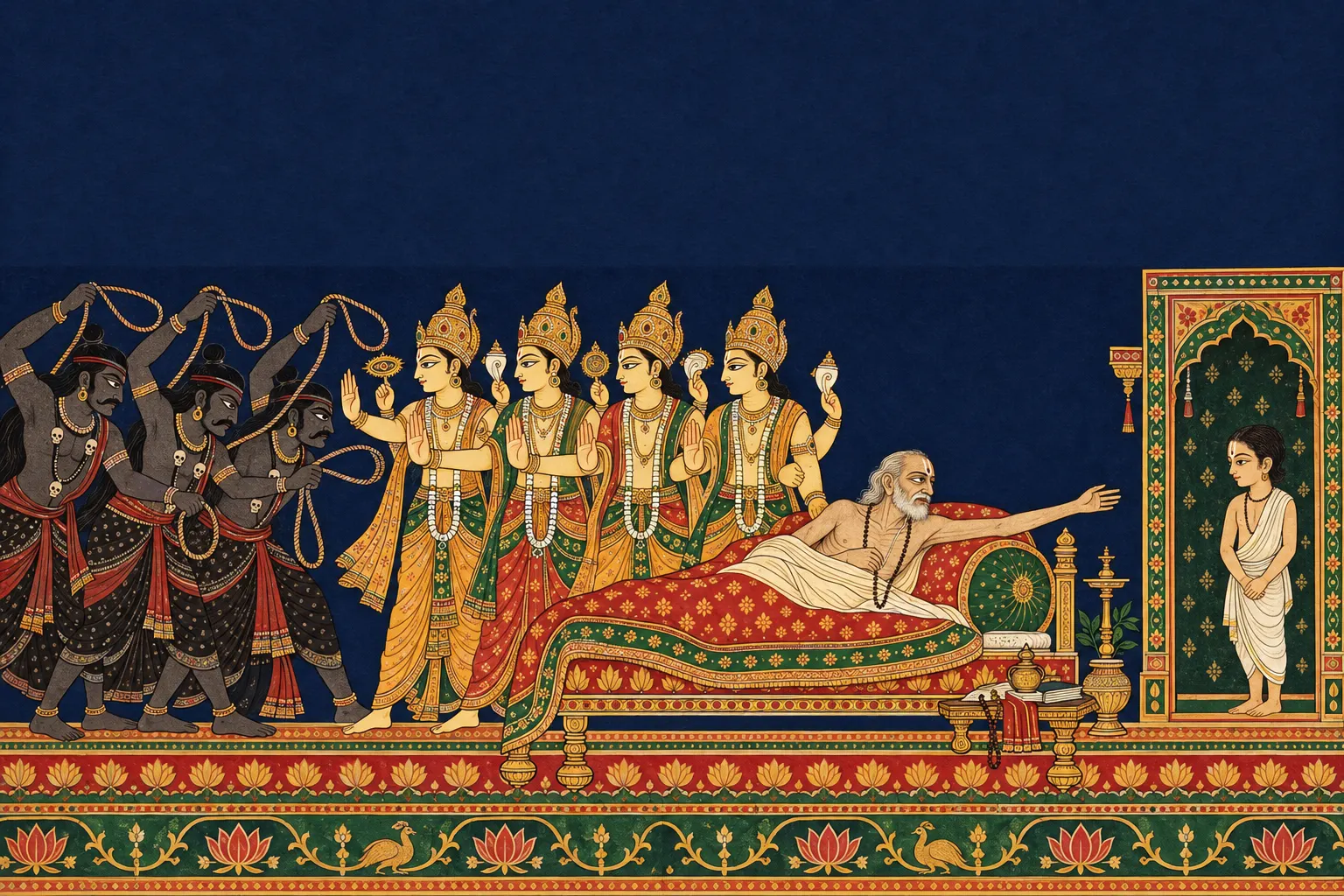
He saw three terrible figures with nooses in their hands, coming toward him. These were the Yamadutas.

In terror he called out loudly — to his son — "Narayana!"

He had called his son. But the name was God's.

That same moment four other figures stood there — full of light — and they blocked the noose of the Yamadutas. These were the Vishnudutas.

Both sides

The Yamadutas protested.

"This man was a sinner all his life. His account is unpaid. The right to take him is ours."

The Vishnudutas answered.

"The name has a power of its own. Whether a person speaks it as a sign for something else, or in mockery, or in pain, or to call someone else — it still burns sin the way fire burns fuel, whether the one who lit it knows or not. Whatever this man meant, the name he called was the name."

Then they said that Yama is not the final authority. And later Yama himself told his servants — "Do not go near those who have taken the name. They are not mine."

The second life

Ajamila lived — and woke fully.

His whole life came back to him, and it disgusted him. He set out that very moment for Haridvara, the gate of the Ganga.

There he did real devotion. After some time the Vishnudutas returned for him, properly, again.

Grace had opened the door. He still had to walk through it himself.

Note: Ajamila's whole story is in the sixth canto of the Bhagavata Purana (chapters 1–2), and later Vaishnava literature cites it constantly as the proof-text for the power of the name. What is unusual about this chapter is that the argument is inside one book — the Yamadutas voice ordinary moral bookkeeping (sin must be paid for), and the Vishnudutas answer with something that genuinely offends that bookkeeping. The text sides with the Vishnudutas, and so does this note — but later ethicists, and Yama's own servants, did not find it easy. The story calls the drunk man a "shudra"; in context the point is public drunkenness and license, and the one who falls is Ajamila, by his own eyes.

Source: from the Bhagavata Purana, Ajamila — saved by a name

Now — how much stayed with you?

Fact

Of which town was Ajamila a brahmin?

  • Mathura
  • Kanyakubja
  • Varanasi
  • Ujjayini
Read the whole story — The start of a disciplined brahmin

Ajamila was a brahmin of Kanyakubja. His parents taught him the Vedas and the disciplines.

Everything was going well — until one day he saw something on the road.

The Bhagavata turns the story here: the fall did not come from outside, it came through his own eyes.

What happened?

What began Ajamila's fall?

  • Seeing a drunk man openly embracing a courtesan on the road
  • A loss at gambling
  • A sage's curse
  • A bad dream
Read the whole story — A fall through the eyes

Ajamila left his wife, his parents, his study.

He brought that woman home and ran the household by gambling, theft and cheating. He had ten sons.

The story calls the drunk man a "shudra"; in context the point is public drunkenness and license, not a caste slur.

Fact

What did Ajamila name his youngest son?

  • Govinda
  • Hari
  • Vasudeva
  • Narayana
Read the whole story — One name, which will save him

In old age Ajamila would call all day — "Narayana, come here. Narayana, eat this."

He was calling his son. But the name was God's.

The Bhagavata builds the whole episode on this one coincidence.

Who said it?

"The name burns sin the way fire burns fuel — whether spoken as a sign for something else, in mockery, in pain, or to call someone else." — who said this?

  • The Yamadutas
  • The Vishnudutas
  • Narada
  • Ajamila himself
Read the whole story — Not intent, but the name

At death Ajamila saw three Yamadutas coming with nooses and cried out "Narayana!" in terror.

At once four Vishnudutas appeared and blocked the Yamadutas.

Their argument: whatever this man meant, the name he called was the name — and the name does its work.

Why is that?

By the Vishnudutas' account, why did calling "Narayana" save Ajamila, when he was calling his son?

  • Because his son really was an incarnation of God
  • Because Ajamila made a true repentance in his last moment
  • Because the name has a power of its own, and does not depend on intent
  • Because the Yamadutas did not know the rule
Read the whole story — Fire burns, whether you know it or not

The Vishnudutas' image is direct: fire burns fuel whether the one who lit it knows its nature or not.

In the same way the name of God burns sin, whatever the speaker's intent.

This is one of the Bhagavata's most contested claims — and the text stands behind it.

What happened?

After being spared, what did Ajamila do?

  • Became a king
  • Went back to living the same way
  • Went to the forest to do penance and never returned
  • Recoiled from his whole life, and set out that very moment for Haridvara (Gangadvara), where he did real devotion
Read the whole story — The door opened; he still had to walk through

Ajamila lived, but he also woke fully.

His whole life came back to him and he recoiled from it.

Grace had only opened the door — he had to do the devotion himself, and only then did the Vishnudutas return for him properly.

Who said it?

"Do not go near those who have taken the name. They are not mine." — who said this, to whom?

  • Yama, to his own messengers
  • Vishnu, to Garuda
  • Narada, to Ajamila
  • Brahma, to the Vishnudutas
Read the whole story — Yama's own confirmation

The Vishnudutas had said that Yama is not the final authority.

Later in the story Yama himself accepted this, and instructed his messengers to keep away from those who take the name.

So the argument is settled inside the Bhagavata, in Yama's own words.

The texts disagree

In Ajamila's chapter, the "disagreement" is between whom?

  • The Bhagavata and the Vishnu Purana
  • The Hindu and Buddhist traditions
  • Inside one book, between the Yamadutas and the Vishnudutas
  • Ajamila and his son
Read the whole story — The argument inside the book

The Yamadutas are not villains — they voice ordinary moral bookkeeping: what you did, you must pay for.

The Vishnudutas answer with something that genuinely offends that bookkeeping.

The Bhagavata sides with the Vishnudutas — but many later ethicists did not find it easy.

Later tradition

Later Vaishnava literature treats Ajamila's story as proof of what?

  • The power of the name
  • Image worship
  • The importance of pilgrimage
  • The varnashrama order
Read the whole story — The proof-story

Ajamila's episode has for centuries been the support for the claim that repeating the name is itself enough.

The poets and teachers of the devotional movement cite it constantly.

That is why this small story is among the most repeated in the Bhagavata.

Who am I?

I was a fallen brahmin, a thief and a gambler. At death I called my son, and Yama's noose stopped. Who am I?

  • Valmiki
  • Kalidasa
  • Gajendra
  • Ajamila
Read the whole story — One name, one chance

Ajamila's story is the most generous picture of devotion — that the door does not close until the last moment.

But the story also says that being saved and being changed are two different things.

Ajamila was saved by a coincidence; he was freed by the devotion he did himself, awake.