
Chapter 10
Ambarisha and Durvasa — the discus that chased a sage
The Lord himself said — "I am not free, I am under the control of my devotees" — and a sage was chased by that sentence for a year
The king
Ambarisha was emperor of the whole earth — of the solar line, the son of Nabhaga, descended from Vaivasvata Manu.
He had everything, and he treated all of it as nothing. A king by circumstance, a devotee by choice.
He and his queen kept a year-long Dvadashi vow — fasting, worship, feeding brahmins, service on the bank of the Yamuna, all the senses handed over to Hari. The mind on Krishna's feet, the speech on describing Vaikuntha, the hands on cleaning the temple.
Pleased, Vishnu set his Sudarshana discus to guard Ambarisha and his line.
The technicality
On the last day, there was one right moment to break the fast — at the turn of Dvadashi — or the whole year's vow was void.
Just then Durvasa arrived with his disciples. Ambarisha received him with full honour and invited him to eat.
Durvasa agreed — then went to the Yamuna for his bath and midday rites, and remained absorbed in meditation as the fasting window ran out.
The moment was passing. The brahmin advisors said — taking a sip of water is both: breaking the fast, and not eating before the guest.
Ambarisha drank only water, and sat waiting for Durvasa, still fasting.
The rage
Durvasa returned, knew everything by his yogic sight, and blazed up — the king had eaten before his guest, in the pride of his kingship.
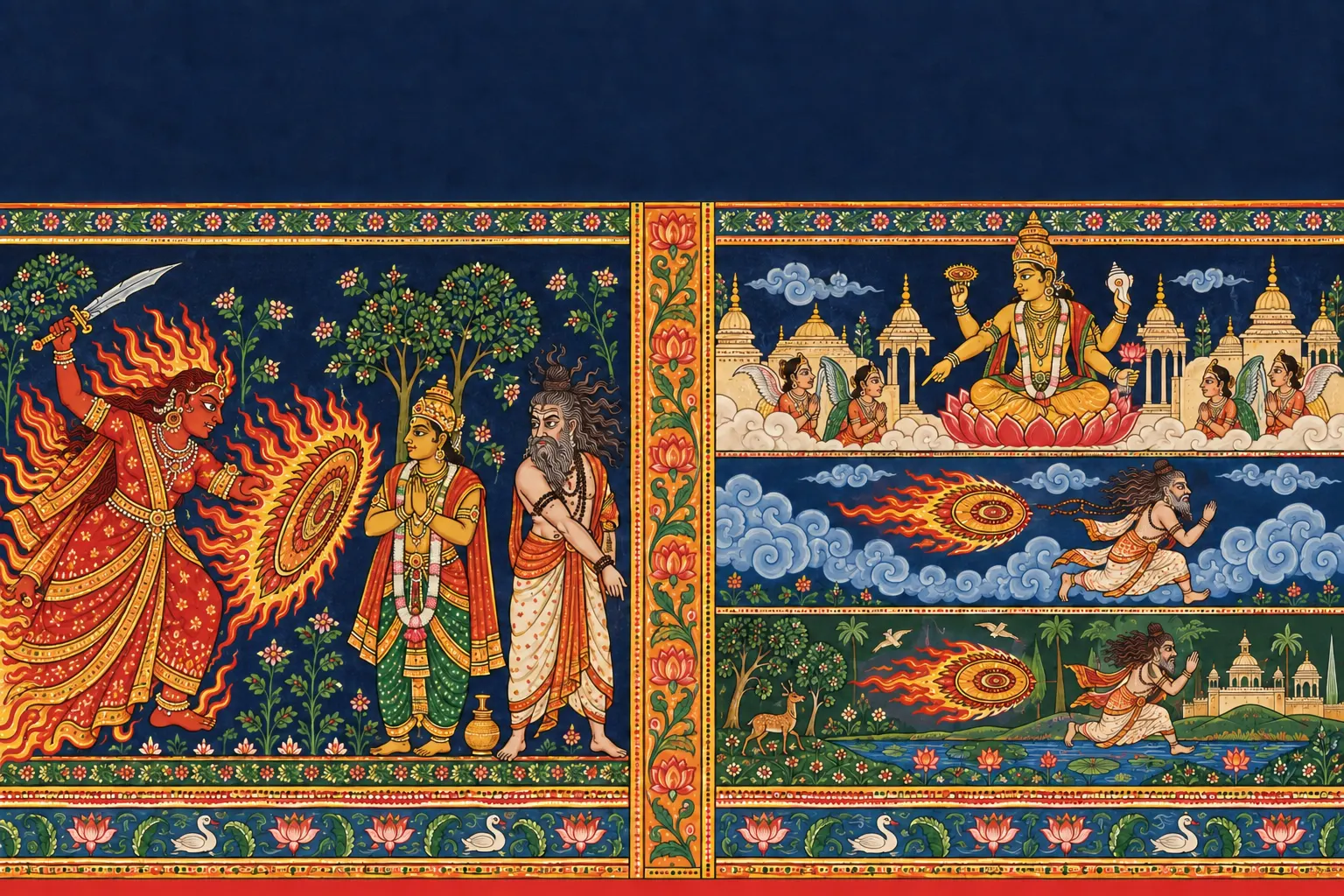
He tore a lock from his matted hair and flung it to the ground — it became a burning kritya, a demoness with a sword, rushing at Ambarisha.
Ambarisha did not move, and did not defend himself — he stood in prayer.
The Sudarshana discus — Vishnu's, left on guard — burned the kritya to ash, and then turned on Durvasa.
The chase
Durvasa ran. The discus followed.
He ran to the ends of the earth, into caves, across the sea, up to the sky. He went to Brahma — who could not help. To Shiva — who could not help either, "we cannot call back his discus." At last to Vishnu in Vaikuntha.
Vishnu's answer — the sentence this book was built to end on —
"I am not free. I am under the control of my devotees. My heart is in their keeping, and they are in mine. The sadhu is my heart, and I am his. Go to Ambarisha. Only he can call this off."
Durvasa — a full year gone by since he fled, the discus still behind him — returned and fell at Ambarisha's feet.
Ambarisha, alarmed that a brahmin was at his feet, prayed to the discus, and it withdrew.
The sting in the tail
Ambarisha had waited a full year for Durvasa's return, maintaining himself only on water.
Now he fed Durvasa first, and then ate himself.
Durvasa said — "I have seen the greatness of the Lord's devotees. One who has patience like yours could purify anyone."
Note: The Ambarisha–Durvasa story is in the ninth canto of the Bhagavata Purana (chapters 4–5), and Vishnu's line "I am under the control of my devotees" (around 9.4.63–68) states the whole book's argument in the first person. This is not the same Ambarisha who appears in the Shunahshepa sacrifice story — those are two different Ambarishas. Durvasa's fierce temper appears all through the Puranas and the Mahabharata (Kunti's boon, Shakuntala's curse, the pestle-curse on the Yadavas); do not read him here as a villain — the text's Durvasa really holds a principle (a householder's duty to the guest is absolute) and is really humbled, and says so. The note can hold both dharmas together — service to the guest, and the devotee's refuge — without making anyone a villain.
Source: from the Bhagavata Purana, Ambarisha and Durvasa — the discus that chased a sage