Chapter 9

Jada Bharata — who became a deer

A king grew so attached to a fawn that his next birth was a deer's

The man who left everything

Bharata was a great king — the son of Rishabha, and, by the text's account, the one Bharatavarsha is named for.

In good time he divided the kingdom among his sons and went to do solitary practice at the Pulaha ashram on the bank of the Gandaki river.

For years he did what was to be done — penance, discipline, solitude.

By the river

One day, while bathing, he saw a pregnant doe come to drink, and just then a lion roared.

She leapt in fright. In the leap her newborn fell into the river. The doe reached the far bank, but, distressed and exhausted, collapsed in a cave and died.

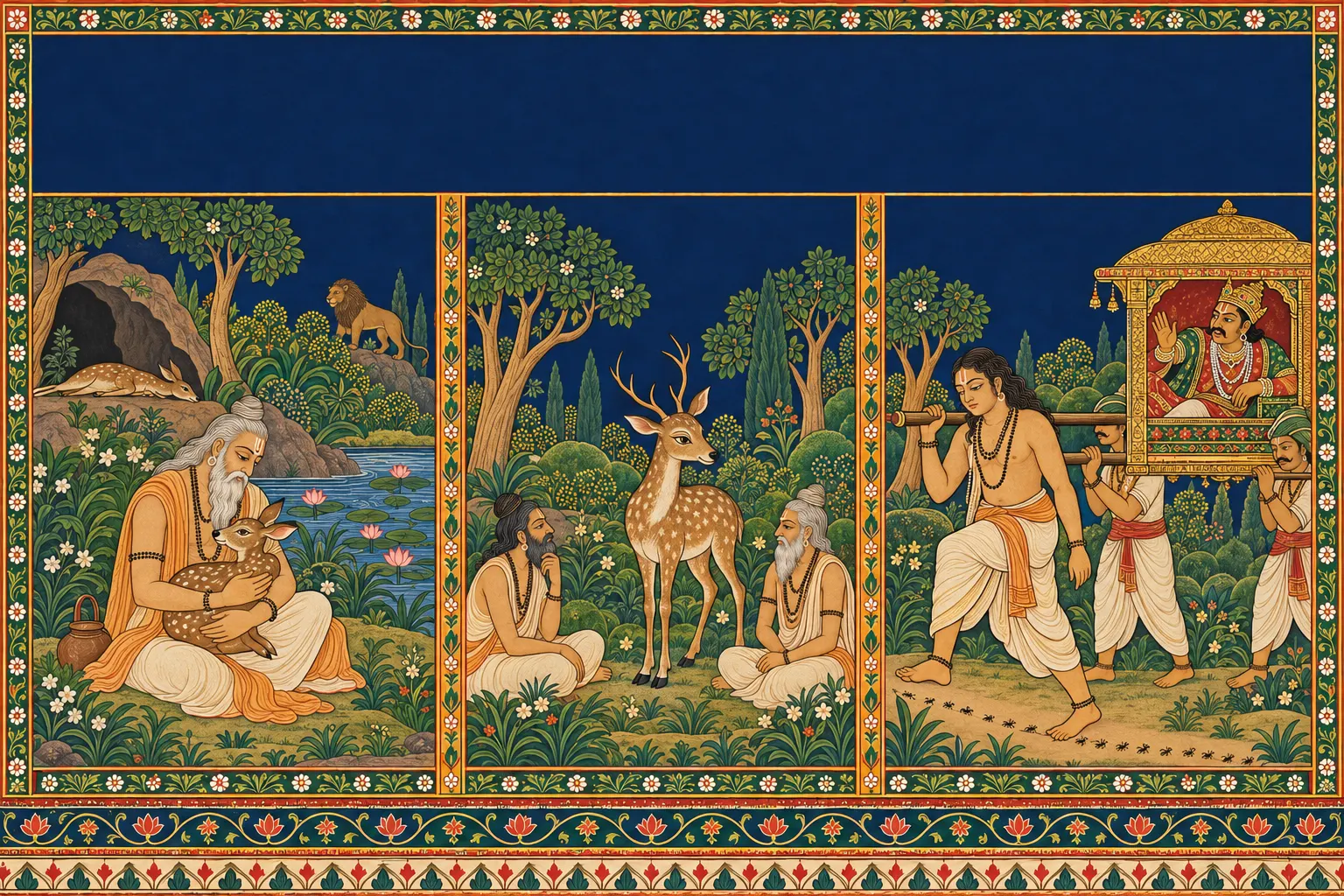
Bharata lifted the newborn fawn and raised it.

Exactly where renunciation was meant to be, attachment moved in. Bharata worried about it, searched for it, ordered his day around it; even in meditation his thoughts went to it.

He died with his mind fixed on that deer, looking for it — and was born as a deer.

But a fragment of his practice stayed with him, so he was a deer that remembered its past life. He kept near the ashrams of sages and let no new attachment form.

Jada Bharata

The next birth was in the house of a brahmin of the Angirasa line.

This time Bharata resolved that the world would not catch him again. He pretended to be deaf, mute and half-witted — "jada", inert.

People took him for a fool. He did any low work, ate whatever he was given, showed nothing.

After his father's death his half-brothers made him a farm ox.

Once, bandits who were devotees of Bhadra Kali seized him to sacrifice before the goddess for a son. As the sword was raised, the goddess herself burst from the image, in fury, and destroyed the bandits.

Bharata was unmoved the whole time, expecting nothing.

The palanquin

Rahugana, king of Sindhu-Sauvira, was on his way to see Kapila. He was short one bearer.

His men grabbed the large, healthy-looking "fool" by the road.

Bharata carried the pole, but stepped around every ant on the path, so the palanquin lurched.

The king threatened him, mocked him.

Bharata answered suddenly — in full, and clear. "The burden is not on me. The body carries the body. Fat and thin, king and bearer, living and dead — these are all conditions of matter, not of the witness that is watching."

The king leapt down from the palanquin and fell at his feet — asking, who are you.

Bharata's teaching went on into the tale of "the forest of the world" — a merchant lost in a wilderness of thieves, mirages, thorns and pits.

The point

In this whole book, every other devotee reaches God by wanting him.

Bharata's lesson is the other face of it — a person becomes what he attaches to, and if even a sage can be pulled back by one fawn, then no attachment is small.

He does not reach God by any grand devotion — he reaches him by refusing every hook the world offers, including the hook of being counted as someone.

Note: The Jada Bharata story is in the fifth canto of the Bhagavata Purana (chapters 7–14, mainly 8–13); the Vishnu Purana (2.13–16) has nearly the same form — the deer, the "jada" pretence, Rahugana, the discourse. That Bharatavarsha is named for this Bharata is the text's own claim; there are other Bharatas of the name. The human-sacrifice episode is in the text and is kept brief here — it is there to show Bharata's total evenness, not for the detail. This chapter is deliberately the quietest and plainest in the book, and it stands ninth so that there is a pause before the last loud chapter. This site's Vishnu-Puran epic also tells Jada Bharata.

Source: from the Bhagavata Purana, Jada Bharata — who became a deer

Now — how much stayed with you?

Fact

By the text's account, the name "Bharatavarsha" is tied to which Bharata?

  • Bharata, son of Rishabha
  • Bharata, son of Dushyanta and Shakuntala
  • Bharata, brother of Rama
  • No Bharata; the name comes from elsewhere
Read the whole story — One name, several Bharatas

The fifth canto of the Bhagavata claims that this land was called "Bharatavarsha" for this Bharata.

There are other Bharatas of the name — so this is the text's own claim, not a single consensus.

This Bharata was Rishabha's son, who in good time divided the kingdom among his sons and left for the forest.

What happened?

What pulled Bharata back into attachment in the middle of his renunciation?

  • A woman
  • The memory of the kingdom
  • A newborn fawn, which he rescued and raised
  • An enemy
Read the whole story — Exactly where renunciation was meant to be

By the river Bharata saw a pregnant doe leap in fright at a lion's roar; in the leap her young fell, and she died.

Bharata lifted the fawn and raised it.

Then he worried about it, searched for it, ordered his day around it — even in meditation, it.

Why is that?

Why was Bharata reborn as a deer in his next life?

  • Because he died with his mind fixed on that deer, looking for it
  • Because a sage cursed him
  • Because he had killed a deer
  • Because he had eaten meat
Read the whole story — The mind at the end

The Bhagavata's principle here is direct — whatever the mind is on at the moment of death, the next birth is like that.

Bharata's mind was on a fawn, so the body was a deer's.

But a fragment of his practice stayed, so he was a deer that remembered its past life.

Fact

How was the deer-Bharata different from an ordinary deer?

  • He could speak
  • He could fly
  • He never died
  • He remembered his past life, and let no new attachment form
Read the whole story — A watchful deer

Bharata kept near the ashrams of sages, and away from the herd.

This time he formed no attachment — he simply waited out that birth in peace.

That watchfulness grew harder still in the next, human birth.

What happened?

In his next (human) birth, how did Bharata protect himself?

  • By hiding in the forest
  • By pretending to be deaf, mute and half-witted
  • By becoming a king, so no one could touch him
  • By pilgrimage without stopping
Read the whole story — Free by being a fool

This time Bharata resolved that the world would not catch him again.

He showed nothing — he did any low work, ate whatever he was given.

People took him for a fool, and that was his shield.

What happened?

Who saved Bharata from the bandits?

  • The goddess (Bhadra Kali) herself, bursting from the image, in fury
  • Rahugana's army
  • Narada
  • Kapila
Read the whole story — The goddess out of the image

Bandits who were devotees of Bhadra Kali seized Bharata to sacrifice for a son.

As the sword was raised, the goddess herself burst from the image and destroyed the bandits.

Bharata was unmoved the whole time, expecting nothing — that is the point of the episode.

Who said it?

"The burden is not on me. The body carries the body. Fat and thin, king and bearer, living and dead — these are conditions of matter, not of the witness that is watching." — who said this?

  • Kapila, to Rahugana
  • Rahugana, to Bharata
  • Narada
  • Jada Bharata, to King Rahugana
Read the whole story — A teaching on the palanquin

Bharata carried the pole, but stepped around every ant on the path, so the palanquin lurched.

The king threatened him, mocked him — and Bharata answered suddenly, in full and clear.

The king leapt down from the palanquin and fell at his feet.

Fact

Which country was King Rahugana of, and where was he going?

  • Magadha, to see Janaka
  • Sindhu-Sauvira, to see Kapila
  • Avanti, to see Narada
  • Kosala, to see Vasishtha
Read the whole story — A bearer taken from the road

Rahugana's party was short one palanquin-bearer.

His men grabbed the large, healthy-looking "fool" by the road.

That "fool" then taught him the clearest lesson in Samkhya-Vedanta.

Why is that?

Why is this the quietest chapter in the book, and what is its lesson?

  • Because no deity appears in it
  • Because it has no miracle
  • Because every other devotee reaches God by wanting him, while Bharata reaches him by refusing every attachment
  • Because it is the shortest chapter
Read the whole story — The negative image

Dhruva, Prahlada, Gajendra — all call out to gain something.

Bharata asks for nothing; he removes every hook — even the hook of being counted as someone.

That is why this chapter stands ninth — a pause before the last loud chapter.

Who am I?

I was a king, then a deer, then a fool who would not speak — and free. Who am I?

  • Shukadeva
  • Nachiketa
  • Raikva
  • Jada Bharata
Read the whole story — Three births, one lesson

Bharata's story is the other face of devotion — freedom by refusal, not by love.

A single fawn can pull a sage back — so no attachment is small.

Bharata won in the third birth, when he refused every hook the world offered.