Chapter 4

Citraketu — whose son was taken

A king paid for one laugh with a birth among demons — and he had no complaint about it

The man who had everything but one thing

Citraketu was emperor of Shurasena. He had ten million queens, and not one child.

The sage Angira came. He gave the senior queen Kritadyuti a son — but as he left he said, "This son will bring joy and grief both."

The poison

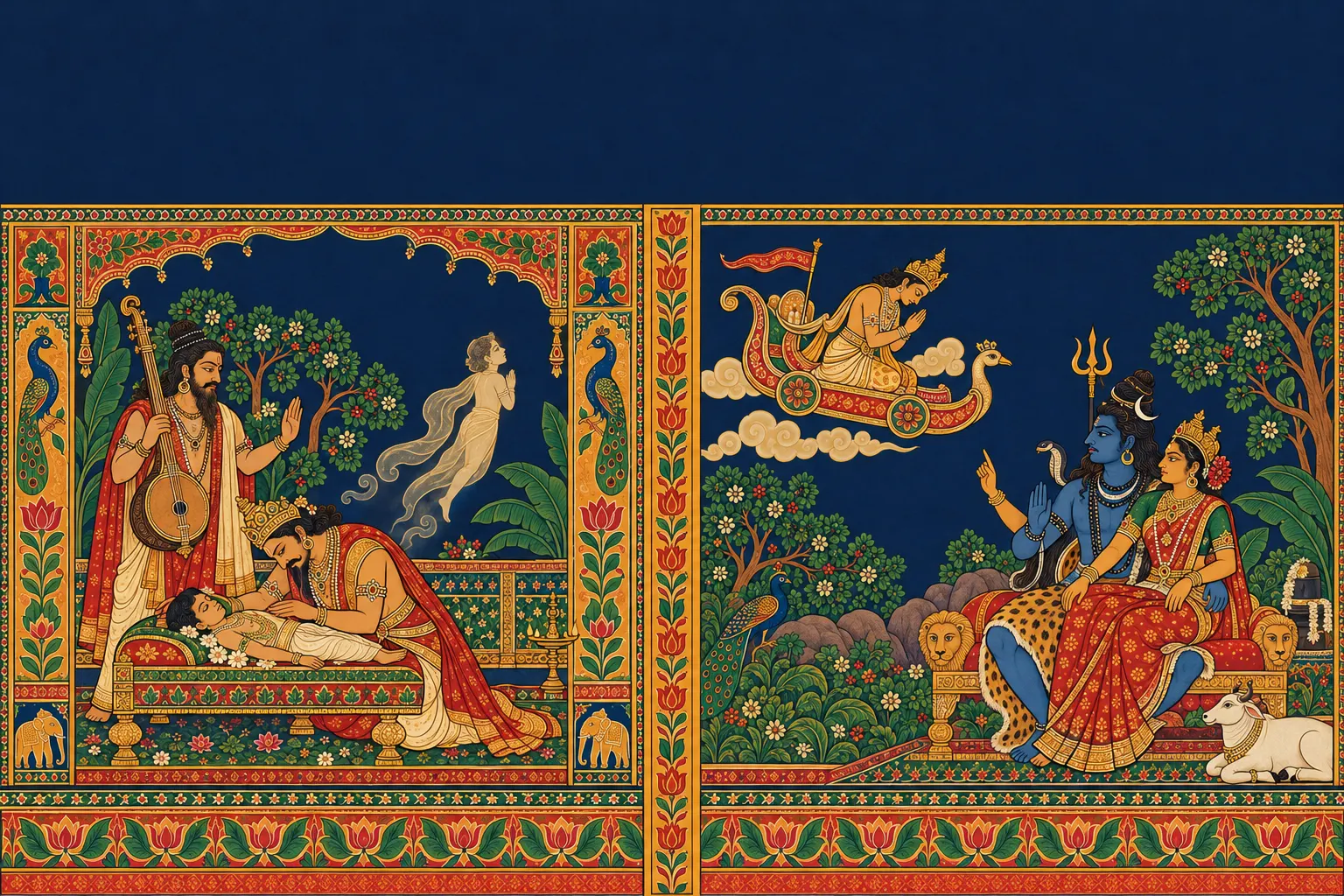
The other queens burned with envy. One day they poisoned the infant.

The child died. The court broke into weeping. Citraketu was destroyed.

Then Angira returned, this time with Narada.

To teach, Narada briefly called back the departed soul of the child, and let it speak.

The soul asked — "I have had so many mothers and fathers across so many births. Which do you mean? I have belonged to all of them, and to none."

Then it left.

The grief broke open into understanding.

In the sky

Narada gave Citraketu a teaching — a hymn to Sankarshana.

Citraketu practised it, and in seven days became king of the vidyadharas — luminous, flying, master of mantras. And a true devotee, light of the weight of the crown.

One day he was flying over Kailasa.

He saw Shiva in the assembly, among the sages, with Parvati on his lap, his arm around her.

Citraketu laughed. "The one who teaches dharma to all the worlds, sitting in open assembly holding his wife like this, like an ordinary man?"

The curse

Parvati was stung.

"You mocked," she said. "Go, take birth among the asuras."

Citraketu neither begged nor raged.

He came down from his vehicle, bowed, and said — "A curse and a boon are the same to me. Whatever the cause of this body, the refuge is God. I accept."

Then Shiva said to Parvati — "See, this is what a devotee is. See how he stands."

Citraketu was born as Vritra — and the Bhagavata says that Vritra fought on the battlefield like the greatest of devotees, speaking of God even as he died.

Note: Citraketu's story is in the sixth canto of the Bhagavata Purana (chapters 14–17). The other half of Vritra — the war with Indra — is in the oldest layer of the Rigveda too, where Vritra is only an enemy with no backstory; and in the Mahabharata Vritra is a brahmin and Indra incurs the sin of brahmin-killing. The Citraketu frame — a devotee born as the demon — is the Bhagavata's own; that is, the Bhagavata has laid a devotional backstory over an old Vedic combat myth. Do not read the curse scene as "Parvati the villain" — the text keeps both right: a goddess stung on a point of propriety, and a devotee the curse cannot reach; Shiva takes no one's side.

Source: from the Bhagavata Purana, Citraketu — whose son was taken

Now — how much stayed with you?

Fact

Of which country was Citraketu emperor?

  • Shurasena
  • Magadha
  • Vidarbha
  • Kosala
Read the whole story — The man who had everything

Citraketu had everything — except a child.

The sage Angira came and gave the senior queen Kritadyuti a son.

But as he left he said — "This son will bring joy and grief both."

What happened?

How did Citraketu's only son die?

  • Of illness
  • In battle
  • By a curse
  • The other queens poisoned him out of envy
Read the whole story — The poison of envy

The queens who had no son burned with envy toward the one who did.

One day they poisoned the infant. The child died, the court broke into weeping, Citraketu was destroyed.

Angira's warning came true — this son brought both joy and grief.

Who said it?

"I have had so many mothers and fathers across so many births. Which do you mean? I have belonged to all of them, and to none." — who said this?

  • Narada
  • The soul of the dead child
  • Citraketu
  • Angira
Read the whole story — The soul's words

Narada called the child's departed soul back for a moment and let it speak.

The soul claimed no one as "its own" — not this life's parents, not any of the past.

Then it left, and Citraketu's grief broke open into understanding.

Fact

After practising the teaching, Citraketu became king of whom?

  • The gandharvas
  • The yakshas
  • The vidyadharas
  • The nagas
Read the whole story — Light of the crown's weight

Narada gave Citraketu a hymn to Sankarshana (the Lord as the substratum).

Practising it seven days, he became king of the vidyadharas — but now a true devotee, freed of the crown's weight.

It is this lightness that keeps him steady before the curse.

What happened?

Why did Parvati curse Citraketu?

  • Because he flew over Kailasa without permission
  • Because he did not worship Shiva
  • Because he spoke Vritra's name
  • Because he laughed at Shiva sitting with Parvati on his lap in open assembly
Read the whole story — One laugh

Citraketu was flying over Kailasa and saw Shiva in the assembly of sages with Parvati on his lap.

He laughed and made a jibe.

Parvati was stung, and said — "Go, take birth among the asuras."

Who said it?

"See, this is what a devotee is. See how he stands." — who said this, to whom?

  • Shiva, to Parvati
  • Narada, to Citraketu
  • Citraketu, to Parvati
  • Brahma, to Shiva
Read the whole story — Shiva's verdict, taking no side

Citraketu neither begged nor raged at the curse — he came down, bowed, and said "a curse and a boon are the same to me."

Shiva called neither Parvati wrong nor Citraketu wrong — he only pointed to the devotee.

The text keeps both right: a goddess stung on a point of propriety, and a devotee the curse cannot reach.

Whose son?

As what was Citraketu reborn after the curse?

  • As Ravana
  • As Hiranyakashipu
  • As Vritra
  • As Kamsa
Read the whole story — A demon, but a devotee

Citraketu was born as Vritra — the same enemy of Indra called the oldest adversary in the Vedas.

But the Bhagavata's Vritra speaks of God even as he dies on the field.

So even in the body the curse gave him, the devotee remained.

The texts disagree

How do different texts present Vritra?

  • In the Rigveda Vritra is Indra's ancient adversary; the Mahabharata preserves several later Vritra accounts, including versions in which Indra is pursued by Brahmahatya; the Bhagavata makes Vritra Citraketu reborn and a great devotee
  • All call him a devotee of Vishnu
  • All three texts call him Bali, king of the demons
  • Vritra is found only in the Bhagavata
Read the whole story — One name, three layers

In the oldest Rigvedic layer, Vritra is a serpent-like enemy who holds back the waters, and Indra kills him to release the rivers.

The Mahabharata adds several different layers around Vritra and Indra's guilt; its accounts are not themselves completely uniform.

The Bhagavata goes furthest: it laid a devotional story over an old combat myth.

Why is that?

Why did Citraketu accept the curse so calmly?

  • Because the curse was not going to affect him
  • Because he feared Parvati
  • Because Narada had told him in advance
  • Because a curse and a boon were equal to him
Read the whole story — What the curse cannot reach

For Citraketu the real thing was not the body but the refuge that stays the same in every body.

So "become a demon" was no punishment to him.

This is the point of the chapter — devotion protects the thing a curse cannot touch.

Who am I?

I had ten million queens and no child. My one son died. I calmly accepted the goddess's curse and bowed to her. Who am I?

  • Harishchandra
  • Citraketu
  • Dasharatha
  • Janaka
Read the whole story — From grief to evenness

Citraketu's story rests on an impossible turn — a father who, having lost his son, bows to the one who curses him.

The Bhagavata keeps him among the hardest examples of devotion.

His answer was no slogan; he simply stood calm, and Shiva pointed to him.