Chapter 1

Dhruva — the lap he did not get

A five-year-old was denied his father's lap, and walked out to find a place no one could remove him from

In the court

King Uttanapada had two queens.

The elder was Suniti — quiet, straight. The younger was Suruchi, and she was the one the king loved.

Suniti's son was Dhruva. Suruchi's son was Uttama.

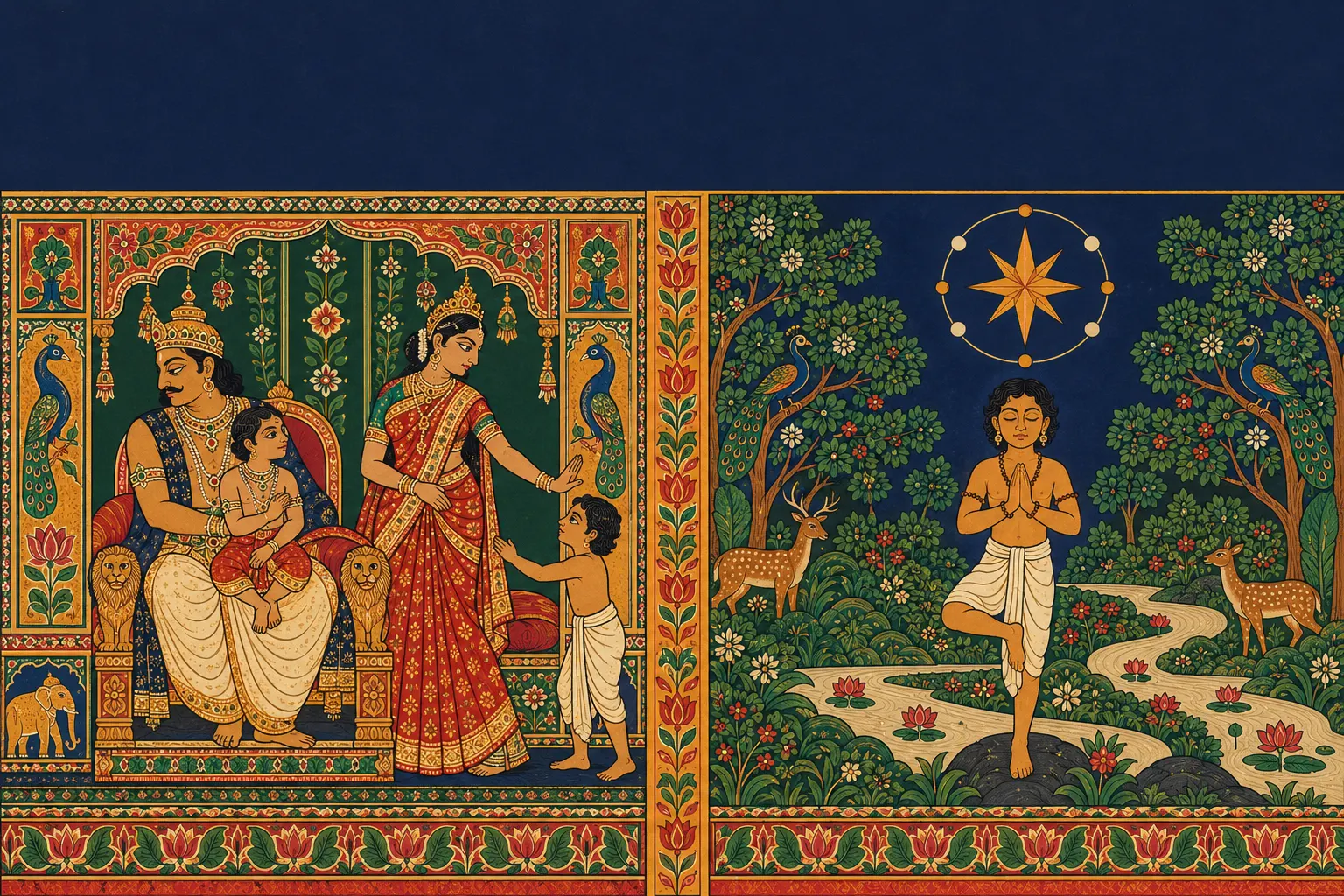
One day the king sat with Uttama on his lap. Dhruva came near and began to climb up too.

The king did not lift him. He said nothing.

Then Suruchi spoke.

"This is not your place, child. You are the king's son, yes, but you were not born from my womb. This lap, this throne — for these you must do penance, and come back in your next life from my body."

Dhruva was five. His lips shook and he could not answer, and he left the room.

With his mother

Dhruva went to Suniti in tears and told her everything.

Suniti's eyes filled. She did not give her son a false comfort.

"Your stepmother spoke bitterly," she said, "but she was not wrong. There is only one lap no one can take from you."

"Whose?"

"His, who is the refuge of all. Before whom even your father is small. Seek him."

Then, with his mind made up, Dhruva left his father's house and walked toward the forest.

At Madhuvana

On the road he met Narada.

Narada reasoned with him — you are a child, the forest is hard, go home. Dhruva would not.

Then Narada gave him a mantra — "om namo bhagavate vasudevaya" — and told him to go to Madhuvana on the bank of the Yamuna.

Dhruva sat down there.

The first month he ate one fruit every third day. The second month, dry grass and leaves every sixth day. The third month, only water. The fourth month, only air.

In the fifth month he stood on one leg, his breath stilled, his mind fixed on a single point. He continued until the six months were complete.

The text says that as he stood motionless on one leg, the pressure of his big toe pressed down half the earth, and the three worlds trembled.

What he had not asked for

Then Hari came.

Dhruva wanted to pray, but no words came. The Lord touched his forehead with his conch — and a whole hymn broke out of Dhruva's mouth.

The Lord said, "I know what you came for. You will have that too — your father's kingdom. But after it you will have a place that never ends. Around which all the stars and planets turn. That stands even through the dissolution of the worlds."

Then he left.

But Dhruva had no peace. He said — "I reached the Lord himself, and still my mind had been fixed on rank, revenge and a larger kingdom. I am ashamed that I asked for so little."

Dhruva went home. His father came forward and embraced him. Suruchi bowed too.

The axis

Years later Dhruva was king.

His younger brother Uttama went hunting and was killed by a Yaksha. Suruchi died in the forest, searching for her son.

Dhruva filled with grief and rage. He mounted his chariot and fell on Alakapuri, the city of the Yakshas.

He beat the Yaksha army, then began killing those who had already fled — even those who had done nothing.

Then Svayambhuva Manu — his great-grandfather — stood before him.

"Stop," he said. "None of these Yakshas wronged you. A devotee does not turn into Yama."

Dhruva set down his bow.

Then Kubera came — pleased, not because he had won the fight, but because he had learned to stop.

At last two attendants of Vishnu, Nanda and Sunanda, arrived with a celestial vehicle.

Dhruva hesitated — he could not go and leave his mother Suniti. Then he saw that on the same road ahead, his mother had already been placed on another vehicle.

He passed through the planetary worlds and took his fixed seat.

He is still there.

Note: Dhruva's story is in the fourth canto of the Bhagavata Purana (chapters 8–12); the Vishnu Purana (1.11–12) carries nearly the same form, and the Mahabharata only names Dhruva as the pole star without the full narrative. The mantra Narada gives, "om namo bhagavate vasudevaya" (the twelve-syllable one), is in the text; the month-by-month schedule of the penance is detailed in some recensions and reduced to "six months" in others — all agree on the escalation. The killing of the Yakshas and Manu's intervention are plain in the Bhagavata and kept here deliberately — a devotee-child in a rage can do what anyone can; the text does not hide it. This site's Vishnu-Puran epic also tells Dhruva; there the weight is on the penance and the dissolution-proof station, here on the whole life.

Source: from the Bhagavata Purana, Dhruva — the lap he did not get

Now — how much stayed with you?

Whose son?

Which queen was Dhruva's mother?

  • Suniti
  • Suruchi
  • Aditi
  • Kritadyuti
Read the whole story — Two queens, two sons

King Uttanapada had two queens — Suniti and Suruchi. He loved Suruchi, and her son was Uttama.

Dhruva was Suniti's son. When he was stopped at the lap in court, Suniti said the stepmother had spoken bitterly but not wrongly.

In the Bhagavata, this answer of Suniti's is the engine of the story — she turns her son from grievance to search.

Who said it?

"This is not your place. You were not born from my womb. If you want it, do penance, and come back in your next life as my son." — who said this?

  • Suniti
  • King Uttanapada
  • Narada
  • Suruchi
Read the whole story — Silence and wound

In the Bhagavata the scene is composed — the father holds Uttama, Dhruva comes to climb up, and the king does nothing.

Suruchi's words fall into that silence, and that is why they cut so deep.

Dhruva was five; his lips shook, he could not answer, and he left the room.

What happened?

Leaving the court, where did Dhruva go first?

  • Straight to the forest
  • To his mother Suniti
  • Narada's ashram
  • To Madhuvana on the Yamuna
Read the whole story — Mother first, then the forest

Dhruva went to Suniti first. Her eyes filled, but she said — "There is only one lap no one can take from you."

"Whose?" Dhruva asked. "His, who is the refuge of all. Seek him."

That same night, without telling anyone, Dhruva left the palace.

Fact

Which mantra did Narada give Dhruva?

  • "Om namo bhagavate vasudevaya"
  • "Om namah Shivaya"
  • The Gayatri mantra
  • The "Hare Krishna" mahamantra
Read the whole story — Twelve syllables

Narada first reasoned with Dhruva — you are a child, the forest is hard, go home. Dhruva would not.

Then Narada gave him "om namo bhagavate vasudevaya" and told him to go to Madhuvana on the Yamuna.

This twelve-syllable mantra became one of the most repeated mantras in later Vaishnava practice.

Why is that?

Why was Dhruva ashamed after seeing Hari?

  • Because he had abandoned his penance in the forest
  • Because he had taken revenge on his father
  • Because the Lord had scolded him
  • Because he had done penance for a lap and was given the axis of the whole world
Read the whole story — A small ask, a large boon

The Lord said Dhruva would have his father's kingdom, and after it a fixed, imperishable station around which all the stars turn.

After receiving the boon, Dhruva was not simply delighted; he was ashamed that, after reaching the Lord, his original desire had been so small and worldly.

This is the real point of the chapter: he asked for a splinter and was given the tree.

What happened?

Who stopped Dhruva when he fell on the city of the Yakshas?

  • Kubera
  • Svayambhuva Manu
  • Vishnu himself
  • Suniti
Read the whole story — A devotee does not turn into Yama

Dhruva's brother Uttama was killed by a Yaksha; Suruchi died in the forest searching for him.

Dhruva beat the Yaksha army, then went on killing those who had fled — those who had done nothing.

The Bhagavata does not hide this. Manu came and said these Yakshas had not wronged him, and Dhruva set down his bow.

Put it in order

Put Dhruva's story in order.

  • Snub in court → seeing Hari → Narada's mantra → the Yaksha war → departure for Dhruvaloka
  • Narada's mantra → snub in court → the Yaksha war → seeing Hari → Dhruvaloka
  • Snub in court → Narada's mantra → seeing Hari → the Yaksha war → departure for Dhruvaloka
  • Snub in court → the Yaksha war → Narada's mantra → seeing Hari → Dhruvaloka
Read the whole story — The line of one life

The Bhagavata tells this as a whole life, not just the miracle of a penance.

Child → ascetic → boon-granted prince → king lost in rage → devotee who stopped and came back → lifted up bodily.

The Yaksha war in the middle is what keeps it from being a greeting card.

Later tradition

What is Dhruva identified as in the sky?

  • The planet Venus
  • One of the stars of the Great Bear
  • A dark mark on the moon
  • The pole star (the northern Dhruva-tara)
Read the whole story — The fixed point

The Lord's boon was a station that lasts a full kalpa, unerased even by dissolution, with all stars and planets circling it.

The Mahabharata also names Dhruva as the pole star, though without the full story.

For centuries the fixed star was the one to steer by — it does not move.

The texts disagree

How do the recensions differ on the length of Dhruva's penance?

  • Some recensions give the month-by-month tightening of diet in detail; some just say "six months"
  • Some say six months, some say sixty years
  • Some say there was no penance at all, Narada arranged the boon directly
  • No difference, all say the same
Read the whole story — The escalation

In one detailed form: month one, one fruit every third day; month two, grass and leaves every sixth day; month three, only water; month four, only air; month five, on one leg, breath stilled.

In another form the whole penance is folded into "six months."

What is the same in every telling is the direction — the discipline keeps tightening.

Who am I?

I was five when I was stopped from my father's lap. I walked into the forest, and now I am the fixed point in the sky. Who am I?

  • Prahlada
  • Nachiketa
  • Dhruva
  • Markandeya
Read the whole story — From a lap to the axis

The shape of Dhruva's story is simple — a rejected child who chooses search over grievance.

What he was given was far larger than what he asked for, and he said so himself.

The Bhagavata keeps it among the oldest and gentlest examples of devotion.