
Chapter 7
Gajendra — the elephant in the jaws
After a thousand years in a crocodile's grip the elephant did what it had never done before — it gave up
The lake
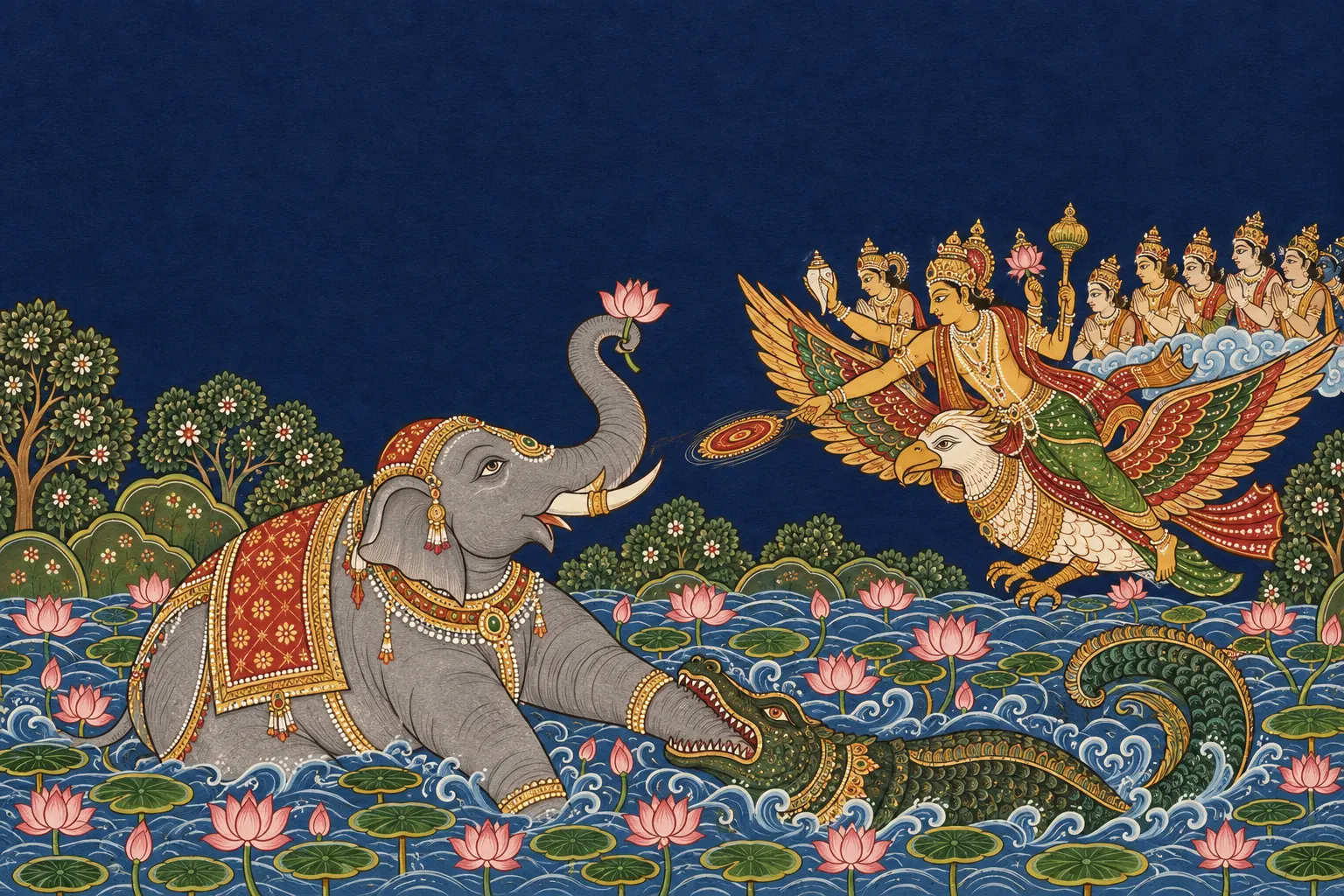
On Mount Trikuta there was a lake, full of lotuses.
Gajendra — the bull elephant, leader of the herd — went into the water in the heat with his cows and calves.
A thousand years
A crocodile seized his leg.
The elephant pulled toward the shore, the crocodile pulled toward the deep. This tug went on for a thousand years.
The elephant grew weaker — the water was not its home. The crocodile grew stronger — the water was its home.
The herd drifted away from the shore. Nothing helped.
The lotus
At last, when the elephant's own strength was spent, a prayer returned to it — one it had learned not in this life but in some earlier human birth.
In that long hymn it called on the source of all things — "the one from whom all this has come, in whom all this rests." No bargain, no condition.
And when help came, it had only a lotus, lifted in its trunk, to offer.
The fastest answer
Vishnu came at once on Garuda, with the gods accompanying and praising him.
He first pulled Gajendra and the crocodile together out of the water, then severed the crocodile's mouth from its body with the Sudarshana discus.
Then it came out — both had been cursed men.
The elephant had been Indradyumna, a Pandya king and devotee of Vishnu, cursed by Agastya to elephant birth for failing to greet him while absorbed in meditation.
The crocodile had been a gandharva named Huhu, cursed by the sage Devala for the prank of pulling his leg in the water.
Both were released — in the same moment. The one who bit and the one who was bitten.
The point
The answer comes with remarkable speed — an animal's body, a prayer remembered from an earlier human life, and a call made only after every other strength had failed.
And it got it because the prayer was total. Gajendra called out only when every other strategy had run out.
Note: Gajendra's liberation is in the eighth canto of the Bhagavata Purana (chapters 2–4); the prayer of Gajendra (8.3) is still recited daily by many, and as a prayer before a crisis or before death. The identification of the elephant as Indradyumna, the Pandya king, and the crocodile as the gandharva Huhu, are the Bhagavata's. The story is mainly Bhagavata-centred, retold also in the Vishnu Purana, the Padma Purana and later hymn literature. Some South Indian temple traditions place the lake in their own precincts (for example Ahobilam, Thirukkurungudi).
Source: from the Bhagavata Purana, Gajendra — the elephant in the jaws