Chapter 6

Narasimha — the pillar splits

What came out of the pillar was neither man nor lion — and its rage did not cool even after the killing

On the threshold

Hiranyakashipu struck the pillar with his fist.

There was a sound — like the end of the world.

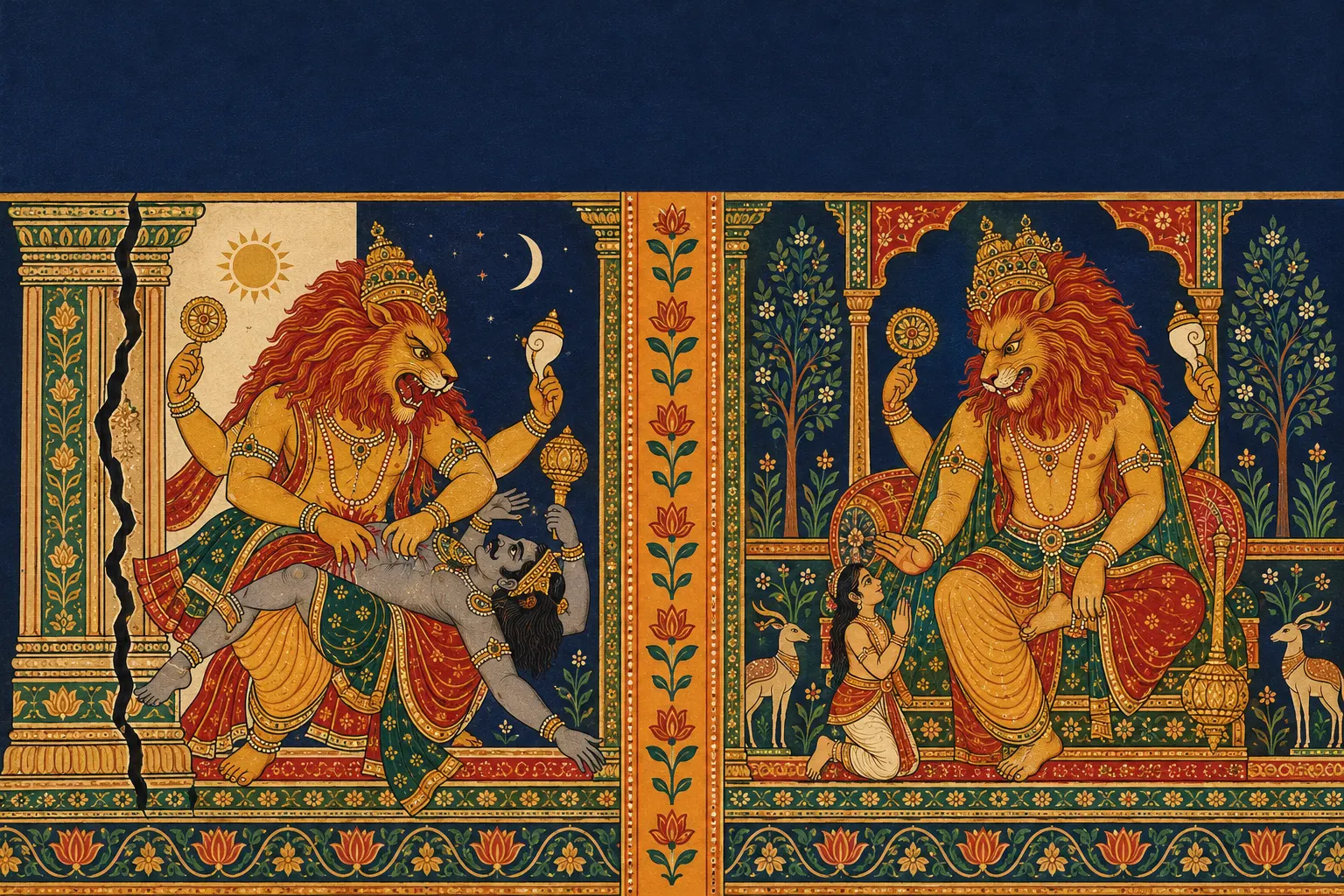
A form came out of the pillar — not a man, not a lion. A man's torso, a lion's head and claws, a blazing mane, eyes like molten gold. Narasimha.

Every condition, undone

Every wall of the boon had a crack in it.

Not death from any creature Brahma made — Narasimha is an avatara of Vishnu, not a made creature; and he is neither man nor beast.

Not inside a house, not outside — Narasimha catches him on the threshold of the hall, right on the doorway.

Not day, not night — the time is twilight, the seam between the two.

Not on the ground, not in the sky — he lays him across his own thighs.

Not by any weapon — he tears him with his claws, which are not a weapon but part of the body.

Not a god, not a demon, not a human, not a serpent — none of these.

Hiranyakashipu is torn open on his lap.

The rage that did not cool

But the story does not end there.

Narasimha's fury did not subside. The gods could not go near. Lakshmi could not. Brahma could not. Shiva could not.

Then they sent Prahlada — the child — before the blazing form of God.

And he alone could calm it, with folded hands, with a hymn.

When told to ask for a boon, Prahlada asked for no material reward — only that the desire to seek such rewards should never arise in his heart.

Then the Lord instructed him to rule. Prahlada made one further request: that his father be forgiven the hostility and offences he had committed.

The Lord answered that Hiranyakashipu had been purified, and twenty-one generations of Prahlada's family through him.

Prahlada was made king of the demons. Narasimha withdrew.

Twilight

Today Narasimha Jayanti is kept on the fourteenth day of the bright half of Vaishakha — at twilight, exactly as the killing was.

Note: The Narasimha episode is in the seventh canto of the Bhagavata Purana (chapter 8), and its real weight is in the next two chapters (7.9–7.10) — the God who is not calmed even after the killing, and who is calmed by the smallest, gentlest character. The detail of undoing each condition of the boon — the threshold, the twilight, the lap, the claws — is set out at length in the Bhagavata. This chapter is not a "the monster is torn open" story; it is the killing (fast, terrifying, over in a page) and the long problem that follows. Ahobilam, Simhachalam and Yadagirigutta are famous Narasimha sites; forms like Ugra, Yoga and Lakshmi-Narasimha are later iconographic tradition.

Source: from the Bhagavata Purana, Narasimha — the pillar splits

Now — how much stayed with you?

What happened?

What came out of the pillar?

  • A lion
  • A form that was neither man nor lion
  • A man
  • A light, from which a voice spoke
Read the whole story — Neither this nor that

At Hiranyakashipu's blow there was a sound — like the end of the world.

Out of the pillar came Narasimha: a blazing mane, eyes like molten gold, half man and half lion.

This "neither this nor that" form breaks the first wall of the boon.

Put it in order

How did Narasimha get past the conditions of the boon — choose the right pairing.

  • Not inside, not outside → at noon; not day, not night → on the roof
  • Not by any weapon → with a trident; not by a demigod or demon → by an ordinary demigod
  • Not inside, not outside → on the threshold; not day, not night → at twilight; not on ground, not in sky → on his own thighs; not by any weapon → with his claws
  • Not on ground, not in sky → in the sea; twilight → midnight
Read the whole story — A step in every crack

Every condition of the boon had a "middle place," and Narasimha put his foot exactly there.

The threshold (not inside or outside), twilight (not day or night), the thigh (not ground or sky), the claws (not a weapon, part of the body).

And Narasimha is not one of the created beings covered by the boon — he is Vishnu himself in a form that is neither human nor animal.

Fact

At what time of day did Narasimha kill Hiranyakashipu?

  • Exactly noon
  • Midnight
  • At sunrise
  • At twilight
Read the whole story — The seam between the two

The boon was — not by day, not by night. Twilight is neither.

That is why Narasimha Jayanti is still kept at twilight.

The Bhagavata keeps this "seam" detail very carefully.

Fact

With what did Narasimha kill Hiranyakashipu?

  • His own claws
  • The Sudarshana discus
  • A trident
  • His roar
Read the whole story — Not a weapon

The boon was — no death by any weapon.

Claws are no made weapon; they come with the body.

Through that crack, Narasimha tore him open on his lap.

What happened?

After the killing, who could calm Narasimha's wrath?

  • Lakshmi
  • Brahma and Shiva together
  • Prahlada
  • No one; the wrath subsided on its own
Read the whole story — The smallest, the gentlest

The killing was fast and terrifying, but afterward Narasimha's wrath did not subside.

The gods, Lakshmi, Brahma, Shiva — none could go near.

Then Prahlada was sent, and he alone could calm that blazing form. This is the real scene of the chapter.

What happened?

When told to ask for a boon, what did Prahlada ask for?

  • Freedom from the wish to ask for boons; and forgiveness for his father
  • His father's kingdom and heaven
  • Strength like Narasimha's
  • Immortality
Read the whole story — What he did not ask for

Prahlada first refused material rewards and asked that no desire for worldly boons grow in his heart.

After the Lord told him to rule, Prahlada made one further request: that his father be freed from the consequences of his hostility.

The Lord answered that Hiranyakashipu was purified, and that twenty-one generations of Prahlada's family were purified through him.

Why is that?

Why is the weight of this chapter on the aftermath, not the killing?

  • Because the killing is very violent
  • Because Hiranyakashipu comes back to life
  • Because Prahlada was not there at the killing
  • Because the killing is over in a page, and the long problem after it is that God is too angry to return
Read the whole story — The killing, then the problem

The "the demon is torn open" part is fast and passes quickly.

The real story is after it (Bhagavata 7.9–7.10) — a God who has to be calmed.

And that is done not by the largest and strongest, but by the smallest.

Later tradition

When and at what time is Narasimha Jayanti kept?

  • On the full moon of Kartika, in the morning
  • On the fourteenth of the bright half of Vaishakha, at twilight
  • On the new moon of Shravana, at midnight
  • On the first of Chaitra
Read the whole story — The time is part of the story too

The festival kept the "seam" detail of the killing with it.

Worship is at twilight — neither day nor night.

Ahobilam, Simhachalam and Yadagirigutta are famous Narasimha sites.

Fact

In which canto of the Bhagavata is the Narasimha episode?

  • The seventh
  • The fourth
  • The sixth
  • The ninth
Read the whole story — Canto and weight

The killing is in the eighth chapter of the seventh canto.

But chapters 9 and 10 — Prahlada's hymn and God being calmed — are the part the story is remembered for.

That is why on this site Prahlada and Narasimha are two separate chapters.

Who am I?

I am not the creature that killed him; I am the child that calmed him. Who am I?

  • Brahma
  • Lakshmi
  • Garuda
  • Prahlada
Read the whole story — Two scenes, one form

The first scene: the form out of the pillar, on the threshold, at twilight, the killing on the lap.

The second scene: the same form, still blazing, and a child before it with folded hands.

For the Bhagavata the second scene is the larger one.