Chapter 5

Prahlada — who would not stop

The father tried every method to kill his son. Every time, the son came back speaking the same name

The boon

Hiranyakashipu and Hiranyaksha — two brothers — were in fact Vishnu's gatekeepers Jaya and Vijaya, cursed by the four Kumaras to three demon lives.

Varaha had just killed Hiranyaksha. Hiranyakashipu swore he would wipe out Vishnu and everyone who worshipped him.

He did a penance so fierce the worlds heated up. Brahma appeared.

Hiranyakashipu asked for a boon — closing every door.

"Let me not die at the hands of any creature you made, moving or unmoving. Not inside a house, not outside. Not by day, not by night. Not on the ground, not in the sky. Not by any weapon. Not by a god, a demon, a human, or any great serpent."

Brahma granted it.

The son who was not counted

Hiranyakashipu's son Prahlada was a devotee of Vishnu from the womb — he had heard Narada's teaching while inside his mother.

He was sent to learn statecraft from Shanda and Amarka, the sons of the demons' preceptor Shukra.

His father asked — "What is the best thing you have learned?"

Prahlada listed the nine limbs of devotion — hearing, chanting, remembering, serving the feet, worship, obeisance, servitude, friendship, self-surrender.

Hiranyakashipu flew into a rage. He ordered his son killed.

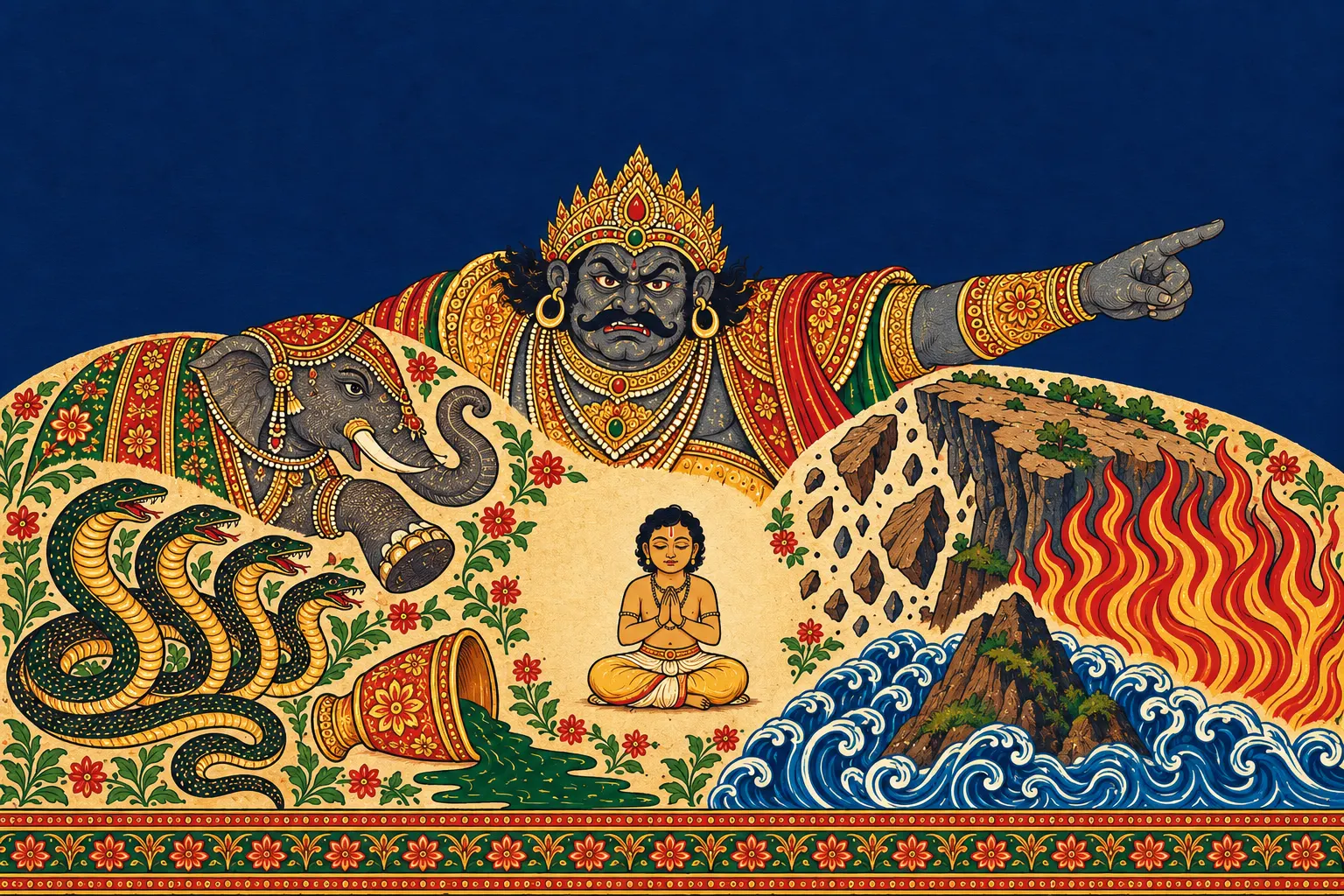
The guards' weapons were used. He was trampled by elephants. Venomous snakes were coiled around him. Poison in his food. Starvation. Exposure to cold, wind, fire and water. Heavy stones and hills used to crush him. Thrown from a mountain. Spells.

Nothing could touch him. He stayed absorbed in Hari each time, and when asked, was not even angry.

The later Holika tradition

Later Holi tradition tells that Prahlada's aunt Holika had a boon that fire would not burn her.

She sat down on a blazing pyre with Prahlada in her lap.

The wind rose. The garment that carried the boon lifted off Holika and settled on Prahlada.

Holika burned. Prahlada walked out.

Holi tradition links the burning of Holika to this episode.

The pillar

The father's same question, again and again — "Where is this God of yours?"

"Everywhere," Prahlada would say. "In you, in me, in everything."

"In this pillar too?"

"Yes."

Between the attempts, Prahlada taught his demon classmates — "Begin dharma while you are still a child; this life cannot be relied on."

Then one day Hiranyakashipu struck his fist against that pillar in the court.

Note: Prahlada's story is in the seventh canto of the Bhagavata Purana (chapters 2–7); the Vishnu Purana (1.17–20) has a slightly older, slightly shorter form, and the Harivamsha and several Puranas carry their own versions of Prahlada–Narasimha. The Jaya–Vijaya frame (which also gave Ravana–Kumbhakarna and Shishupala–Dantavakra) is plain in the Bhagavata. The boon terms and the nine-limbs verse are Bhagavata signatures. The version of Holika with the fireproof boon is thin in the constituted Bhagavata text and full in later and festival tradition (Bhavishya, Narada, local Holi tellings) — the Bhagavata's own account of the fire is brief. A father ordering his small child's death, again and again, is in the text and is the point of the story; the weight here is on the child's calm, not on the methods.

Source: from the Bhagavata Purana, Prahlada — who would not stop

Now — how much stayed with you?

Fact

Who were Hiranyakashipu and Hiranyaksha, really, in relation to Vishnu?

  • Two demon generals
  • Two sages
  • Two avataras of Vishnu
  • The gatekeepers Jaya and Vijaya
Read the whole story — Three lives of a curse

Jaya and Vijaya stopped the four Kumaras at the gate of Vaikuntha; the Kumaras cursed them to three demon lives.

The first pair — Hiranyakashipu and Hiranyaksha. The same frame later gives Ravana–Kumbhakarna and Shishupala–Dantavakra.

The Bhagavata keeps this frame clear.

Fact

Which of these was NOT a condition Hiranyakashipu set in his boon?

  • Not death by day, nor by night
  • "Not by fire, nor by water"
  • Not inside a house, nor outside
  • Not by any weapon
Read the whole story — Every door, but not one

Hiranyakashipu asked — not by any creature you made, moving or unmoving; not inside or outside; not day or night; not on ground or in sky; not by any weapon; not by god, demon, human or great serpent.

He did not mention fire or water — but his real mistake was leaving every "seam" open.

Narasimha entered through exactly those cracks.

Fact

Where did Prahlada get his devotion?

  • From his teachers
  • In a dream
  • In the womb, when Narada taught his pregnant mother
  • After seeing Narasimha
Read the whole story — A devotee from the womb

During Hiranyakashipu's penance, Narada took Prahlada's mother Kayadhu to his ashram and taught her devotion.

Prahlada, in the womb, heard it, and was born with it.

That is why no punishment, no fear could shake him — the devotion was not learned, it was brought.

Who said it?

The nine limbs of devotion — hearing, chanting, remembering, serving the feet, worship, obeisance, servitude, friendship, self-surrender — who listed them, to whom?

  • Narada, to Kayadhu
  • Shukra, to Prahlada
  • Shanda and Amarka, to Hiranyakashipu
  • Prahlada, to his father Hiranyakashipu
Read the whole story — The wrong answer, in the wrong place

Hiranyakashipu had sent his son to learn statecraft, and heard in reply — the nine limbs of devotion.

This verse (Bhagavata 7.5.23) is among the most quoted in the tradition.

To the father it was defiance; to Prahlada it was the only thing worth learning.

What happened?

Which of these did Hiranyakashipu NOT try, to kill Prahlada?

  • Walling him up alive in a blind well
  • Trampling by elephants
  • Coiling venomous snakes around him
  • Drowning him in the sea
Read the whole story — Every method, no effect

The Bhagavata lists — the guards' weapons, elephants, snakes, poison in the food, starvation, being flung from a mountain, being sunk in the sea under mountains, spells and fire.

Each time Prahlada stayed absorbed in Hari, and when asked, was not even angry.

The weight of the text is not on the methods but on the child's calm.

Later tradition

The Holika story is tied to which festival, and what is its status in the Bhagavata?

  • Diwali; and it is detailed in the Bhagavata
  • Navaratri; and it is only in the Bhagavata
  • Holi (Holika-dahan); and the Bhagavata's own account of the fire is brief
  • Makar Sankranti
Read the whole story — A later layer

The Bhagavata has an attempt to kill Prahlada by fire, but the full scene of "aunt Holika, who had a boon that fire would not burn her" is fuller in the Bhavishya, the Narada, and local Holi tellings.

Holika-dahan on the eve of Holi is tied to this.

So this chapter keeps it as "later tradition," not a settled Bhagavata scene.

Who said it?

"In this pillar too?" — who said this?

  • Hiranyakashipu
  • Prahlada
  • Narasimha
  • Brahma
Read the whole story — The last question

Prahlada kept saying — God is everywhere, in you, in me.

Hiranyakashipu, to refute that very thing, pointed at the pillar — "In this too?" Prahlada said "yes."

Then he struck the pillar with his fist — and there the next chapter begins.

Why is that?

Why was Prahlada not angry despite every cruelty done to him?

  • Because he felt no pain
  • Because he knew Narasimha would come
  • Because his teachers had taught him to control anger
  • Because he saw God in everything
Read the whole story — No enemy

For Prahlada, Hiranyakashipu was, before "a bad father," one more place where God was.

So punishment could not break him — he had no one to hate.

Between the attempts he taught his demon classmates — "Begin dharma while you are still a child; this life cannot be relied on."

The texts disagree

Where else is the Prahlada–Narasimha story, and what is the Bhagavata's own signature?

  • It is only in the Bhagavata
  • The Vishnu Purana, the Harivamsha and several Puranas have their own forms; the Bhagavata's signature is the exact terms of the boon and the nine-limbs verse
  • Only in the Ramayana
  • The story is found complete in the Vedas
Read the whole story — A shared story, a different signature

In the Vishnu Purana (1.17–20) the same story is slightly older, slightly shorter.

The Harivamsha, the Padma, the Matsya and others carry variants of Prahlada–Narasimha.

What the Bhagavata shapes most sharply is the "seam" conditions of the boon and the nine-limbs verse.

Who am I?

I am a demon's son, but a devotee from the womb. My father tried every way to kill me, and every way failed. Who am I?

  • Prahlada
  • Dhruva
  • Bali
  • Vritra
Read the whole story — The one who would not stop

The whole weight of Prahlada's story is on this one thing — that every time, he came back speaking the same name.

The father reasoned, scolded, struck — nothing changed.

And when it was all over, the largest scene was not the killing but what came after — the same child calming the wrath of God.