
Chapter 2
Prithu — who milked the earth
The sages killed the king who said "I alone am the enjoyer" — and drew a better king out of his own body
Vena
King Anga was a good king, but his wife Sunitha was the daughter of Death.
Their son Vena was cruel from childhood. He killed the other children at play. Anga wore himself out advising him, and one night left the kingdom quietly.
Without a king the people were unprotected. The sages set Vena on the throne.
Vena's first order was this — "There will be no sacrifice, no charity. The only enjoyer, the only one worth worship, is me. Offer to me."
The sages reasoned with him at length. Vena would not listen.
Then the sages, their anger fully roused, killed Vena without any weapon — by the force of their humkara, their terrible utterance.
Two who came out of the body
Vena was dead, and robbery spread again. A king was still needed.
The sages churned Vena's thigh. Out of it came a short, dark, misshapen man. They said — "nishida" — sit down, stay here.
He was called Nishada. The text says he carried Vena's sin away with him.
Then the sages churned Vena's arms. Out of them came Prithu — radiant, the mark of the discus on his palms — and his queen Archi.
Prithu was a portion of Vishnu. The first properly consecrated king of the earth — the first king.
The work first, the praise later
The moment he was born, Suta and Magadha — the first bard and the first keeper of lineages — began to praise him.
Prithu stopped them. "I have done nothing yet. Instead, sing of the qualities the Lord will show through me — so that I know what I have to live up to."
The earth, who fled as a cow
A famine came over Prithu's kingdom. No grain would grow.
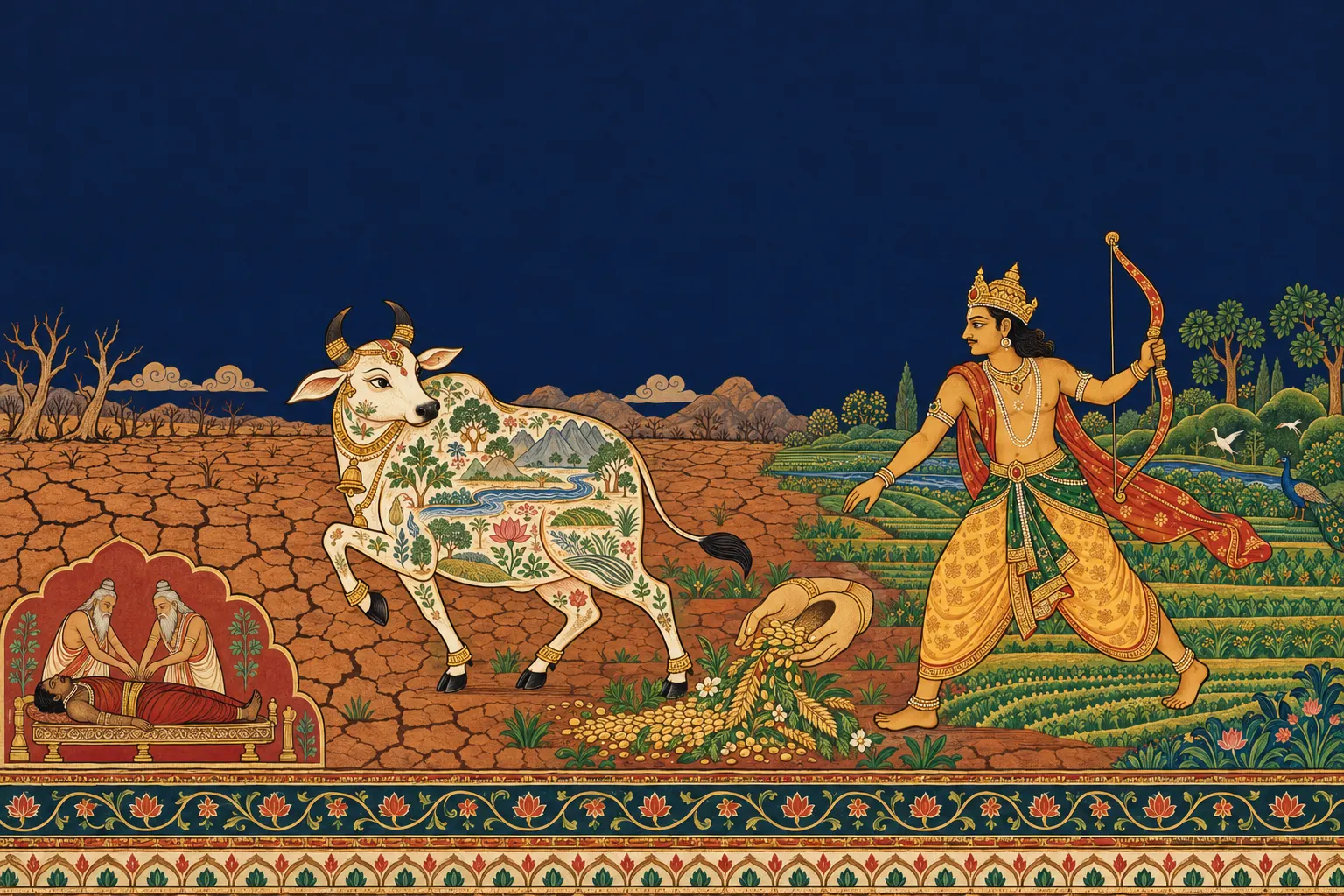
Prithu blamed the Earth. The Earth took the form of a cow and fled. Prithu chased her through the three worlds with his bow raised.
At last the Earth turned and spoke — "The seeds are shut inside me and spoiling. Give me a calf and a milker, and I will give everything back as milk."
Prithu made Svayambhuva Manu the calf and milked all the grains and herbs into his own cupped hands.
Then, one by one, all the others came. The sages made Brihaspati the calf and milked the Vedas. The gods made Indra the calf and milked strength and nectar. The Daityas and Danavas made Prahlada the calf and milked liquor. The Gandharvas milked music and beauty. The ancestors milked their own offering. Each kind, into its own vessel, what suited it.
Then Prithu levelled the earth with the tip of his bow — before this it was all ridges and hollows — so that villages could stand on it and crops could grow.
The text says the earth was called "Prithvi" for this reason — Prithu's.
The hundredth horse
Prithu resolved to perform a hundred horse sacrifices.
Ninety-nine were done. At the hundredth, Indra, out of envy, stole the horse — disguised as a false ascetic.
Prithu's son caught him and brought him back. The sages were about to curse Indra when Brahma came and stopped the sacrifice at ninety-nine and reconciled the two.
Later the four Kumaras taught Prithu detachment. In old age Prithu and Archi went to the forest. Archi gave up her life after her husband.
Note: Prithu's story is in the fourth canto of the Bhagavata Purana (chapters 13–23, mainly 14–18); the Vishnu Purana (1.13) carries its source-form, a little shorter, and the Atharvaveda calls "Prithi Vainya" the first to draw agriculture out of the earth — the oldest kernel. The episode of Nishada emerging from Vena's body is an etymology of a name; modern scholars read "such-and-such a people came to be this way" passages as later social justification written back into myth, and this site takes no position on it and does not repeat any list of peoples. In the milking list, the calves and vessels shift a little from recension to recension; the order here follows the Bhagavata (4.18). Indra stealing the hundredth horse, and Brahma stopping the sacrifice — the gods are not always right — is the Bhagavata's own note.
Source: from the Bhagavata Purana, Prithu — who milked the earth