
Chapter 8
Vamana and Bali — three paces
A dwarf brahmin asked for three paces of land, and there was nowhere left for the third pace but the king's own head
The king who was on top
Bali — grandson of Prahlada, son of Virochana — was king of the asuras.
After a defeat, Shukra and the Bhrigus revived him and gave him strength. He stormed heaven. Indra and the gods fled and hid.
Now Bali was master of the three worlds — and a good master. Generous, truthful, devoted to his guru, unbeaten in charity. The text does not call him wicked.
Aditi's vow
Aditi, mother of the gods, was in grief. Her husband Kashyapa taught her the payas-vow.
Pleased, Vishnu said — I will come as your son. Not by killing Bali — by a trick of measure.
Vamana
Vishnu was born to Aditi and Kashyapa as Vamana — a short brahmin boy, counted fifth in the familiar Dashavatara sequence.
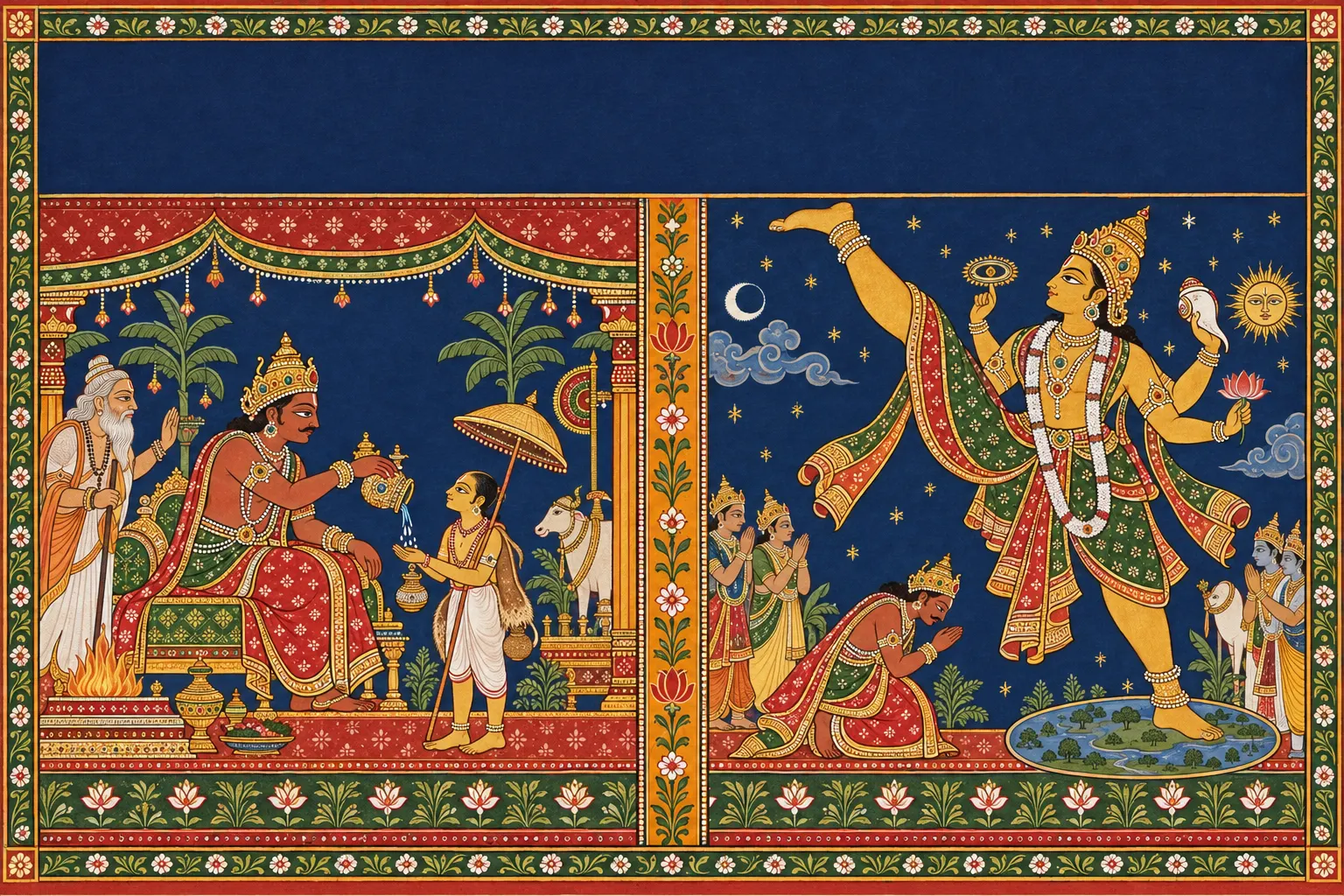
Carrying an umbrella, a staff, a deerskin and a water-pot, in the dress of a student, he came to Bali's horse-sacrifice at Bhrigukachchha — Bharuch — on the north bank of the Narmada.
Three paces
Bali said to the boy — ask for whatever you want. Land, gold, villages, cows.
Vamana asked for — "three paces of land, measured by my own feet." Nothing more.
Bali laughed that it was so little, and agreed.
Shukra saw through it. He forbade his own student — "This is Vishnu. You will lose everything. A promise got by deception need not be kept."
Bali refused his own guru.
"A thing promised — especially to a brahmin who asked, especially by one in Prahlada's line — is not taken back for advantage. And if it really is Vishnu come to take from me with his own hand, what could be better than that. Let him take it."
He poured the water of the gift over his hand.
Shukra cursed Bali for disobeying — that he would lose his wealth, which was about to happen anyway. Bali accepted that too.
(Some tellings add an episode here — Shukra shrank into the spout of the water-pot to stop the flow, and Vamana, clearing it with a blade of kusha grass, put out one of Shukra's eyes.)
Trivikrama
Vamana began to grow — into Trivikrama, immense.
One stride covered the whole earth. The second covered the sky and all the worlds above, rising beyond Brahma's Satyaloka — and there Brahma washed his raised foot, and from that water the Ganga came down.
There was no room left for the third.
Vamana asked Bali — "You said three. Where do I put the third?"
Bali offered his own head for the third step.
But the text does not narrate a third step landing on his head and pressing him under — before that, Garuda binds Bali with Varuna's ropes, and Brahma, Prahlada and Bali's wife Vindhyavali intercede.
Not a punishment, a reward
The Lord released Bali, blessed him by placing his foot on Bali's head, and gave him Sutala — a world more pleasant than heaven, free of anxiety and disease — to rule. He promised he would himself stand guard at Bali's door. And he said Bali would be the Indra of the next, eighth (Savarni) age.
Prahlada and the elders agreed.
This was not a villain's defeat — it was a test of a devotee's surrender, which Bali passed.
Note: The Vamana–Bali story is in the eighth canto of the Bhagavata Purana (chapters 15–23, mainly 18–22). The oldest form of the three strides is Vedic — in the Rigveda (1.154), Vishnu's three steps, with no Bali anywhere; Vishnu simply measures the worlds. The Shatapatha Brahmana adds a dwarf and the asuras conceding "as much as he can lie on." The Ramayana, the Mahabharata and several Puranas carry it, and of all of them the Bhagavata's version is the most generous to Bali. In Kerala this same story is Onam: Mahabali a golden-age king under whom all were equal, sent below "by a trick" by a brahmin Vamana, allowed to visit his people once a year. There is genuine disagreement about how to read Vamana's act, and this site does not adjudicate it — but the story is incomplete without naming Onam and the memory of Mahabali as a just king.
Source: from the Bhagavata Purana, Vamana and Bali — three paces