
Chapter 6
Chamunda
Kali Becomes Chamunda
The ashes of Dhumralochana
Dhumralochana arrived with an army of sixty thousand asuras.
Dhumralochana threatened to drag her away by the hair. Kaushiki replied that if he believed he could take her by force, there was little she could say to stop him. Then he charged.
Kaushiki uttered a single sound — "hum" — and Dhumralochana was reduced to ash where he stood. Then her lion cut through the rest of the army.
Chanda and Munda
Shumbha now sent Chanda and Munda with a large army.
They reached the Himalayas and found Kaushiki seated alone upon her lion, smiling.
They attacked.
Kali from the brow
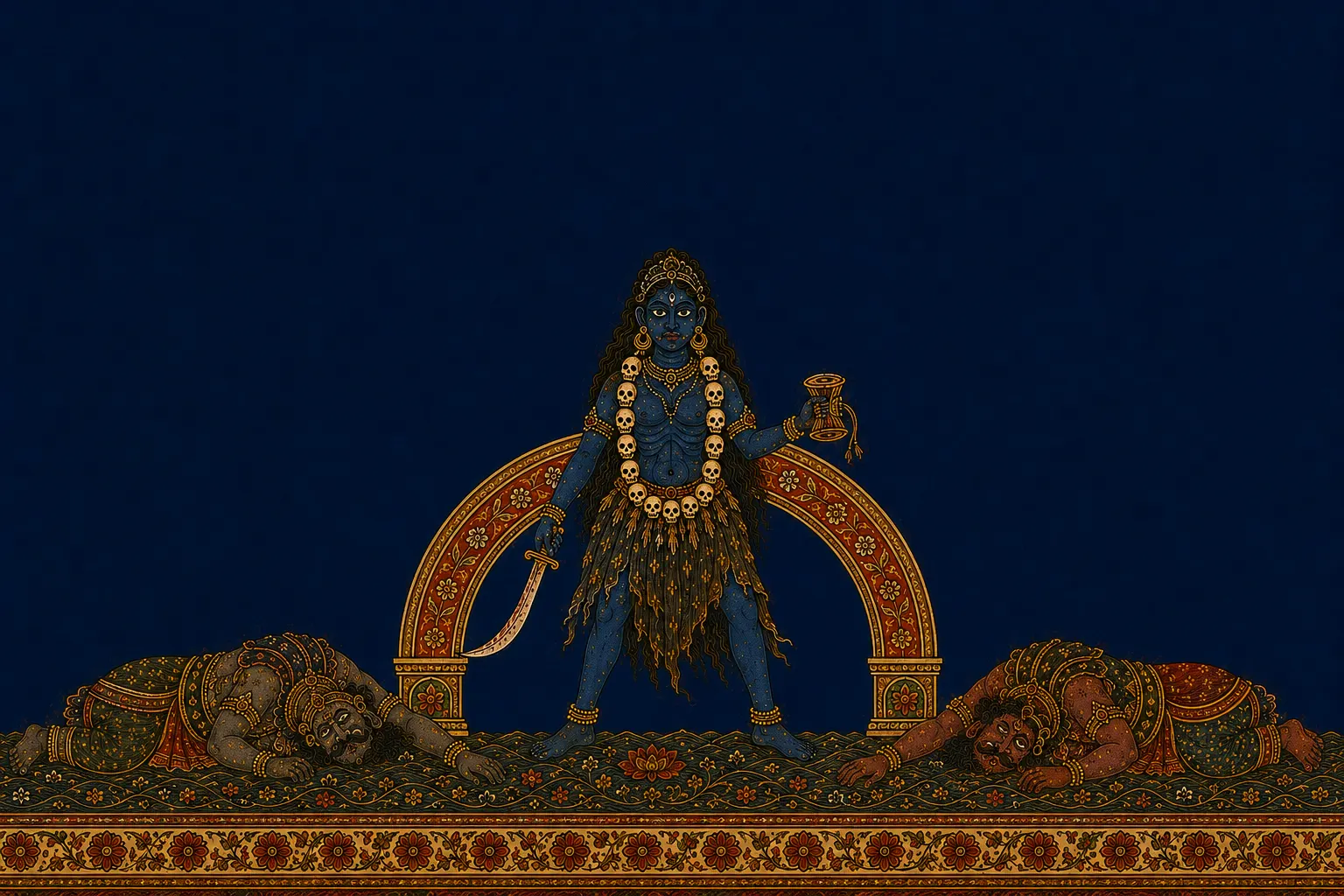
Kaushiki's face darkened with rage. From her furrowed brow burst a terrifying goddess.
She was gaunt, clad in an animal skin, with a garland of severed heads at her throat and a *khatvanga* in her hand. Her mouth gaped open and her tongue hung out.
She gave a roar that shook the sky.
Kali tears through the army
Kali hurled herself into the asura army.
She seized elephants, chariots, horses and riders alike, crushing them between her jaws. She struck down the great warriors with her *khatvanga* and tore through the rest of the army.
Chanda and Munda watched as their forces collapsed before her.
Two heads
Chanda stepped forward. Kali caught him by the hair and cut off his head with her sword.
Munda ran. His head fell the same way.
Kali carried both heads to Kaushiki. "Here are Chanda and Munda — two great beasts, my offering. Now kill Shumbha and Nishumbha yourself."
The name Chamunda
Kaushiki was pleased.
"You have brought me Chanda and Munda," she said. "So in the world your name will be Chamunda."
Their two names, Chanda and Munda, were joined in hers: Chamunda.
Note: This episode is in the seventh chapter of the Devi Mahatmya. The name Chamunda comes from there — Chanda plus Munda. Here Kali is a fierce power that emerges from the wrath of Kaushiki, also called Ambika; after killing Chanda and Munda she is given the name Chamunda. In the later Tantric traditions this same form — thin, bony, tied to the cremation ground — develops its own independent and very extensive worship.
Source: from several texts, Chamunda