Chapter 10

The Ten Mahavidyas

Sati's Ten Forms

Shiva refuses

Sati wanted to attend her father Daksha's sacrifice. Shiva refused, warning that she would be insulted there.

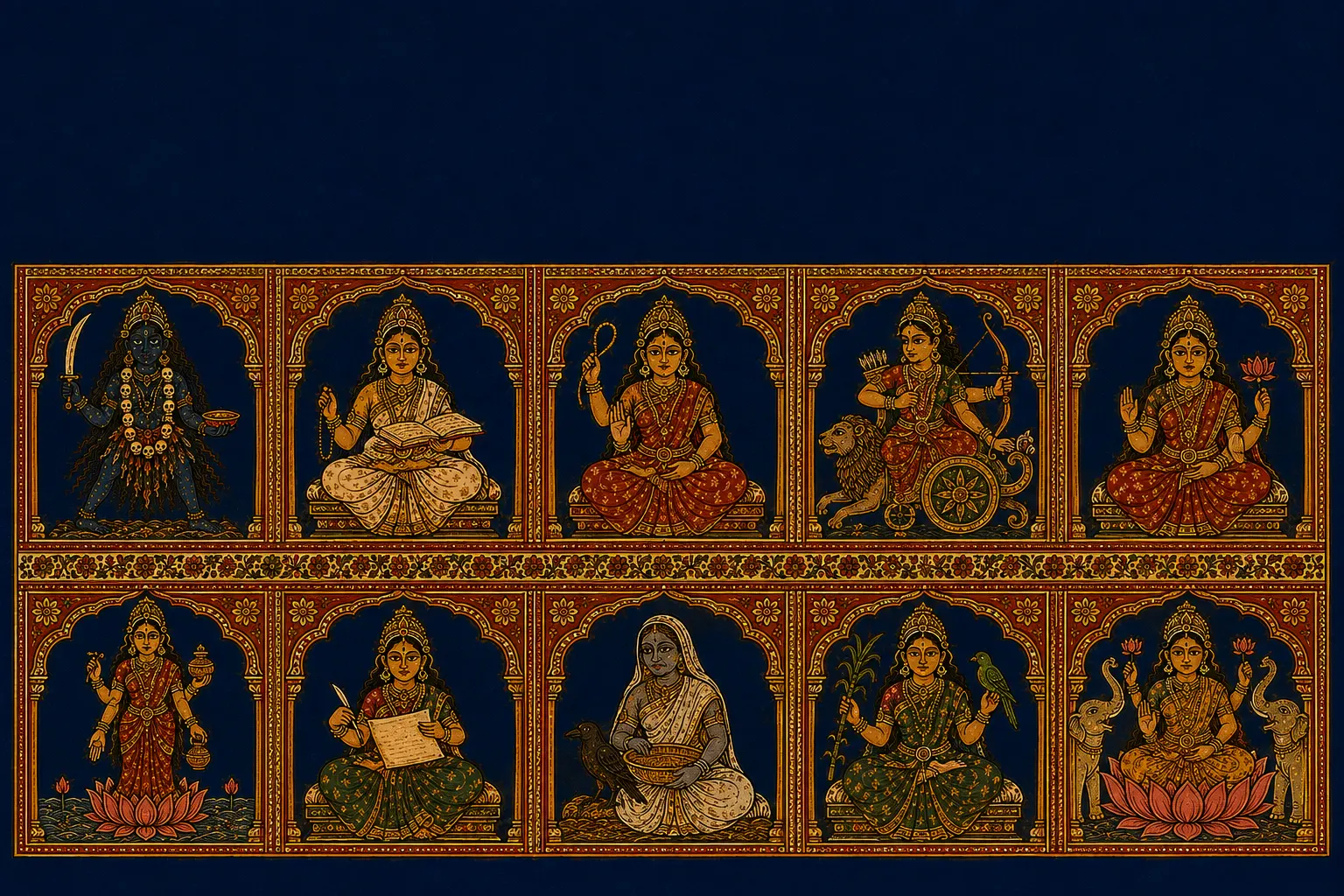
Sati grew angry. Her form began to change, and ten goddesses appeared around her, one by one: black, blue, aged, beautiful, terrifying — one even carried her own severed head.

Ten forms, ten directions

Shiva, alarmed, tried to leave.

But whichever way he turned, one of the ten stood there — east, west, north, south, above, below, in every corner.

"Who are these?" Shiva asked.

Sati's answer

"These are all me," Sati said. "My ten forms. You stopped me, so I have shown you what I am."

Shiva let her go.

What happened next — Daksha's insult and Sati's death — is told in *Shiv-Mahima*. In this telling, Sati does not wait for permission.

The first four

The ten are called the Mahavidyas — the "great wisdoms." They are more than ten characters in a single story: each developed her own practices, symbols and philosophy.

The first two are the fiercest: Kali, goddess of time, death and liberation; and Tara, a fierce saviour whose name evokes carrying devotees across danger. Tara's name and form appear in both Hindu and Buddhist Tantric traditions, though the traditions are distinct.

The third is Shodashi, also called Tripurasundari — the beautiful goddess associated with the perfection of sixteen and closely identified with Lalita in the Shrividya tradition (Chapter 11).

Chhinnamasta offers the most startling image. She holds her own severed head while three streams of blood rise from her neck; she drinks one, and her two attendants drink the others.

The other six

Several of the other six are less familiar in mainstream temple worship.

Bhuvaneshvari calmly contains the whole universe within her body. Bhairavi embodies fierce power, austerity and the transcendence of fear. Dhumavati is a smoke-coloured widow, goddess of absence, who rides a chariot bearing a crow emblem.

Bagalamukhi is clothed in yellow and stills an enemy's speech and movement. Matangi overturns social boundaries and ideas of impurity, and is associated with outcastes and leftover food. Kamala, closely linked to Lakshmi, embodies the lotus and abundance.

Traditions of practice

The main scriptural framework of the Mahavidyas is tied to Tantric practice, though several of these goddesses also have wide, independent devotional worship.

Different traditions developed their own mantras, yantras and rites for these goddesses. Some practices seek knowledge or liberation; others seek eloquence, protection or the stilling of an enemy. They cannot be reduced to a single form of worship.

The Mahavidyas are ten forms of the Goddess that do not let divine femininity be confined to beauty and mildness alone. There is room in them for fierceness, for absence, for death, and for what has been held to lie outside social boundaries.

Note: The story of Sati taking ten Mahavidya forms and surrounding Shiva on all sides is found in later Shakta Upapuranas such as the Mahabhagavata Purana and the Brihaddharma Purana. The list of the Mahavidyas and their practice develop further across many Tantric texts. Dhumavati — the goddess with no husband — is an unusual form that steps outside the conventional pattern of female divinity.

Source: from several texts, The Ten Mahavidyas

Now — how much stayed with you?

What happened?

What did Sati do when Shiva forbade her to go to Daksha's sacrifice?

  • She wept until Shiva relented
  • She set ten terrifying goddesses around her, one in every direction, so that Shiva could not leave
  • She slipped out of the house quietly
  • She cursed Shiva
Read the whole story — She did not ask permission, she took it

This is the same story as chapter 2 of Shiv-Mahima — but there it was from Shiva's side: he forbade her, and she went anyway.

Here we see it from Sati's side: she made her own way out by showing her power.

That is the method of Devi-Charit — the stories that stand in Shiv-Mahima from a god's point of view stand here from the Goddess's. Same event, different angle.

Who said it?

"All of them are me. My ten forms." — who said this, and to whom?

  • Kali, to Tara
  • Parvati, to Shiva
  • The gods, to Shiva
  • Sati, to Shiva
Read the whole story — An answer like chapter 8's

It is the same declaration the Goddess made to Shumbha in chapter 8 — "I am alone, all these are my forms" — only running the other way.

In chapter 8 she was going from many to one, gathering the Mothers in. Here Sati is going from one to many, setting ten forms up.

Both times the point is the same: being one and being many are both her choice, and she does it to show somebody.

Who am I?

I am one of the ten Mahavidyas. I have cut off my own head. Three streams of blood run from my severed neck — two into the mouths of my two companions, and one into the mouth of my own severed head. Who am I?

  • Chhinnamasta
  • Dhumavati
  • Bagalamukhi
  • Tara
Read the whole story — Made of herself, standing on herself

Chhinnamasta is the hardest image among the Mahavidyas: life, as blood, flowing out of its own source to feed itself.

The tantric reading: creation runs itself on itself — the giver, the receiver and the food are all one thing.

She connects to the Lalita of chapter 11 too: Chhinnamasta is a practice-goddess of the Shrividya tradition, and her meditation is held to be for the most advanced.

Why is that?

Why did Sati show Shiva the ten forms — only to frighten him?

  • Yes, only to frighten Shiva
  • Because Daksha had told her to
  • To show that she is far more than Shiva's wife
  • Because Shiva had asked her to
Read the whole story — Far more than a wife

This is the real turn of the story: Sati does not ask permission like a wife. She changes what she is — from Sati into the company of the Mahavidyas.

Shiva letting her go is not a defeat but a recognition — that his wife is also somebody else.

It is the most domestic form of the spine of Devi-Charit: the Goddess cannot be stopped, not even inside her own house.

Fact

Which of the ten Mahavidyas is in fact Lakshmi?

  • Tripura Sundari
  • Kamala
  • Bhuvaneshvari
  • Matangi
Read the whole story — Lakshmi as a goddess of practice

It startles: the Lakshmi we take for the goddess of the household, of good fortune and wealth, is also on this fierce tantric list, under the name Kamala.

What it means is that in the Shakta tradition Lakshmi is not merely "Vishnu's wife" — she is an independent power, and one of her forms belongs to tantric practice.

It sets up chapter 13 directly: "Lakshmi and Saraswati — who are not wives".

Riddle

I am held the most inauspicious of the ten Mahavidyas. I am a widow, smoke-coloured, and I ride a crow. I am the goddess of what is not there — lack, hunger, despair. And still I am a form of the Mahadevi. Who am I?

  • Kamala
  • Tripura Sundari
  • Bhuvaneshvari
  • Dhumavati
Read the whole story — The goddess who is absence

Dhumavati is the boldest idea among the Mahavidyas: the Mahadevi is not only life, wealth and beauty — she is widowhood too, and hunger, and loneliness.

Every other goddess has a god beside her, a Bhairava; Dhumavati alone has none — she has no companion, because she is absence itself.

It is the hardest form of the spine of Devi-Charit: if the Goddess is everything, then she is also the goddess of the things we avoid.

Put it in order

Which is the correct order of events?

  • Shiva forbids Sati to go to the sacrifice → Sati's anger and the appearance of the ten forms → one in every direction, so Shiva cannot leave → Shiva asks "who are these?" → Sati says "all of them are me" → Shiva lets her go → (after this: Daksha's insult and Sati giving up her body
  • The ten forms appear → Shiva forbids her → Sati's anger → he lets her go
  • Sati gives up her body → the ten forms → Shiva forbids her → he lets her go
  • Shiva asks "who are these?" → the ten forms → Sati's anger → Shiva forbids her
Read the whole story — From a prohibition to a set of forms

The shape of this chapter runs from a domestic quarrel to a cosmic declaration: from "let me go" to "I am ten forms".

The turn in the middle is Shiva's alarm — where this stops being a matter between husband and wife and becomes one between a god and the Mahadevi.

The chapter deliberately stops where Shiv-Mahima's story begins — because what follows, Daksha and the giving up of the body, is already told there.

The texts disagree

Is the group of ten Mahavidyas in the Devi Mahatmya, and where does it come from?

  • Yes, the full list is in the Devi Mahatmya's eleventh chapter
  • It is in the Rig Veda
  • The group is not in the Devi Mahatmya; the settled list of ten Mahavidyas is found in later tantric texts and in the Mahabhagavata Purana and the Brihaddharma Purana, around the tenth century and after
  • It is only a Nepali tradition, not an Indian one
Read the whole story — A layer that comes after the Devi Mahatmya

Chapters 2 to 8 of Devi-Charit are the Devi Mahatmya's story. Chapters 9 and 10 step outside it.

The Mahavidyas are a tantric idea: ten particular practice-goddesses of the Mahadevi, each for one specific vidya, an attainment or a knowledge.

The birth story of Sati's ten forms is later too — from the Mahabhagavata Purana, which gives a Shakta colouring not to the Mahisha story but to the story of Daksha's sacrifice.

Who am I?

Among the Mahavidyas, leftover or "polluted" food is offered to me. I am deliberately a goddess outside the order, one who refuses the line between pure and impure. And still I am a form of the Mahadevi. Who am I?

  • Chhinnamasta
  • Matangi
  • Kamala
  • Bagalamukhi
Read the whole story — A goddess who refuses "impure"

Matangi is a bold claim of the Shakta tradition: if the Goddess is everything, then the leftover and the impure are hers too, and she can be worshipped with exactly that.

Matangi is often associated with Chandali, or with communities on the margin — she is the goddess of the people the order keeps outside.

It agrees with the spine of Devi-Charit: as Kaushiki is nobody's wife and Shivaduti's messenger is Shiva, so Matangi stands outside the rule of purity. The order does not bind the Goddess.

Later tradition

Which two Mahavidyas are most independently worshipped, and where?

  • Dhumavati and Bagalamukhi, in South India
  • Kamala and Matangi, in every household
  • Matangi and Chhinnamasta, in Gujarat
  • Kali, in Bengal at Kalighat and Dakshineswar, and Tara, at Bengal's Tarapith
Read the whole story — Of the group, and also great alone

Kali and Tara are the only Mahavidyas with vast independent devotional traditions of their own — the other eight are mainly goddesses of practice.

In Bengal, Kali is a household goddess; Tarapith is Tara's greatest site, and the stories of practitioners like Ramakrishna and Bamakhepa are attached to it.

So one group holds some goddesses belonging to millions and others to a handful of practitioners — and the tradition treats both as forms of the Mahadevi.