
Chapter 15
The Devi Gita — the last I
From battle to teaching
Another call
Tarakasura had conquered the gods. A boon protected him from everyone except a son of Shiva, but after Sati's death Shiva had withdrawn from the world. The gods could see no way for such a son to be born.
Once again, the gods turned to the Goddess. The pattern has recurred since Chapter 3: when danger overwhelms them, they call on her. This time, however, the story takes a different turn.
Bhuvaneshvari
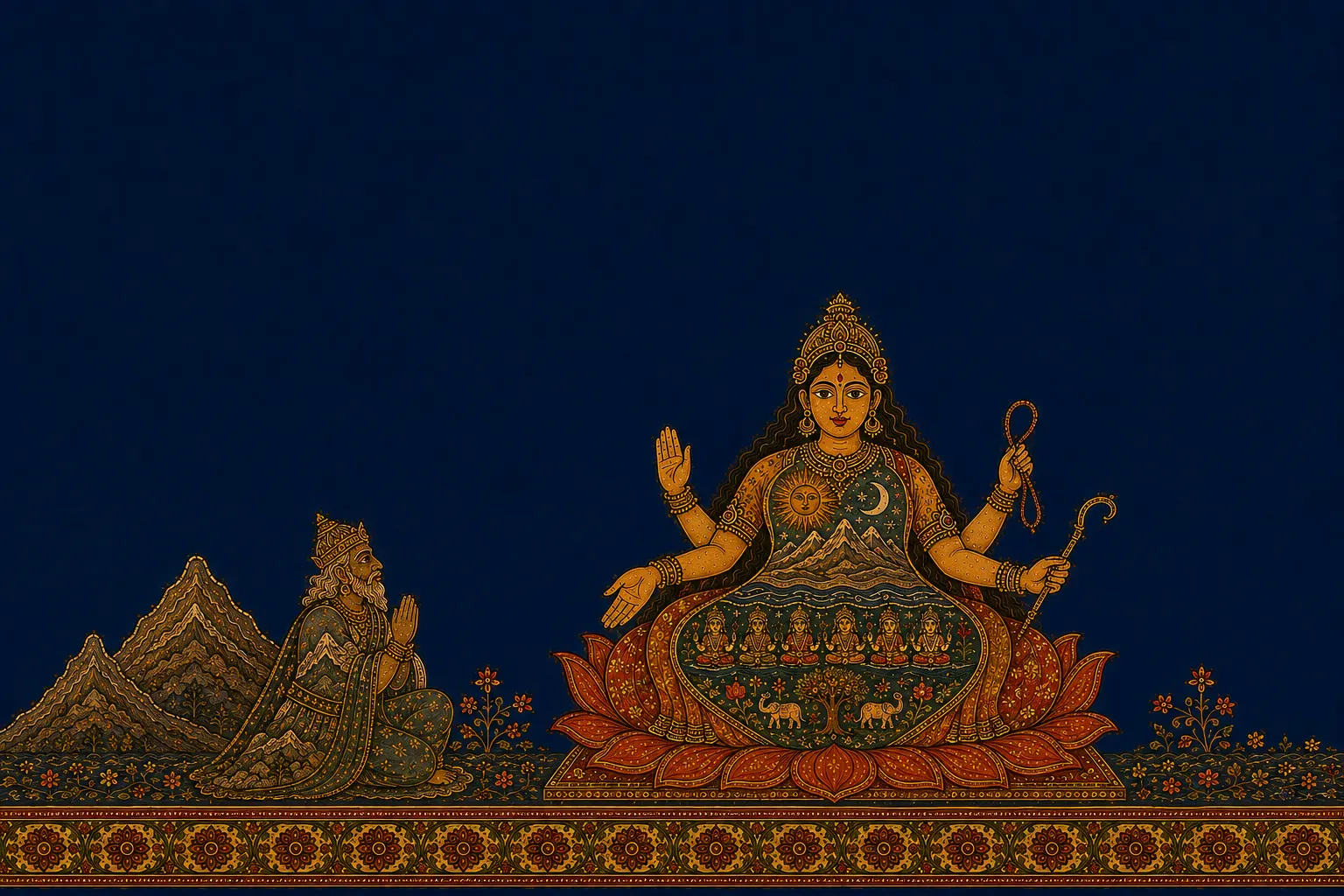
The Goddess came — not with a trident in her hand, not with her foot on Mahisha's head.
She came as Bhuvaneshvari — "mistress of the worlds." Calm, four-armed, granting boons.
Himavan, king of the mountains, stood before her. He did not ask for victory in war. Instead he asked, "Who are you? What is this universe? How can liberation be attained?"
The cosmic form
The Goddess first described her true nature. She said that before creation only she existed and that maya is her own power. Then, at Himavan's request, she showed her cosmic form.
In her body were all the worlds — the sun, the moon, the oceans, the mountains, all the gods. Those watching trembled and began to pray that she withdraw the form.
The scene strongly echoes the cosmic-form passage of the Bhagavad Gita, where Krishna reveals the *vishvarupa* to Arjuna. Modern scholars often note these structural echoes between the two works. Here, however, it is the Goddess who reveals the universe within herself.
The teaching
The Goddess withdrew the cosmic form and continued her teaching.
"Before creation, I alone was." The declaration recalls Vak in Chapter 1 and the "ekaivaham" of Chapter 8, but here the same idea becomes an extended philosophical teaching.
The Goddess says that the visible world appears through her maya and that her true nature is Brahman. She then describes knowledge, yoga and devotion at length. Under yoga come the channels, the chakras, mantra and the practice of kundalini. Devotion she calls an especially accessible path.
From a Shakta perspective, the central point is clear: the Goddess defines herself not through her relationship to another god, but through her own nature as Brahman.
The Goddess's sacred geography
Then the Goddess herself names her sacred sites, her vows, her forms of worship.
Several of the places in this list match the later Shakti Pitha and Goddess-tirtha traditions, though the two lists are not fully the same. Here the sacred geography is built not from a single origin-story but from the places the Goddess herself names as dear to her.
The last "I"
Before the teaching began, the Goddess had told Himavan and the gods that her power would be born in his house as Gauri, marry Shiva and bear the son destined to kill Tarakasura. Once the teaching is complete, the Goddess vanishes and is later born as Gauri.
Parvati's story will go on to Shiva. But in the Devi Gita, the Goddess speaks of herself as the reality that precedes Shiva, Vishnu, Brahma and the world itself.
In the Devi Mahatmya, the combined radiance of the gods brings forth her warrior form. The Devi Gita reverses that perspective: here the gods do not create her. The supreme Goddess is the ground from which both they and the world arise.
And the book comes full circle. In Chapter 1, Vak spoke in the first person: "I." In the final chapter, the Goddess does the same.
Note: The Devi Gita is in the seventh skandha of the Devi Bhagavata Purana (chapters 31–40). It is a much later text than the Devi Mahatmya. Its structure shows clear resemblances to the Bhagavad Gita — the cosmic form, the question-and-answer, the teaching of knowledge and devotion. Alongside this it has a full Shakta character: yoga, mantra, kundalini, and the Goddess's own vows, tirthas and forms of worship. The promise of Gauri's birth to Himavan is given before the philosophical teaching; the Goddess vanishes after the teaching and is then born in Himavan's house. Not all Vaishnava and Shaiva traditions accept the claim of a "supreme Goddess" in this form; different sects understand the supreme reality differently. This collection does not deliver a verdict for any one side.
Source: from several texts, The Devi Gita — the last I