Chapter 3

Durga — The Goddess Born from Defeat

Born from the gods' light

Mahishasura

Mahishasura was king of the asuras. He could assume the form of a great buffalo and change shape at will.

The Devi Mahatmya says nothing here about his birth or a boon. Its account begins with his war against the gods.

A hundred years of war

The war lasted a hundred years.

In the end Mahisha won. He took Indra's throne and made himself lord of the three worlds.

The gods were driven out of heaven and wandered the earth like ordinary men.

The defeated gods appeal

The defeated gods went to Vishnu and Shiva and told them what had happened. Mahisha had seized the functions of the sun, the moon, the wind and even death itself, while the gods had been driven from their own heaven.

As they listened, Vishnu and Shiva grew angry. Blazing energy poured from their faces.

The same fire poured from the bodies of the other gods as well.

The mountain of light

The flames converged into a blazing mass like a mountain, illuminating all three worlds.

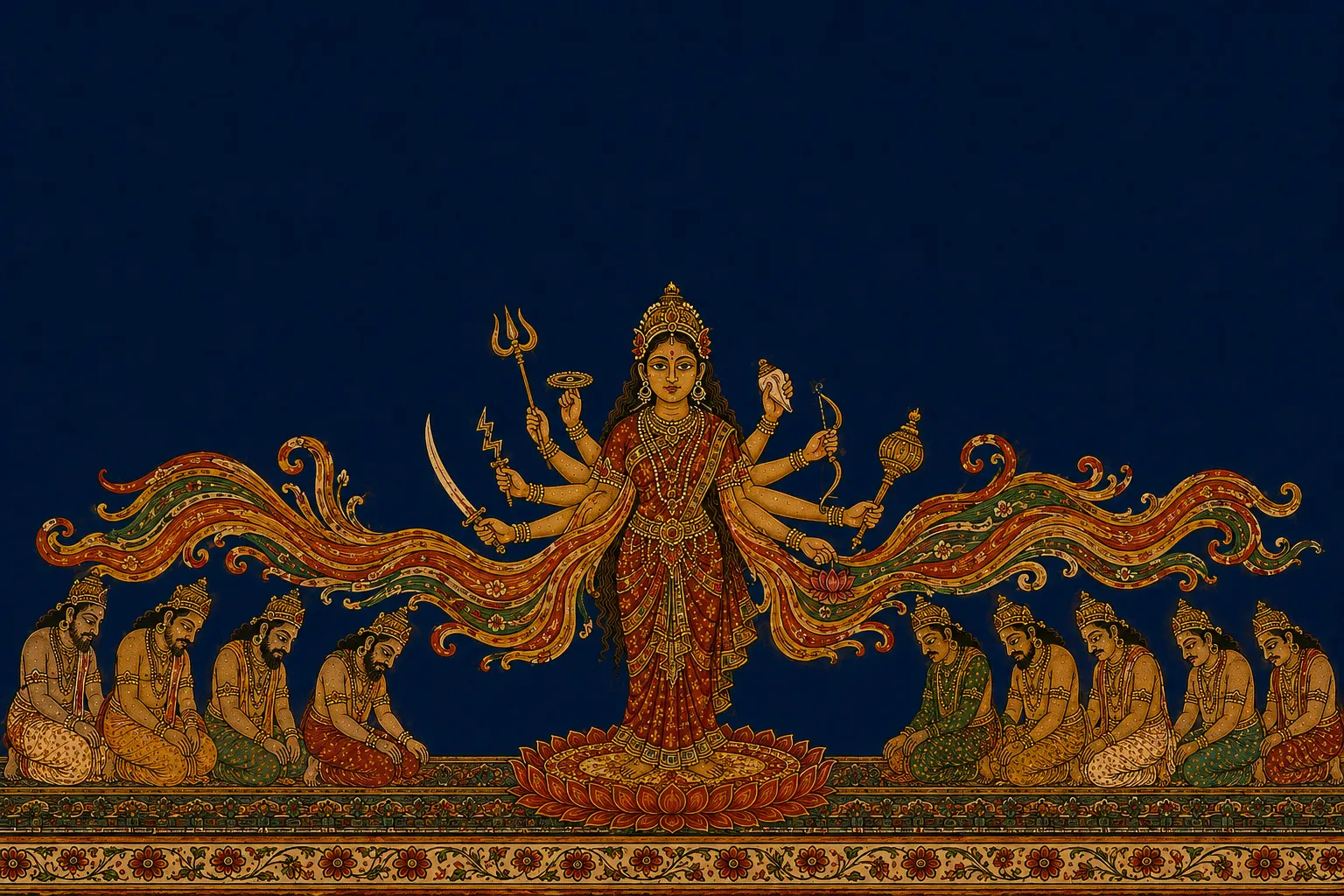
Then the light coalesced into the form of a woman, three-eyed and many-armed.

The Devi Mahatmya does not call her by one name — Chandika, Ambika, Durga, Katyayani are all names for her.

One limb from each god

Each of her limbs was made from the light of a different god.

From Shiva's light came a face; from Vishnu's, arms; from the moon, breasts; from Indra, a waist; from Varuna, thighs; from the earth, hips; from Brahma, feet; from the Vasus, hands and fingers; from Agni, three eyes; from the wind, ears. The sun filled the pores of her skin with his rays.

She was neither the daughter nor the consort of any one god. She had arisen from their combined radiance, yet she belonged to none of them.

One weapon from each god

Then each god placed in her hands a counterpart of his own weapon.

Shiva gave her a trident; Vishnu, a discus; Varuna, a conch; Agni, a spear; Vayu, a bow and arrows; Indra, a thunderbolt and a bell; Yama, a staff; Brahma, a water-pot and rosary; and Kala, a sword and shield. Kubera offered a cup that was always full of wine. The ocean gave her an unfading garland, and Himavan gave her a lion to ride.

The Goddess let out a thunderous laugh. The three worlds shook. The oceans heaved, and the mountains swayed.

Mahisha heard the sound. "What is this?" he demanded, and advanced with his army.

Note: The fullest telling of this form of Durga is in the Devi Mahatmya (Markandeya Purana, middle carita). The scene of the Goddess made from light is in that text, and so is the list of which god's radiance became which limb. Mahisha's boon — that no man or god could kill him, with "woman" left off the list — is not in this carita of the Devi Mahatmya; it appears in other Puranic traditions (some of which make him the son of the asura Rambha and a buffalo cow). The Devi Mahatmya begins straight from the hundred-year war and the gods' defeat. Kubera's cup of wine is in the original text, and it connects to the wine in Chapter 4.

Source: from several texts, Durga — The Goddess Born from Defeat

Now — how much stayed with you?

Whose son?

Whose son was Mahishasura, and what was his form?

  • The son of the asura Rambha and a she-buffalo
  • The son of Hiranyakashipu
  • The son of Tarakasura
  • Ravana's brother
Read the whole story — Half asura, half buffalo

"Mahisha" simply means buffalo. In the story he takes buffalo shape when he likes, and something like human shape when he likes.

That form is also his best weapon in a fight — heavy, horned, ground-shaking. In the next chapter the Goddess has to beat him through exactly these changes of shape.

His mother being a buffalo is not incidental — it stands for the brute strength that has to lose to intelligence and restraint.

Why is that?

Why did Mahisha's boon fail to save him?

  • Because Brahma cheated in the wording
  • Because Vishnu broke the boon
  • Because the boon had a time limit that ran out
  • Because he asked only about "man or god"
Read the whole story — An oversight that became a crack

The pattern recurs through Devi-Charit, as it did through Shiv-Mahima: every boon is left with a crack in it somewhere.

Mahisha's crack is his own prejudice — he never counted a woman at all. Which left the gods one road: make a power that is neither man nor god.

It is the first solid form of this gatha's spine: the gods lost one by one, so together they made the thing that none of them was.

Who said it?

Whom did the gods tell the story of their defeat to?

  • To Brahma alone
  • To Vishnu and Shiva
  • To Indra
  • To the Goddess
Read the whole story — A complaint that became a goddess

In the Devi Mahatmya the Goddess does not arrive out of austerity or worship — she arrives out of the gods' anger. And that anger rises from hearing an account of a defeat.

So the Goddess is born from a report of a loss. The bigger the defeat, the bigger the fire.

It repeats in every large chapter after this — at Shumbha and Nishumbha too, the gods lose first and call on her after.

What happened?

In what form did the gods' anger gather?

  • Each god cut off a portion of himself and dropped it into a pit
  • All the gods marched off together to fight Mahisha
  • Brahma performed a sacrifice and the Goddess appeared from it
  • Fire came from every god's mouth and body, all of it joined into a burning mountain, and that mountain drew itself in and took the form of a woman
Read the whole story — A mountain of fire

This scene in the Devi Mahatmya is the most famous account of the Goddess's origin: no womb, no parents — only light, growing to the size of a mountain and then becoming a body.

Each god's fire carries his own nature — Vishnu's, Shiva's, the sun's — and all of it meeting in one place makes something new, belonging to none of them.

Which is why she cannot be called anybody's daughter. She is the sum of many defeats.

Who am I?

The Himalaya gave me to the Goddess. I became her mount, and in every image since I stand at her feet or below them — trampling Mahisha. Who am I?

  • The lion
  • Airavata, Indra's elephant
  • Nandi, Shiva's bull
  • Garuda
Read the whole story — The mountain's gift

Every god gave a weapon; the Himalaya gave a mount — a lion. In some versions the gift is Vishnu's rather than the mountain's.

The lion stays with her through every battle and tears at the asuras himself — he is not a ride, he is a fighter.

The Mahishasura-mardini image always has three things: the Goddess, the buffalo, and the lion. All three are joined in this chapter.

Fact

What did each god give the Goddess?

  • Only blessings, no objects
  • Together they made one single trident
  • A copy of his own weapon
  • Only Vishnu and Shiva gave weapons; the others gave nothing
Read the whole story — Many hands, many weapons

This is what her many arms mean: a different god's weapon in each. What they could not do one at a time, their weapons can do together in one body.

It is the Devi Sukta's line (chapter 1) made visible — "I draw the bow for Rudra". Here every god's bow, discus and thunderbolt is in her hands.

Worth noticing: the weapons are the gods', but the strength to wield them all at once, on one target, is hers. The power was scattered; she is what joined it.

Riddle

I am neither a man nor a god, so one particular boon has no hold on me. Every limb of me was made from some god's anger, and in every hand of mine is somebody else's weapon. I am no one's daughter and no one's wife. Who am I?

  • Parvati
  • Durga (Chandika, Ambika)
  • Lakshmi
  • Sita
Read the whole story — Made out of a defeat, belonging to nobody

Every part of this riddle is the spine of Devi-Charit: neither man nor god (the crack in the boon), every limb from the gods' anger (the birth), another's weapon in every hand (power pooled), nobody's daughter or wife (the independence).

The Devi Mahatmya calls her by many names — Chandika, Ambika, Durga, Katyayani — all meaning one thing: the power that arrives once the gods have already lost.

And she does not go back. Even after Mahisha she does not dissolve into the gods — she goes to live on the Vindhya mountain, under her own name.

Put it in order

Which is the correct order of events?

  • The gods' fire → Mahisha's boon → the hundred-year war → the Goddess is born
  • The Goddess is born → Mahisha's boon → the gods' defeat → the mountain of fire
  • Mahisha's boon → the Goddess is born → the hundred-year war → the gods' complaint
  • Mahisha's austerity and his boon against death by man or god → a hundred-year war with the gods and Mahisha's victory → the gods made homeless out of heaven → the complaint to Vishnu and Shiva → all their fire becoming a burning mountain → the mountain taking a woman's form → every god's weapon and the Himalaya's lion → the Goddess's roar of laughter
Read the whole story — From a defeat to a birth

The shape of this chapter is straight: a clever boon, a long defeat, and then a new form rising out of that defeat.

The turn in the middle is the complaint. That is where the story swings from "the gods against Mahisha" to the origin of the Goddess.

The chapter deliberately ends on the laugh, not on a battle — the battle is the next chapter, and the laugh is the moment Mahisha learns his boon is no longer enough.

The texts disagree

Which texts carry the killing of Mahisha, and how common is the Devi Mahatmya's "born from the gods' fire" account?

  • The story is only in the Devi Mahatmya and nowhere else
  • The story is in several puranas; the Devi Mahatmya's "made from every god's fire" is its most famous form, but in texts like the Devi Bhagavata the Goddess is already the Adi Shakti and the fire account is only a figure
  • In every text the Goddess is made from the gods' fire
  • In every text it is Vishnu who kills Mahisha, not the Goddess
Read the whole story — One birth, two readings

In the Devi Mahatmya her birth is an event — the gods lose, they rage, and out of that the Goddess is made.

In Shakta-centred texts like the Devi Bhagavata she is beginningless; the fire account is there to show that the gods are portions of her, not she of them.

The difference is fine but large: in one the Goddess is made from the gods, in the other the gods from the Goddess. Devi-Charit records both.

Later tradition

Which of today's great festivals is the killing of Mahisha tied to?

  • Diwali
  • Holi
  • Durga Puja and Navaratri
  • Makar Sankranti
Read the whole story — Nine nights, one victory

The nine nights of the autumn Navaratri are held to belong to nine different forms of the Goddess, and the tenth day — Vijayadashami, or Dussehra — to her victory over Mahishasura.

In Bengal's Durga Puja those are the days when the great images are made — always with the trident going into the buffalo, always with the lion.

So the origin story in this chapter is re-enacted once a year across the subcontinent — in clay, and then in the immersion, when the clay goes back into the water.