Chapter 14

Manasa, Shitala, Shashthi

Three Goddesses of Folk Tradition

Between text and folk

Most of the goddesses discussed so far come from major Sanskrit works — the Devi Mahatmya, the Puranas and the Tantras.

The stories of many goddesses worshipped in everyday life, however, are not defined by Sanskrit texts alone. They also live in regional languages, songs, votive tales and household rites. Later works placed them within broader Puranic frameworks, but their worship remains far more varied than any one text suggests.

Manasa, Shitala and Shashthi belong to this world. Their worship grows out of immediate fears and hopes: a snakebite, a fever, the fragile breath of a newborn.

Manasa and Chand Sadagar

Manasa is worshipped as a snake goddess, especially in Bengal, Assam and Bihar. There is no single account of her origin: some traditions call her a daughter of the sage Kashyapa, others connect her birth with Shiva, and still others describe her as a serpent goddess.

In the Bengali *Manasa-mangal* poems, the struggle for recognition lies at the centre of Manasa's story. Shiva's wife Chandi refuses to accept her into the household, while Chand Sadagar, a devoted worshipper of Shiva, refuses to worship her. Manasa answers his defiance with severe punishment.

Chand Sadagar is a great merchant and a devotee of Shiva. Manasa destroys his trade and causes the deaths of his sons. The details of events and the number of sons vary across the different Manasa-mangal compositions.

Behula

The youngest son, Lakhindar, was married to Behula. Chand built an iron wedding chamber to protect him, but the snake found its way in, and Lakhindar died on his wedding night.

Behula refused to let his body be cremated. She placed it on a raft of banana stems and began a long journey.

At last Behula reached the realm of the gods and danced before them. She asked for Lakhindar's life and her family's lost fortune to be restored. In return, Chand Sadagar had to accept the worship of Manasa. In many popular versions, he finally makes an offering with his left hand or with his face turned away. Lakhindar returns to life.

Shitala — goddess of smallpox

Shitala's name means "the cool one" — and she is a goddess of smallpox and fever.

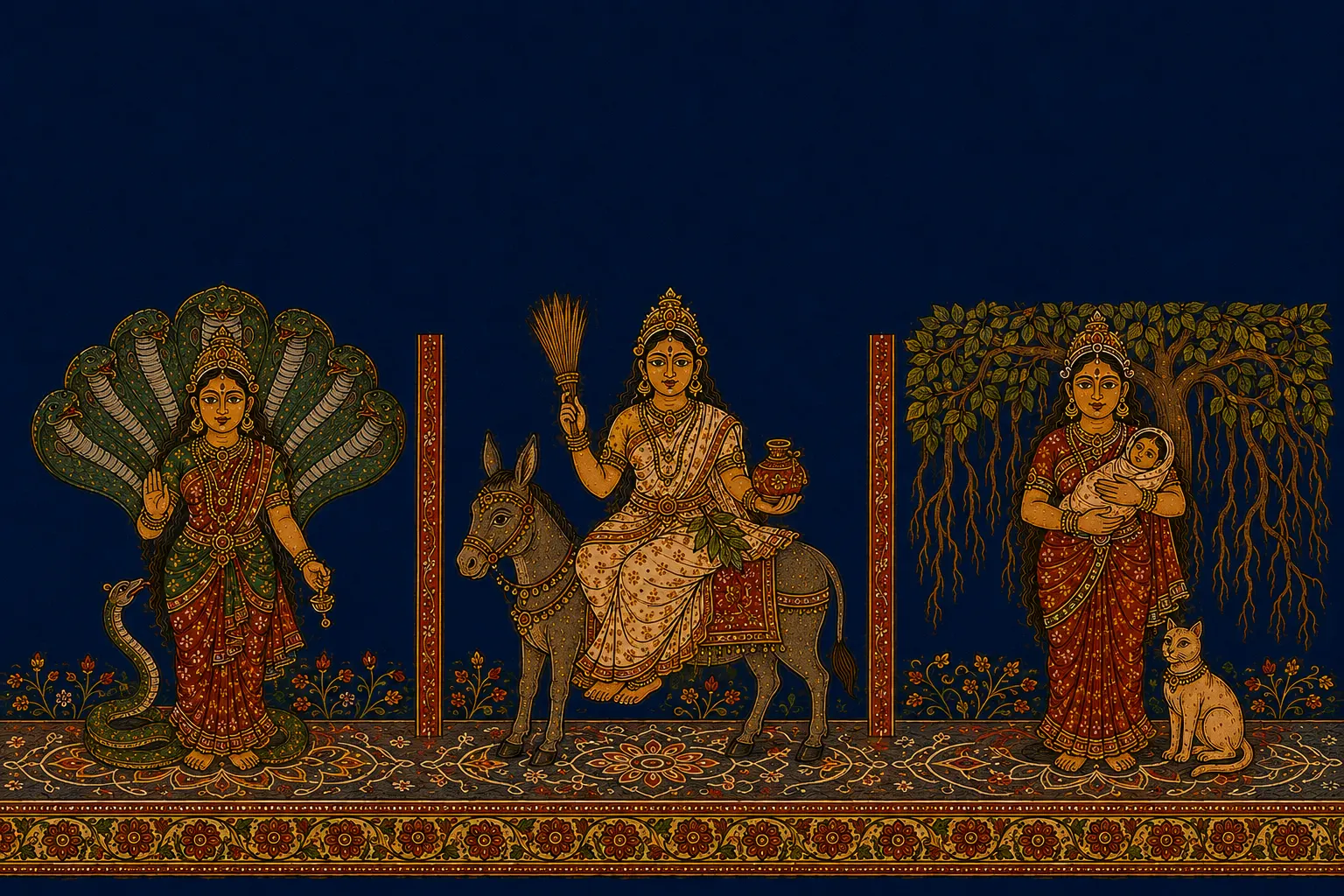
In older North Indian belief, smallpox could be understood as Shitala's "arrival" — not merely an illness, but the presence of the goddess. Families responded by keeping the patient cool, placing neem leaves nearby and taking care not to anger her. Shitala is shown riding a donkey and carrying a broom and a water-pot.

Shitala's folk stories vary by region. In Gujarat, Shitala Satam, and in many parts of North India, Sheetala Ashtami or Basoda, are festivals tied to her. In many places no fresh food is cooked that day, and cold food made the day before is offered and eaten.

Shashthi — goddess of the sixth day

Shashthi is the protector of children. She is worshipped on the sixth day after a birth. In many folk traditions it is held that on this night the goddess writes the newborn's fate and guards the child.

She is often shown riding a cat; the cat became her most recognisable emblem in folk tradition. In many regions women perform her vows and rites inside the house, under a banyan, or at a local place of worship. The form of the worship varies by region and community.

In Bengal her worship is a separate "Shashthi Puja" — different from Bihar's "Chhath," which is worship of the sun.

From folk to text

Over time, Sanskrit and Puranic traditions also found places for these goddesses. Several accounts of Manasa's origin were composed; Shitala became associated with Puranic episodes; and Shashthi was identified in some traditions as Skanda's foster-mother and in others as his wife, Devasena.

The relationship between folk worship and textual tradition was not one-way. Old local beliefs reached the texts, and the texts in turn gave them new identities. The Shakta "Mahadevi" framework links these separate goddesses as forms of one wider divine power, but it does not entirely erase their regional distinctiveness.

Devi-Charit records this; it does not hide it.

Note: The largest source of Manasa's story is the Manasa-mangal poetry (Bengal, medieval); she is also mentioned in the Devi Bhagavata. Behula and Lakhindar are the centre of that story. Puranic references to Shitala are connected with the Skanda Purana, but the history of her folk worship is not confined to that text alone. The worship of Shashthi is tied to the "Shashthi tithi" and to folk traditions around pregnancy and the newborn. In the worship of these goddesses folk and textual traditions meet — and yet their strongest living traditions have been household and regional.

Source: from several texts, Manasa, Shitala, Shashthi

Now — how much stayed with you?

Fact

What do Manasa, Shitala and Shashthi have in common?

  • All three are goddesses of the Devi Mahatmya
  • All three killed asuras
  • All three were already worshipped in folk tradition, and the Sanskrit texts took them in late, or never
  • All three are forms of Kali
Read the whole story — Worship first, scripture after

The order for these goddesses is the reverse of the great gods': worship began in the villages first, and the Sanskrit texts gave them a place afterwards.

Manasa was called Shiva's daughter, Shitala was added to the Skanda Purana, Shashthi was attached to Skanda — all three are later joins.

So the great "Mahadevi" frame is a synthesis — the work of bringing separate, already-running worships under one roof.

What happened?

What happened when Chand Saudagar refused to worship Manasa?

  • Manasa cursed him and turned him into a snake
  • Manasa killed his seven sons and sank his ships
  • Manasa let him be and went away
  • Shiva stepped in and stopped Manasa
Read the whole story — A goddess who takes her worship

The Manasa of the mangal-kavyas does not ask — she forces, and the story does not hide it either.

The reason is in the story itself: nobody worships Manasa, and even in her own father's house she has no place.

It is another form of the spine of Devi-Charit — here the Goddess has to take her place not from the gods but from human beings.

Who am I?

On my husband's wedding night a snake bit him. I would not let his body be burned — I laid him on a raft of banana stem and took to the river, and floated for months, all the way to heaven. Who am I?

  • Manasa
  • Sati
  • Chandi
  • Behula
Read the whole story — A raft, a corpse, and a refusal

Behula is the real protagonist of the mangal-kavya — not a goddess but a woman, and the story turns on her.

In heaven she dances before the gods, and by pleasing them she takes her husband's life back.

It is among Bengal's most popular stories — in song, in jatra theatre, in film.

Put it in order

Which is the correct order of Behula's story?

  • Chand Saudagar refuses to worship Manasa → Manasa kills his sons → a snake bites Lakhindar on his wedding night → Behula floats down the river with the body → she dances in heaven and pleases the gods → Chand worships, and Lakhindar comes back to life
  • Lakhindar dies → Chand refuses → Manasa kills the other sons → Behula floats
  • Behula takes to the raft → Lakhindar dies → Chand worships
  • Chand worships → Manasa is pleased → Lakhindar dies
Read the whole story — A story that ends in worship

That is the shape of a mangal-kavya: a man who will not accept a goddess, his ruin, and worship at the end.

Even at the end Chand does not fully bend — he offers his flower with his left hand, his face turned away.

That half-surrender is the most remembered thing in the story — the goddess wins, but not completely.

Later tradition

Shitala was held to be the goddess of smallpox — so what was done with the sick?

  • They were kept warm and sent away from the house
  • They were left at Shitala's temple
  • They were made to fast
  • They were kept cool, neem leaves were kept by them, and care was taken not to anger the goddess
Read the whole story — The goddess's coming, not a disease

Shitala's very name means "the cool one", and her whole tradition is about quieting heat.

On Shitala Ashtami, Basoda, cold food from the day before is offered in the houses and no cooking fire is lit that day.

Smallpox has been wiped off the earth, but Shitala's worship has not gone with it — she is now the goddess of every fever and rash.

Riddle

I am worshipped on the sixth day after a birth — the day held to decide whether a newborn will live. My mount is a cat, and the women of the house worship me without a priest. Who am I?

  • Shitala
  • Manasa
  • Shashthi
  • Parvati
Read the whole story — The sixth day

Shashthi's name comes from "sixth" — the day of a newborn's life held to be the most fragile.

There is no priest in her worship; it is the women of the household's own tradition, under a banyan or in a corner of the house.

The "Chhath" festival of Bihar and the eastern plains is a different thing — that is worship of the sun — but this chhathi tradition is spread across northern and eastern India.

The texts disagree

What question do the village goddesses raise against the claim that "the Mahadevi is one, and all the rest are her forms"?

  • None; these goddesses too were worshipped as the Mahadevi from the start
  • Their worship was running before the Sanskrit texts and independently of them, in their own languages and with their own priests
  • These goddesses deny the Mahadevi
  • Their worship never actually existed
Read the whole story — A roof put on afterwards

This is Devi-Charit's honest chapter: "one Mahadevi" is a beautiful idea, but it is not the whole account of the history.

What was on the ground was many — a different goddess in every village, different songs, different priests.

The Devi Mahatmya's "ekaivaham" (chapter 8) is a claim, and this chapter sets the state of the ground beside that claim.

Whose son?

Whose daughter does the tradition call Manasa, and what is that relation like in the story?

  • Shiva's daughter
  • Brahma's daughter, and the relation is ordinary
  • Vishnu's daughter, and he thinks highly of her
  • Nobody's daughter; she is self-born
Read the whole story — A daughter with no place in the house

The relation of "Shiva's daughter" itself says the join is a later one — because in the story the relation does not work.

It resembles the Saraswati and Brahma awkwardness of chapter 13: when a folk goddess is fitted into a great frame, the stitching shows.

Manasa's strength is exactly that she does not accept the join — she takes her worship straight from human beings.

Fact

What are the mangal-kavyas?

  • Sanskrit hymns written after the Devi Mahatmya
  • A part of the Vedas
  • Bengali narrative poems that promote the worship of folk gods and goddesses
  • A branch of the tantric texts
Read the whole story — Worship written in the local language

The mangal-kavyas are works of medieval Bengal, in Bengali — not in Sanskrit, and that is their whole point.

Their shape is nearly always the same: a goddess nobody worships, a human being who refuses, and at the end the establishment of her worship.

Manasamangal, for Manasa, and Chandimangal, for Chandi, are the most famous, and they were performed sung, like plays.

Later tradition

These three goddesses share one more thing in their worship — what?

  • Their worship is largely at the level of the household and the village
  • All three are worshipped only in temples, by brahmin priests
  • All three are worshipped once a year, only at Navaratri
  • Their worship has now died out
Read the whole story — Worship that stays in the house

These goddesses' power does not come from temples and texts — it comes from the fears of ordinary life: snakes, illness, whether a newborn survives.

Which is why their worship held on, whether or not the Sanskrit texts gave them a place.

Devi-Charit puts this second to last so that the next chapter — the Goddess's own teaching — is read standing on this ground.