
Chapter 5
Kali, from Kaushiki
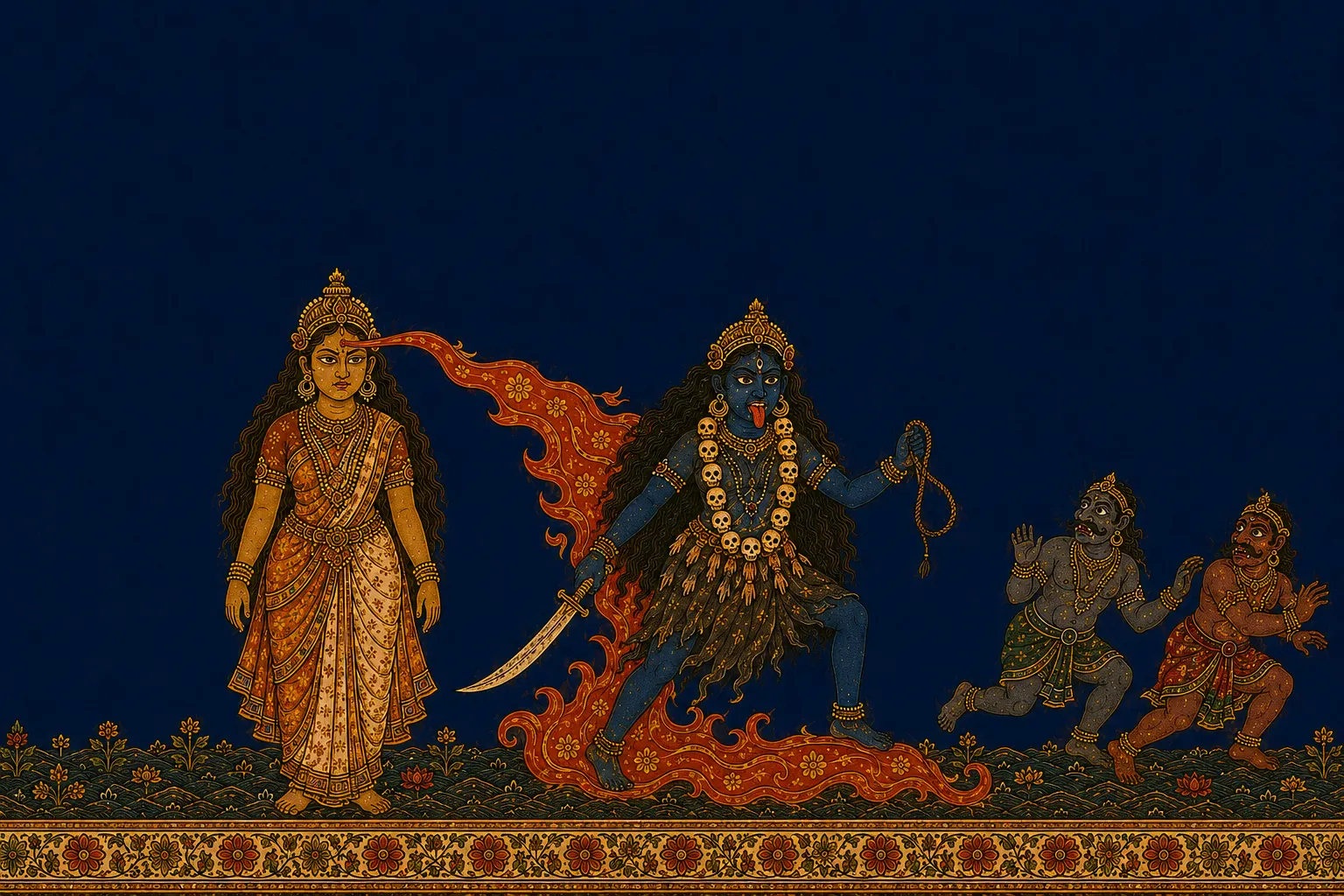
Parvati, Kaushiki and Kalika
The reign of Shumbha and Nishumbha
Long after Mahisha, two asura brothers rose — Shumbha and Nishumbha.
They defeated Indra and the other gods, seized their ritual shares, and took control of the powers of the sun, the moon and the wind. Once again, the gods were driven out of heaven.
But this time they had something they had not had in Mahisha's day — a promise. The Goddess had said: if you remember me, I will come.
The gods' song
The gods went to the Himalayas and began to sing:
"Ya Devi sarvabhuteshu — to the Goddess who dwells in every being as power, as intelligence, as sleep, as hunger, as shadow, as mercy, as forgiveness, to her we bow again and again."
This is not the Devi Sukta from Chapter 1 — that one was Vedic. This is the Devi Mahatmya's own hymn, and it is still sung at Durga Puja.
Kaushiki from the sheath
Just then Parvati arrived to bathe in the Ganga.
"Whom are you praising?" she asked.
As Parvati spoke, a radiant goddess emerged from the sheath of her body — luminous, beautiful and complete in herself. Because she had emerged from Parvati's *kosha*, or bodily sheath, she became known as Kaushiki. She was also called Ambika.
The gods said: "It was her we were praising. She has come."
Parvati became Kalika
Once the radiant goddess emerged, Parvati herself changed.
It was as though the radiance of Parvati's body had passed into Kaushiki. Parvati's complexion darkened, and from that day she was also known as Kalika.
Here, "Kalika" refers to Parvati after she turns dark. Later in the war a fierce Kali will also emerge from Kaushiki's brow. The Devi Mahatmya tells the two episodes separately; later Shakta traditions link both forms to a single Mahadevi.
"Defeat me first"
Shumbha's two servants, Chanda and Munda, saw Kaushiki in the Himalayas and returned to tell him about her.
"You hold every jewel of the three worlds," they said. "This woman is the most beautiful of all — she too should be yours."
Shumbha sent a messenger with a proposal of marriage.
Kaushiki said: "I have a vow. I will marry only the one who defeats me in battle and proves himself my equal in strength. Go and tell your master — defeat me first."
Shumbha sends Dhumralochana
Shumbha flew into a rage.
He sent a general named Dhumralochana with an army of sixty thousand asuras — "Drag her here by the hair. Kill anyone who gets in the way."
Dhumralochana marched into the Himalayas with his army. High above them, Kaushiki sat calmly, as though nothing had happened.
Note: The emergence of Kaushiki from Parvati, and Parvati being called Kalika, is in the fifth chapter of the Devi Mahatmya's last carita. The name "Kaushiki" is formed from *kosha*, sheath. The hymn "Ya Devi sarvabhuteshu" comes in this context — it is the Devi Mahatmya's own hymn, not the Vedic one. Chanda and Munda here are observers who carry the report; the formal envoy comes separately. The relationship between Kali and Parvati is not the same in every text.
Source: from several texts, Kali, from Kaushiki