
Chapter 13
Lakshmi and Saraswati
Lakshmi and Saraswati in Their Own Right
Shri before Lakshmi
In the Shri Sukta, a later appendix to the Rigveda, worshippers appeal directly to Shri for prosperity, cattle, grain and children. Her marriage to Vishnu, central to later Vaishnava tradition, is not the subject of the hymn.
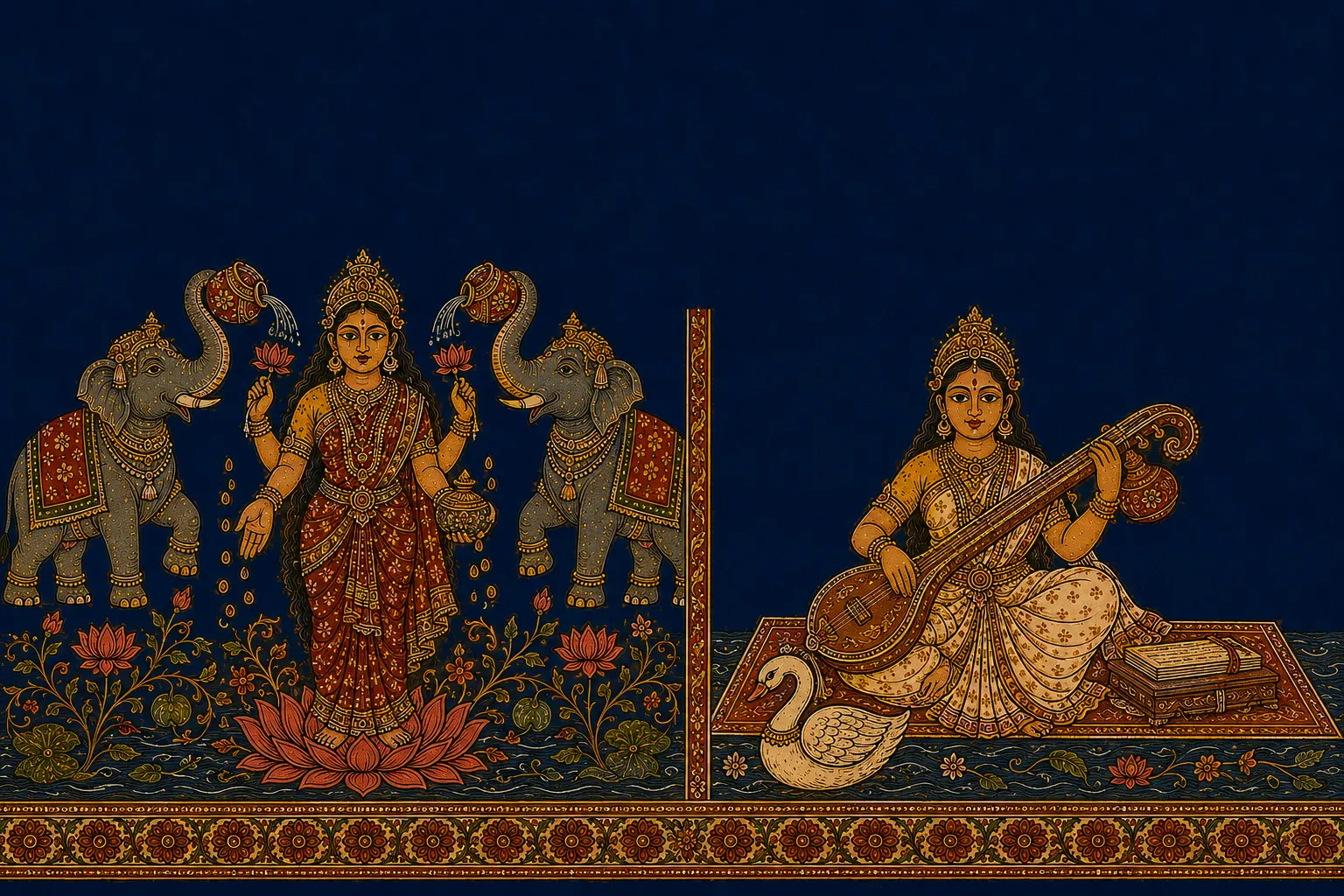
Early Buddhist monuments such as Sanchi show a woman surrounded by lotuses and elephants. Some scholars identify her as Gajalakshmi; others connect the figure with Maya, the Buddha's mother. Whatever her precise identity, the image shows that this combination of elephants, water, lotuses and an auspicious female figure is older than the standard later iconography of Lakshmi with Vishnu.
Lakshmi at the churning
Lakshmi appeared during the churning of the ocean. She surveyed the gods and other beings gathered there, then chose Vishnu and placed a garland around his neck.
Later tradition turned this into the familiar image of Lakshmi as Vishnu's consort.
A Shakta reading places the emphasis elsewhere: Lakshmi emerges from the ocean as a goddess in her own right, and the choice is hers.
Lakshmi's shadow
In some Puranic accounts another goddess comes out of the churning before Lakshmi — Jyeshtha, linked to Alakshmi. She is the "elder" sister.
She is a goddess of misfortune, associated with idleness, quarrels and neglect. Lakshmi remains in a household only when Alakshmi is kept away.
In this respect, Jyeshtha invites comparison with Dhumavati among the Mahavidyas (Chapter 10). If the Goddess encompasses all experience, she contains want and misfortune as well as abundance. This is an interpretive parallel, not a claim that every tradition identifies the two goddesses.
Saraswati and Vak
Saraswati's oldest identity is not "Brahma's wife."
In the Vedic literature Saraswati is first a goddess tied to a river and to inspiration. In later tradition she became the presiding deity of speech, learning, music and the arts, while her identification with Vak grew steadily stronger.
But it would not be right to call the speaker of Rigveda 10.125 Saraswati directly. The seer and speaker of that hymn is Vak Ambhrini. The clear merging of Saraswati and Vak developed in the later Vedic and Puranic traditions.
Saraswati and Brahma
Another strand of tradition is more unsettling.
Many Puranic accounts tell of a woman created by Brahma, whom different traditions connect with Shatarupa, Savitri or Saraswati. Brahma becomes infatuated with her; she keeps turning away, and Brahma grows extra faces to keep watching her.
This is neither Saraswati's only story nor her oldest. But where it does appear, simply calling her "Brahma's wife" smooths over the tension at the heart of the story.
Mahasaraswati
The Devi Mahatmya uses these names differently.
The three caritas of the Saptashati have three presiding goddesses: Mahakali for the first carita (Madhu-Kaitabha); Mahalakshmi for the middle (Mahisha); Mahasaraswati for the last (Shumbha and Nishumbha).
In this ritual division the presiding goddess of the Mahisha carita is Mahalakshmi and of the Shumbha-Nishumbha carita is Mahasaraswati. Here these names do not mean simply the consort of Vishnu or Brahma; they express the wider forms of the supreme Goddess. This is the Shakta recitation tradition's own religious framework.
Note: The Shri Sukta is a khila, or appendix, of the Rigveda, and among the oldest independent references to Shri/Lakshmi. The identity of Sanchi's "woman and elephants" image is disputed among scholars — some read it as Gajalakshmi, some as Maya. The story of Brahma's extra heads and his infatuation with a woman of his own creation is found in different Puranas with different names and forms — in some the woman is Shatarupa, in some she is linked to Savitri or Saraswati. The story of Shiva cutting off Brahma's fifth head is also told in different Puranic traditions for different reasons. None of these should be taken as one fixed version. The Shakta tradition links the independent identities of Lakshmi and Saraswati by treating both as forms of the Mahadevi.
Source: from several texts, Lakshmi and Saraswati