
Chapter 11
Lalita and Bhandasura
A demon from ash, a goddess from fire
Bhandasura from the ashes
Shiva's third eye had burned Kama to ashes.
From those ashes, one of Shiva's attendants shaped a figure. When Shiva's gaze fell on it, the figure came to life as a mighty man.
Chitrakarma taught him the Shatarudriya mantra and told him to perform austerities. When the austerities were done, Shiva appeared. The figure asked for a boon: that half the strength of anyone who faced him in battle should pass into him, and that his enemies' weapons could not bind him. Shiva granted it, and also blessed him to rule for sixty thousand years.
Brahma exclaimed "Bhanda!" as a rebuke, and the name stayed with him. Bhanda founded the city of Shunyaka and brought the three worlds under his power.
Lalita from the sacrifice
At Mahashambhu's direction, the gods performed a great sacrifice and finally offered themselves into its fire.
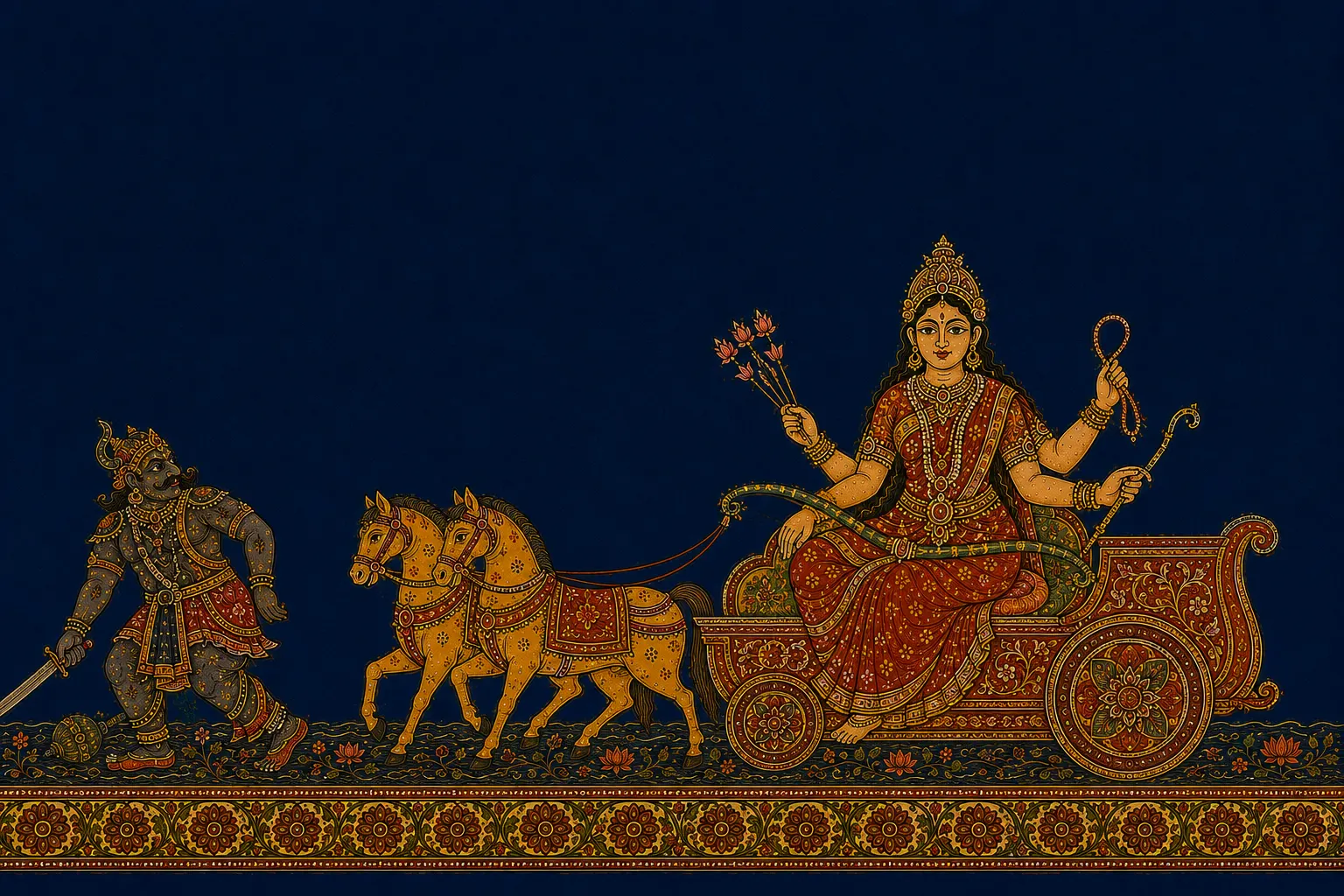
From *chidagni*, the fire of consciousness, appeared a red, four-armed goddess. She carried a sugarcane bow, flower-arrows, a noose and a goad.
She was Lalita Tripurasundari, the supremely beautiful. She took Kameshvara, a form of Shiva, as her consort and ruled from Shripura.
The chariot of the Shri Chakra
Lalita rode to war in the Chakraraja, a vast chariot patterned on the Shri Chakra — nine interlocking triangles around a central point, the sacred diagram at the heart of the Shrividya tradition.
Her companions included Dandanatha, or Varahi, who commanded her army, and Mantrini, or Shyamala, who served as her minister.
Opposite her stood Bhanda's army, and his brothers Vishukra and Vishanga.
Ganesha from a smile
Vishukra devised a device — the Jayavighna yantra — that spread discord and sloth through Lalita's army.
Lalita looked towards Kameshvara and smiled. From her smile Ganesha appeared and shattered the device.
This tradition gives Ganesha a different birth. In *Shiv-Mahima*, Parvati fashions him from paste taken from her body; here he arises from Lalita's smile as the remover of obstacles.
The ten avatars from her fingernails
Bhanda used his maya to raise up forms like Madhu and Kaitabha, Raktabija and other old demons. Durga and the other powers that came forth from Lalita destroyed them.
Then Bhanda brought forth Somaka and other demons. In answer, from the nails of Lalita's hands came Vishnu's ten avatars — from Matsya to Kalki — and they defeated those demons.
Kama restored
At last Lalita released the Mahakameshvarastra. Bhandasura and his city were reduced to ash.
The gods then pleaded that the world was incomplete without love. Lalita restored Kama to life, reunited him with Rati and returned the power of desire to the world.
The same goddess who carried a sugarcane bow and flower-arrows — the symbols of desire — restored to life the Kama whom Shiva's third eye had burned.
Note: This story is in the Lalitopakhyana, which is part of the Brahmanda Purana. It is a major source of the Shrividya tradition, separate from the narrative stream of the Devi Mahatmya and the Devi Bhagavata. In this story it is Shiva who grants Bhandasura his boon; his name comes from Brahma's exclamation, and his city is Shunyaka. Lalita is linked with Shodashi and Bhuvaneshvari among the ten Mahavidyas. Shrividya is a complex Tantric worship still living in South India. Mantrini, that is Shyamala, is the minister and Dandanatha, that is Varahi, the commander — this pairing also appears in the Lalita Sahasranama. The Mahakameshvarastra is in the original text.
Source: from several texts, Lalita and Bhandasura