Chapter 2

Mahamaya

Vishnu's Yoga Nidra

The sleeping Vishnu

King Suratha had lost his kingdom. The merchant Samadhi had been cast out by his own family. They came to the ashram of the sage Medhas with the same question: why did they remain attached to the very people who had rejected them? Medhas told them the answer was Mahamaya, and then began his first story.

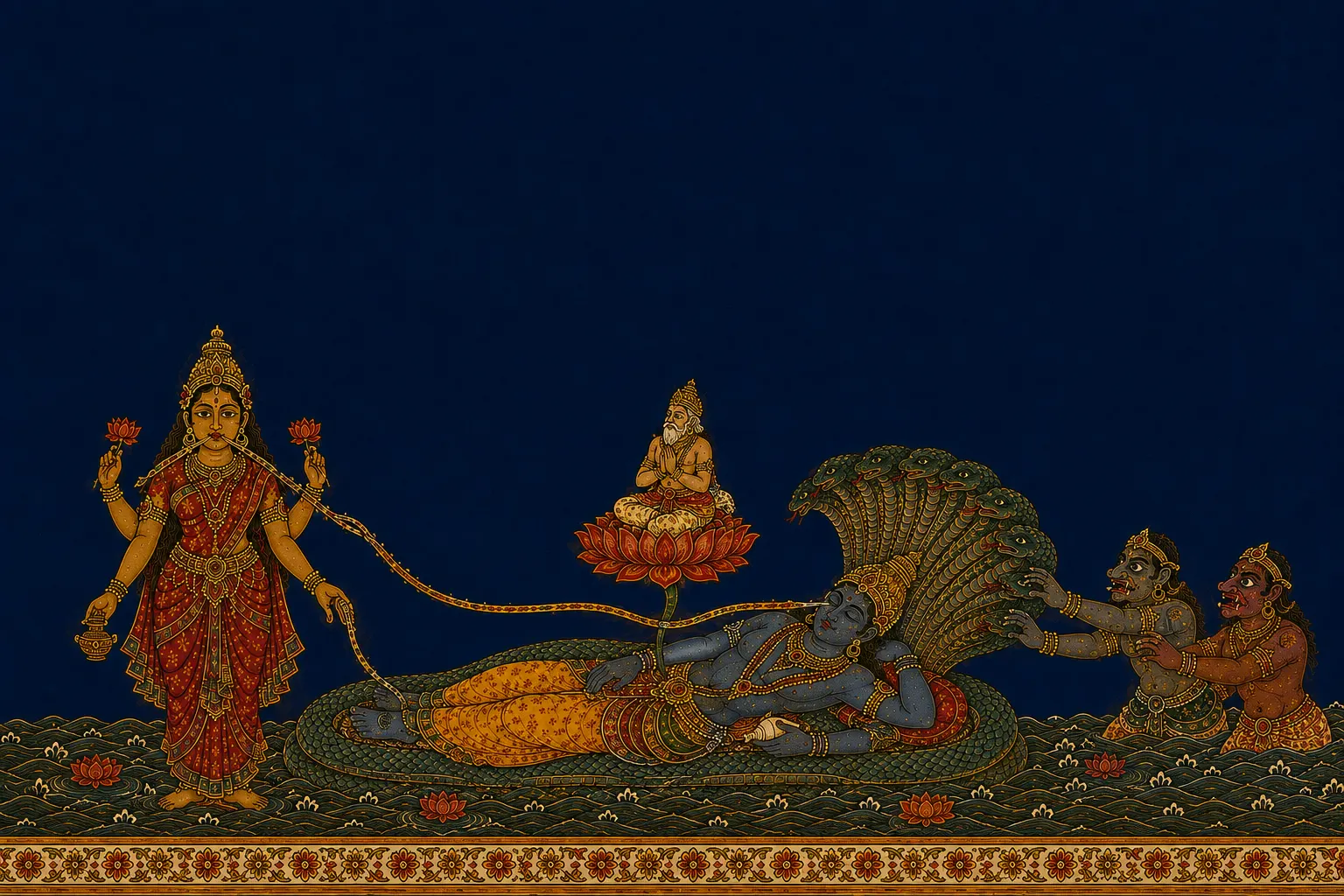
At the end of a cosmic age, when everything was water, Vishnu lay on the coils of the serpent Shesha.

This was no ordinary sleep. It was Yoga Nidra, a divine power that held his eyes, breath and body in its grasp.

A lotus rose from Vishnu's navel. On it sat Brahma, alone in the watery darkness.

Madhu and Kaitabha

Then two demons emerged from the wax of Vishnu's ears: Madhu and Kaitabha, intoxicated by their own strength.

They saw Brahma on the lotus and moved to kill him.

Brahma had no weapon and nowhere to flee. Water stretched below him in every direction, and the only god who could help him was asleep.

Brahma praises Yoga Nidra

Brahma did not try to rouse Vishnu directly. He praised the power that held Vishnu in sleep.

"You are Shri, you are the power of understanding," Brahma said. "You hold up this whole world. You draw even the minds of the wise into confusion."

"Withdraw from Vishnu's body, so that he may wake and fight them."

This is the first hymn in the Devi Mahatmya, and it is addressed not to Vishnu, but to the power holding Vishnu in sleep.

The Goddess comes out

Mahamaya withdrew from Vishnu's eyes, mouth, nostrils, arms and heart, and appeared before Brahma.

Vishnu's eyes opened.

He saw Madhu and Kaitabha beside the lotus and engaged them in battle.

A fatal offer

Vishnu fought the two demons for five thousand years, with neither side prevailing.

Then Mahamaya clouded the demons' judgement. In the pride of their own strength the two said to Vishnu: "You fight well. Ask — whatever you want."

Vishnu said: "Then grant this — that you die at my hands."

Only then did they realise their mistake. But the boon had already been offered.

Where there is no water

The demons were clever. "Very well — but kill us where the ground is not covered by water."

Water covered everything. Vishnu raised his vast thighs above it, laid the demons' heads across them and severed both with his discus.

The Devi Mahatmya ends the episode here. The Devi Bhagavata preserves another version, in which the demons' marrow spreads through the waters and becomes the earth. This, it says, is why the earth is called Medini.

Vishnu supplies the force, but Mahamaya creates the opening that makes victory possible. That is Medhas's point: the power that held Vishnu in sleep is the same power that binds the world in attachment — including Suratha and Samadhi.

Note: This story appears in the first carita of the Devi Mahatmya, within the Markandeya Purana. It is told to Suratha and Samadhi by the sage Medhas as an explanation of Mahamaya. Here Mahamaya resides in Vishnu as Yoga Nidra, and Brahma praises her so that Vishnu can wake and kill Madhu and Kaitabha. The Devi Mahatmya ends the episode with their beheading; the creation of the earth from their marrow belongs to the Devi Bhagavata version. Other Puranas preserve further variations.

Source: from several texts, Mahamaya

Now — how much stayed with you?

Who am I?

I am a sleep that is itself a goddess. I had taken hold of Vishnu's eyes. Brahma woke not Vishnu but me — so that I would let go and Vishnu could fight. Who am I?

  • Yoganidra, that is, Mahamaya
  • Nidra, ordinary sleep
  • Lakshmi
  • Ratri, goddess of the night
Read the whole story — A sleep that is a goddess

In the first story of the Devi Mahatmya the Goddess arrives not as a fighter but as a sleep — the sleep that covers Vishnu at the end of creation.

"Mahamaya" means the great illusion, or the great measure — the power that holds everyone, Vishnu included, in its grip.

It connects to chapter 1: there the Goddess was the power of the word, here of sleep and confusion. Neither time does she fight — she holds.

Whose son?

Where did Madhu and Kaitabha come from?

  • From the dust of the earth
  • From Brahma's pride
  • From the poison of the churning of the ocean
  • From the wax of Vishnu's ear
Read the whole story — An enemy that came from inside

In the Devi Mahatmya, Madhu and Kaitabha are born from Vishnu's own body — from the wax of his ear. The danger comes not from outside but from within him.

This recurs through Devi-Charit: asuras are often made out of some god's own portion, or boon, or mistake.

Their names speak too: "madhu" is wine or honey, "kaitabha" an insect — both tied to intoxication. And in the end it is their own intoxication that hands Vishnu the boon.

Who said it?

"Now let go. Come out of Vishnu's body, so that he wakes." — who said this, and to whom?

  • Vishnu, to Yoganidra
  • Brahma, to Mahamaya (Yoganidra)
  • Madhu, to Kaitabha
  • Shiva, to Vishnu
Read the whole story — A hymn that was not for a god

This is the finest turn in the story: in danger, Brahma does not call on Vishnu — he calls on the power that has Vishnu bound.

The implication is plain: the real strength here is not the sleeping god's, it is the sleep's. Vishnu can do nothing until the Goddess withdraws.

This is where the Devi Mahatmya plants its claim — even a god's victory rests on the Goddess stepping aside, or standing with him.

Why is that?

Why did Madhu and Kaitabha give Vishnu a boon?

  • Because they were afraid of him
  • Because Vishnu had beaten them by a trick
  • Because they were drunk on their own strength, and in Mahamaya's confusion never grasped that the one in front of them was an enemy
  • Because Brahma told them to
Read the whole story — The intoxication that became the defeat

Madhu and Kaitabha were so strong that even Vishnu could not beat them. They lost not for want of strength but out of pride.

Saying "ask whatever you want" in the middle of a fight is the very drunkenness their names carry. And behind that drunkenness is Mahamaya's hand.

It is one corner of the spine of Devi-Charit: the Goddess does not only win by fighting — she often tangles the enemy in his own foolishness.

What happened?

How did Vishnu finally kill Madhu and Kaitabha?

  • With the discus, out in the middle of the water
  • By spreading his thighs, laying their heads on the dry thighs, and then using the discus
  • With a trident
  • By drowning them in the sea
Read the whole story — A condition met on a pair of thighs

The asuras thought that by saying "where there is no water" they had saved themselves — on every side there was nothing but water.

Vishnu did not break the condition; he satisfied it — by making dry land out of his own thighs.

From their marrow — meda — the earth was made, which is why one of its names is Medini. The asuras' own bodies became the ground they had refused to be killed on.

Riddle

At the end of creation I settle over Vishnu. I lift no weapon. Still the victory in that story is mine — because until I let go Vishnu cannot even wake, and until I spread confusion the asuras do not lose. Who am I?

  • Lakshmi
  • Kali
  • Yoganidra / Mahamaya
  • Saraswati
Read the whole story — The one who does not fight, and still wins it

In the first story of the Devi Mahatmya the Goddess strikes not a single blow. She does two things: she releases Vishnu, and she confuses the asuras.

That is her first identity — maya, the power of illusion. The goddess of force, Durga, arrives in the next chapter.

It is the quietest form of this gatha's spine: the Goddess needs no weapon to win. Standing with someone, or stepping away, is enough.

Put it in order

Which is the correct order of events?

  • Vishnu asleep in Yoganidra → Madhu and Kaitabha born from his ear-wax → they advance on Brahma → Brahma praises Mahamaya → the Goddess leaves Vishnu and he wakes → five thousand years of fighting → the asuras offer a boon in their pride → Vishnu kills them on his thighs, on the "where there is no water" condition
  • Madhu and Kaitabha are born → Brahma's hymn → Vishnu wakes → Vishnu falls into Yoganidra
  • Vishnu's battle → Brahma's hymn → Madhu and Kaitabha are born → the boon
  • Brahma's hymn → Madhu and Kaitabha are born → Vishnu falls asleep → the battle
Read the whole story — From a sleep to an earth

The shape of this chapter is a circle: it opens with the sleep at the end of creation and closes with a new earth being made — and that earth is made out of two asuras.

The turn in the middle is Brahma's hymn. That is where the story swings from "Vishnu against the asuras" to the Goddess's part in it.

Which is why the Devi Mahatmya places this story first: to show that the Goddess's power predates the fighting — it is there in sleep and in confusion too.

The texts disagree

How does the Madhu-Kaitabha story differ in other texts from the Devi Mahatmya's version?

  • In every text Yoganidra is the real hero
  • In the Mahabharata and some puranas it is simply Vishnu's victory over Madhu and Kaitabha, with no goddess in it; the Devi Mahatmya adds Yoganidra/Mahamaya as the real power
  • The story is only in the Devi Mahatmya and nowhere else
  • In every text the asuras are killed on the sea floor rather than on Vishnu's thighs
Read the whole story — One story, one added layer

The killing of Madhu and Kaitabha is an old Vishnu story — in the Mahabharata "Madhusudana", slayer of Madhu, is a common name for him.

What the Devi Mahatmya does is take that old story and set the Goddess at its centre: Vishnu fights, but the victory comes from Yoganidra letting go and spreading confusion.

It is like Lingodbhava or Bhasmasura — one event, and a different real hero in each tradition. Devi-Charit records, every time, whose eye we are looking through.

Later tradition

Which deities are the three "charitas" of the Durga Saptashati associated with, and which one holds the Madhu-Kaitabha story?

  • All three charitas belong to Shiva; Madhu-Kaitabha is in the first
  • The Madhu-Kaitabha story is in the middle charita
  • The Madhu-Kaitabha story is in the last charita
  • The presiding goddess of the first charita is Mahakali, and Madhu-Kaitabha is its single story; the middle charita is Mahalakshmi's (Mahisha), the last Mahasaraswati's (Shumbha-Nishumbha)
Read the whole story — Three sections, three goddesses

Tradition divides the Saptashati into three charitas and gives each a presiding goddess: the first Mahakali, the middle Mahalakshmi, the last Mahasaraswati.

That division is itself an answer to the "one or many" question: all three are forms of the one Mahadevi, with a different form foremost in each section.

Madhu-Kaitabha is the only story in the first charita — the other two run for many chapters. The first is short, but it sets the shape of the whole Saptashati.

Fact

Where does the earth's name "Medini" come from, according to this story?

  • From "Medini", one of the Goddess's names
  • From a sage called Medin
  • From a jewel that came out of the churning of the ocean
  • From the marrow and fat
Read the whole story — Ground made out of asuras

"Meda" means fat or marrow. The story says the bodies of Madhu and Kaitabha became the very stuff from which solid ground rose in a world of water.

There is an irony in it: the asuras had set the condition that they be killed where there was no water — and their own deaths made that waterless ground.

Among the earth's many old names, "Medini" is tied to this story; "Prithvi" comes from king Prithu, "Dhara" from bearing or holding up.