Chapter 4

Mahishasura-mardini

The end of Mahishasura

The generals fell one by one

Hearing the roar, Mahisha sent his generals — Chikshura, Chamara, Udagra, Bashkala, and thousands of soldiers.

The Goddess's lion tore into the asura army, and from her sharp breaths hundreds and thousands of warriors sprang up and fought.

The generals fell one by one. Word of the defeat kept reaching Mahisha's court.

The buffalo enters the battle

Then Mahishasura entered the battle himself, in the form of a huge buffalo.

He tossed mountains with his horns, beat the ground with his tail, trampled hills under his hooves. His breath scattered the clouds.

The Goddess threw her noose and bound him.

Mahisha changes shape

The moment the noose tightened, Mahisha began changing shape.

First he left the buffalo form and became a lion. The Goddess cut off the lion's head — and he became a man with a sword in his hand.

The Goddess loosed a storm of arrows. He became a huge elephant and seized her lion with his trunk. She cut the trunk away.

Each new form was another attempt to escape. The Goddess answered every one.

Back to the buffalo

At last Mahisha became a buffalo again and shook the three worlds.

Then the Goddess drank the divine draught — again and again — until her eyes turned red.

Laughing, she said: "Roar, fool, while I drink this. When you are dead, the gods will roar."

Foot, trident, sword

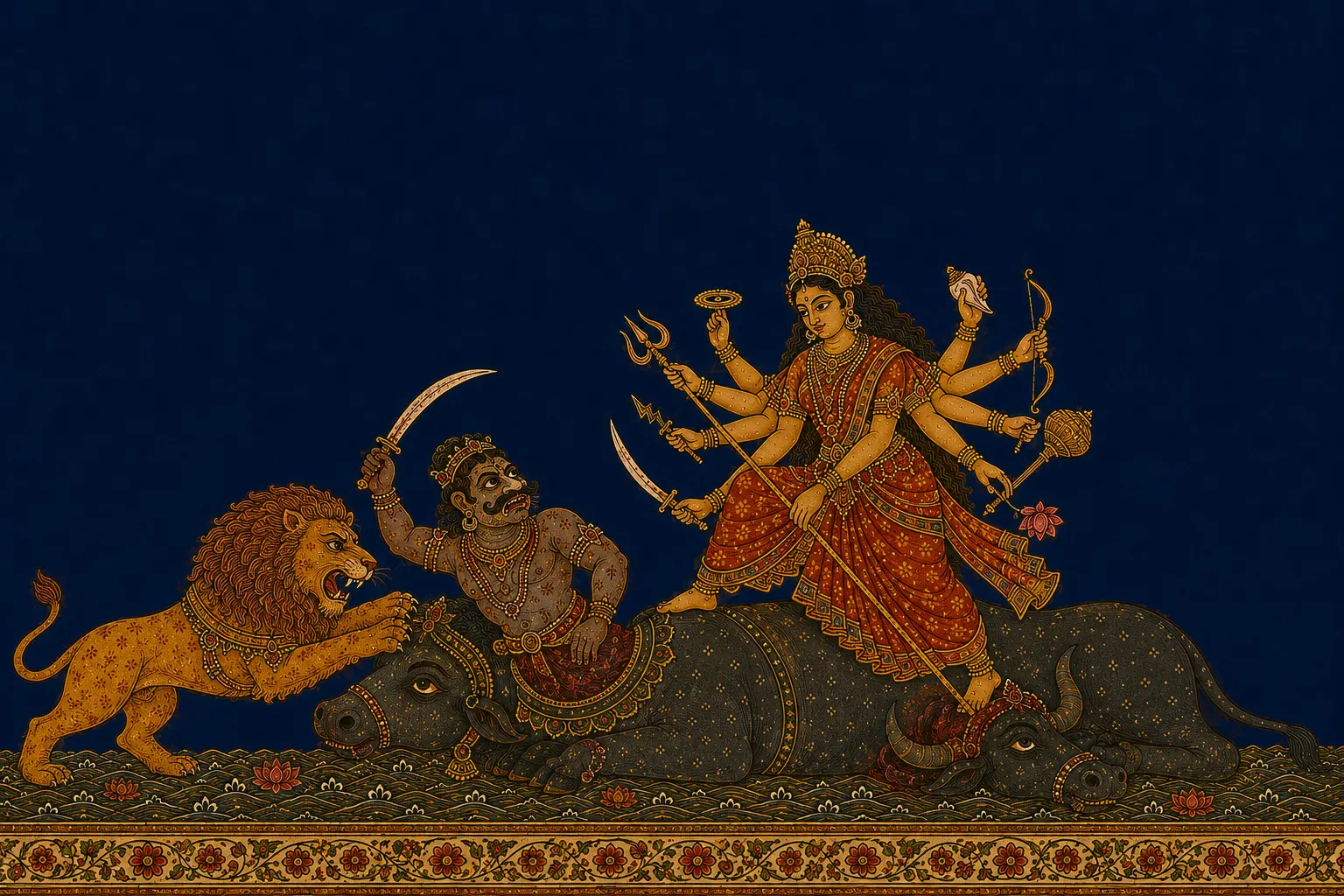
The Goddess sprang onto the buffalo. She set one foot on its neck and drove her trident in.

Mahisha made one last attempt — he began to come halfway out of the buffalo's mouth in his true form.

In that very moment — when he was neither wholly buffalo nor wholly asura — the Goddess cut off his head with her sword. A hundred years of war ended in an instant.

A rain of flowers

The gods showered flowers from the sky. Indra and the others praised the Goddess as Durga, Shri, intelligence and the power present in all things.

The Goddess said: "Whenever the world is in danger, and you remember me, I will come."

Then she vanished. She did not remain in heaven among the gods; she left them a promise that they could call on her again.

Note: This story is in the middle carita of the Devi Mahatmya (chapters 2–4). Mahisha's shape-changing — buffalo, lion, sword-bearing man, elephant, buffalo again — is set out in detail in the text, and so is the Goddess's separate answer to each form. The wine episode is in the original. The Devi Mahatmya gave the Mahishasura-mardini story its most influential literary form; in the later iconography and art of Durga, this scene of victory over the buffalo became central.

Source: from several texts, Mahishasura-mardini

Now — how much stayed with you?

What happened?

What did Mahisha do after the noose caught him?

  • He surrendered and begged the Goddess's pardon
  • He changed shape one after another
  • He called his army back
  • He fled and hid
Read the whole story — Shapes used as cover

Mahisha's greatest strength was his shape-changing — each time the Goddess closed on one form, he became another.

But every change left him weaker: the lion's head gone, the man struck with arrows, the elephant's trunk cut. Changing shape was not saving him, only postponing.

It is what the Mahishasura-mardini image shows — the buffalo under her trident, and a man coming half out of its severed neck. He was caught between two forms.

Who said it?

"Roar while you can, fool, while I am drinking. When you are dead it is the gods who will roar." — who said this, and to whom?

  • The Goddess, to Mahisha
  • Mahisha, to the Goddess
  • Indra, to Mahisha
  • Shiva, to Mahisha
Read the whole story — A taunt, with a drink in hand

It is the Goddess's most famous line in the Devi Mahatmya — "garja garja kshanam mudha" — and she says it while drinking that divine draught, her eyes red.

This is a side of her that is seen less often: not serene but fierce — drinking, laughing, taunting.

In Kali the fierceness goes further still. At Mahisha it is the first glimpse.

Fact

How did the Goddess finally kill Mahisha?

  • With the trident alone, in a single blow
  • With arrows alone
  • By setting a foot on his neck, driving the trident into him, and taking his head with the sword at the moment he was coming half out of the buffalo's mouth
  • By having the lion tear him apart
Read the whole story — One blow, between two forms

The timing of the last blow is everything: Mahisha died when he was neither wholly buffalo nor wholly asura — in between, in the act of escaping.

That is why in every image her foot is on the buffalo, the trident is in the buffalo, and the sword is turned toward the half-emerged man.

It ties to the spine of Devi-Charit: the one who keeps changing shape to survive is caught precisely when he is in no one shape at all.

Why is that?

Why did the Goddess drink the divine draught before killing Mahisha, and what does it signal?

  • Because she was tired and needed strength
  • Because she could not touch Mahisha without drinking it
  • It signals her fierce, reckless aspect
  • Because the gods wanted her to fight drunk
Read the whole story — The fierceness begins here

The Goddess has two faces in the Devi Mahatmya: one calm, beautiful, boon-giving; one fierce, red-eyed, roaring with laughter.

In the killing of Mahisha the second face is fully visible for the first time — the drink, the red eyes, the taunt.

In the chapters to come that fierceness takes a body of its own — first Kali, then Chamunda. At Mahisha it is still inside Durga.

Who am I?

I was half asura, half buffalo. I changed shape four times only to survive. I was killed while pushing my real form half out of a buffalo's mouth. Who am I?

  • Raktabija
  • Mahishasura
  • Shumbha
  • Andhaka
Read the whole story — A name that became an image

"Mahishasura-mardini" means the crusher of Mahishasura. It is the Goddess's most widespread form — her images stand in every corner of India.

His being caught between two forms is not incidental — it stands for the kind of deceit that belongs neither here nor there. She beats him in exactly that instability.

The city of Mysore is held to take its name from "Mahisha-uru", Mahisha's town, and on its Chamundi hill stands her image with the buffalo.

Who said it?

"Whenever trouble comes upon the world, and you remember me, I will come." — who said this, and to whom?

  • Indra, to the gods
  • Brahma, to the Goddess
  • Mahisha, as he died
  • The Goddess, to the gods raining flowers
Read the whole story — A promise that will run the whole gatha

After Mahisha the Goddess does not take a seat in heaven. She gives a promise and disappears — that she will return whenever she is called.

This is the spine of Devi-Charit: she is made from the gods' defeat, she finishes the work, and then rather than dissolving into them she remains an available power.

The next great chapter — Shumbha and Nishumbha — begins with that promise being kept: the gods lose again, they remember her, and she comes.

Put it in order

Which is the correct order of events?

  • Mahisha sends his generals and they are killed → Mahisha comes in buffalo form → the Goddess binds him with the noose → he changes into lion, man, elephant, buffalo → the divine draught and the taunt → the foot, the trident, and the sword taking his head between two forms → the gods' rain of flowers and their hymn → the Goddess's promise and her vanishing
  • Mahisha's buffalo form → the Goddess's draught → the generals arrive → the shape-changing
  • The hymn to the Goddess → the killing of Mahisha → the generals → the noose
  • The Goddess's promise → Mahisha's shape-changing → the trident → the generals
Read the whole story — From an army to a promise

The shape of this chapter is a descending stair: first thousands of soldiers, then the generals, then Mahisha himself, then his dwindling forms, and at the end a single blow.

The turn in the middle is the noose — where Mahisha is bound for the first time and starts changing shape.

The chapter ends on the promise, not on the victory — because in Devi-Charit the Goddess never stops after a win; she leaves a promise behind.

The texts disagree

How do the texts handle the detail of the "divine draught" in the killing of Mahisha?

  • All texts say the Goddess drank plain liquor
  • The detail is in no text, only in the images
  • The Devi Mahatmya says she drinks that "excellent draught" again and again and her eyes go red; tradition reads it variously as madhu or wine, as amrita, or as purely a figure for fierceness
  • In every text the draught is given to her by the gods
Read the whole story — One drink, several readings

The Devi Mahatmya's line is that the Goddess drinks "punah punah" — again and again — and roars with laughter.

Tantric tradition takes it literally: the Goddess takes wine, and her fierceness is bound up with it. The more Vedantic-leaning tradition treats it as a figure — the intoxication of power, not of drink.

Devi-Charit records both, because the difference is a real disagreement inside the Shakta tradition itself.

Later tradition

Which three things are always in a Mahishasura-mardini image?

  • The Goddess, the buffalo (Mahisha), and the lion
  • The Goddess, a lotus, and an owl
  • The Goddess, a trident, and a damaru
  • The Goddess, a veena, and a swan
Read the whole story — Three things, one story

Mahishasura-mardini is recognised by exactly these three — and all three are joined in chapters 3 and 4 of this gatha: the Goddess (from the gods' fire), the lion (the Himalaya's gift), the buffalo (Mahisha's true form).

The oldest such images are from the Kushana period, the first and second centuries; the form settled in the Gupta period. The huge rock relief at Mahabalipuram is the most famous.

Every image in Bengal's Durga Puja is this same scene — made new each year, and returned to the water each year.

Whose son?

Which goddess is held to preside over the Devi Mahatmya's second to fourth chapters, the Mahisha story?

  • Mahakali
  • Mahasaraswati
  • None; the Mahisha story has no presiding form of its own
  • Mahalakshmi
Read the whole story — Three charitas, three great goddesses

The division is startling: the fierce Durga who kills Mahisha is called "Mahalakshmi" by tradition — while we think of Lakshmi as a goddess of wealth and calm.

What it means is that in the Shakta tradition "Mahalakshmi" is not merely a goddess of riches — she is the supreme power of the middle charita, and one of her forms is war.

It is another turn of the "one or many" question: are Durga, Lakshmi, Kali and Saraswati separate goddesses, or three charitas of one Mahadevi? Devi-Charit keeps the question open in every chapter.