Chapter 8

I am alone

The Goddess Stands Alone

The end of Nishumbha

With Raktabija dead, Nishumbha entered the battle.

After a long exchange of weapons, the Goddess shattered Nishumbha's weapons, wounded him and finally struck him down with her trident. Blood poured from the wound.

Then another warrior began to emerge from the wound, shouting, "Stop! Stop!"

The Goddess laughed and cut off the head of that half-emerged warrior. Nishumbha fell where he stood.

Shumbha's taunt

Seeing the end of his brother and his army, Shumbha came forward himself.

He challenged the Goddess — not with a weapon but with words:

"You boast of your strength, Durga, yet you fight with the power of other goddesses. What cause have you for pride?"

"I am alone"

The Goddess answered calmly.

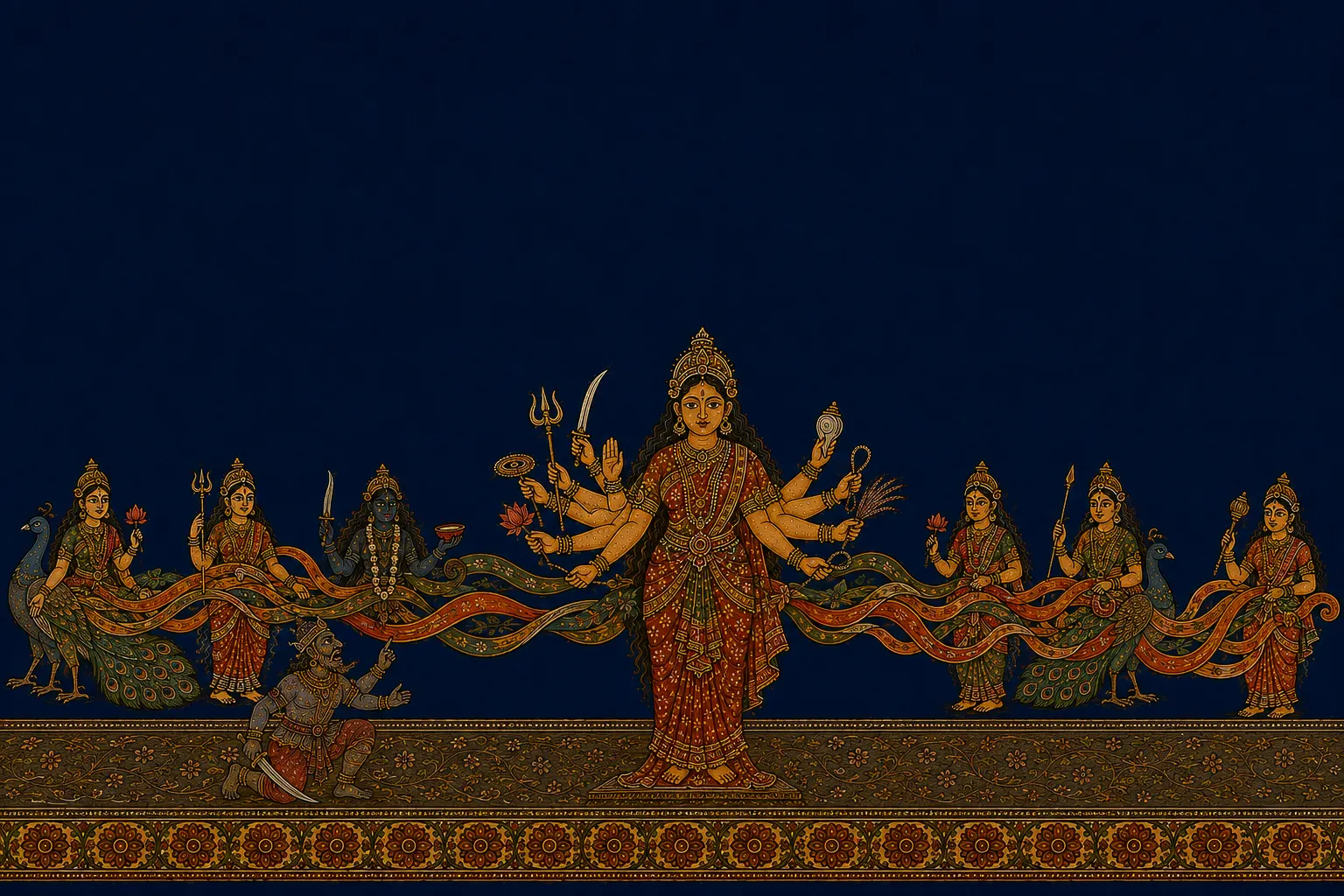
"Ekaivaham jagaty atra dvitiya ka mamapara — I alone am here in this world; who else is there beside me? Look, wretch — all these goddesses are my own powers. They are returning into me now."

The powers return

As she spoke, Brahmani and all the other goddess-powers returned to her body, one by one.

Only Ambika remained on the field.

"I stood here in my many forms, by my own power," the Goddess said. "That power I have drawn back in. Now fight — in earnest."

The duel in the sky

Then the single combat between Shumbha and the Goddess began. The gods, the yakshas, the gandharvas, the siddhas — all stopped to watch.

They fought in the sky and then on the earth, weapon against weapon and finally fist against fist.

Again and again Shumbha rose; again and again the Goddess brought him down.

The final blow

At last the Goddess drove her spear clean through Shumbha's chest.

He fell — and as he fell, the sky, the earth, the sea all went quiet. The wind that had stopped began to move; the fire that had gone out was lit again.

The gods praised her in the hymn known as the Narayani Stuti. She promised that whenever the world was in danger, she would return in new forms — as Raktadantika, Shakambhari, Bhramari and others. Then she vanished, leaving behind the promise of her return.

Note: "Ekaivaham jagaty atra" — I alone am here in the world — is one of the most important lines in the tenth chapter of the Devi Mahatmya. In Shakta readings, it is among the clearest declarations of the Goddess's supremacy and oneness. The matrikas' return to her is also part of the text and directly answers Shumbha's claim that she cannot fight alone.

Source: from several texts, I am alone

Now — how much stayed with you?

What happened?

What came out of Nishumbha's body when he fell?

  • Another copy of Raktabija
  • Shumbha, in hiding
  • Nishumbha's soul, as smoke
  • Another warrior, half out, shouting "Stop, stop!"
Read the whole story — One more, coming out of a body

The scene echoes the end of Mahisha: there he was coming half out of the buffalo's mouth; here another warrior comes out of Nishumbha's body.

Both times the asura is caught between two forms, and the Goddess strikes in exactly that unsteady moment.

Her laughing is particular — this is not a moment of fear or of rage. The asura's last trick makes her laugh.

Who said it?

"You are giving yourself airs about your own strength — when you do not fight alone at all. You fight leaning on all these goddesses." — who said this, and to whom?

  • Nishumbha, to the Goddess
  • Shumbha, to the Goddess
  • The gods, to the Goddess
  • Kali, to Chandika
Read the whole story — A taunt that demanded an answer

Shumbha's charge is clever: he does not challenge her strength but her singleness — you are many, so your pride is false.

This is the real battle of the whole last charita, not the weapons. Shumbha has asked the question Devi-Charit has been asking all along: is the Goddess one, or many?

And her answer is not a weapon but an act — she draws every form back into herself.

Why is that?

Why did the Goddess draw all her powers — the Mothers, Kali, Shivaduti — back into herself?

  • To answer Shumbha's taunt
  • Because the Mothers were tired
  • Because the gods asked for their powers back
  • Because fighting alone was her vow
Read the whole story — From many to one, by her own choice

The Devi Mahatmya's line is "ekaivaham jagaty atra dvitiya ka mamapara" — "I alone am in this world; who is there besides me?"

It connects straight back to chapter 1, Vak's "I am the one", and gives it a dramatic form: the Goddess does not argue, she demonstrates — nine goddesses walking back into one body.

That is the spine of Devi-Charit: she is made from many gods' defeat, she fights in many forms, and when asked she is one — and it is her choice.

Fact

How did the Goddess finally kill Shumbha?

  • By drinking his blood, as with Raktabija
  • With trident and sword between two forms, as with Mahisha
  • By driving her spear clean through his chest
  • By binding him in a noose and giving him to the lion
Read the whole story — One spear, one silence

Shumbha's end is the plainest of them all — no trick, no copies, no changing shape. Only a single duel and a spear.

It is deliberate: Shumbha had challenged her to fight alone, and she killed him in exactly that way — alone, face to face.

Creation going quiet as he fell says how large this battle was — the whole last charita, nine chapters of it.

Who am I?

I am the greatest line in the Devi Mahatmya. The Goddess speaks me when an asura taunts her with being many. I mean: "I alone am in this world; who is there besides me?" Which line am I?

  • "Ya devi sarvabhuteshu…"
  • "Aham rudrebhir vasubhish charamy aham"
  • "Garja garja kshanam mudha"
  • "Ekaivaham jagaty atra dvitiya ka mamapara"
Read the whole story — One line, and the whole gatha's answer

Every chapter of Devi-Charit repeats one question: is the Goddess one, or many? This line is its most direct answer, in the Devi Mahatmya's own words.

But the answer is not simple: she says "one" at the moment she has just been fighting in nine forms. Being many and being one both belong to her.

In chapter 1 Vak said "I am the one". Here the same thing is said in the middle of a war, in answer to a taunt, while nine goddesses walk back in.

Riddle

I challenged the Goddess to fight alone, thinking her strength was borrowed. In answer she drew every goddess into herself and beat me alone. My own challenge settled my end. Who am I?

  • Raktabija
  • Shumbha
  • Mahisha
  • Madhu
Read the whole story — A taunt that was a trap

Shumbha's challenge forced the Goddess to do the very thing that was worst for him — to fight alone, at full strength.

There is an irony in it: Shumbha thought her strength was divided. In fact she had divided it deliberately, and could gather it whenever she liked.

It is like Tripura in Shiv-Mahima, where the gods thought they had built the equipment of Shiva's victory — and he won without using it.

Put it in order

Which is the correct order of events?

  • Nishumbha's fight and the warrior coming out of his body → Shumbha's taunt that she fights on others' strength → the Goddess saying "I am alone" and the Mothers entering her → the Goddess standing in one form → the duel with Shumbha across sky, earth and mountain → her spear through Shumbha's chest and creation going quiet → the Narayani Stuti and the promise of future forms
  • Shumbha's taunt → Nishumbha's fight → the duel → the Mothers entering her
  • The Mothers entering her → Shumbha's taunt → Nishumbha's fight → the spear
  • The Narayani Stuti → the duel → Nishumbha → the taunt
Read the whole story — Taunt, gathering, duel, quiet

The real turn in this chapter is not a battle but a taunt — Shumbha's question.

And the Goddess's answer is an act, not a sentence: nine goddesses walking back into one body. It is the largest scene in the whole last charita.

The chapter ends not on the duel or the quiet but on the promise — and that promise is the seed of both chapter 9 and chapter 12.

The texts disagree

What answer does the Devi Mahatmya give to "is the Goddess one or many", and what do other Shakta texts say?

  • The Devi Mahatmya says they are many separate goddesses
  • All Shakta texts agree there are exactly nine
  • The Devi Mahatmya says plainly that she is one ("ekaivaham…") and that all forms are her power; the Devi Bhagavata and the tantras hold this too, but each puts a different form foremost
  • The question is never raised in any text
Read the whole story — One answer, several emphases

In principle every Shakta text gives the same answer to "one or many": one Mahadevi, many forms.

The difference is which form is taken as the root. In the Devi Mahatmya the three goddesses of the three charitas — Mahakali, Mahalakshmi, Mahasaraswati — are equals. The Shrividya tradition puts Lalita highest. Bengal's tradition puts Kali.

Devi-Charit keeps the question open in every chapter, because the answer is not one even inside the tradition.

Later tradition

In the Narayani Stuti of the Devi Mahatmya's eleventh chapter, what does the Goddess promise, that sets up the stories to come?

  • That she will never return
  • That she will marry Shiva
  • That she will give the gods their powers for good
  • That whenever trouble comes upon the world she will return in new forms
Read the whole story — A hymn that lists a future

The Narayani Stuti is the last great hymn of the Devi Mahatmya, and in it the Goddess names her own coming forms.

One of them — taking the name "Durga" by killing Durgamasura, and feeding the world as Shakambhari in a famine — is the story of chapter 12 of Devi-Charit.

So the Devi Mahatmya points beyond itself, and Devi-Charit takes up those pointers and makes chapters of them.

Who said it?

"Now I am in my one form. Now fight — and stand your ground." — who said this, and to whom?

  • Shumbha, to the Goddess
  • The Goddess, to Shumbha
  • Kali, to Shumbha
  • The gods, to Shumbha
Read the whole story — A challenge answered with a challenge

Shumbha had said "fight alone". In answer she did exactly that — gathered every form, and said: now stand your ground.

It is the Goddess's most self-assured moment in Devi-Charit: she is not reducing her strength, she is collecting it into one place.

The duel after it is short — because the real fight was the one in words, and she had already won it.