Chapter 7

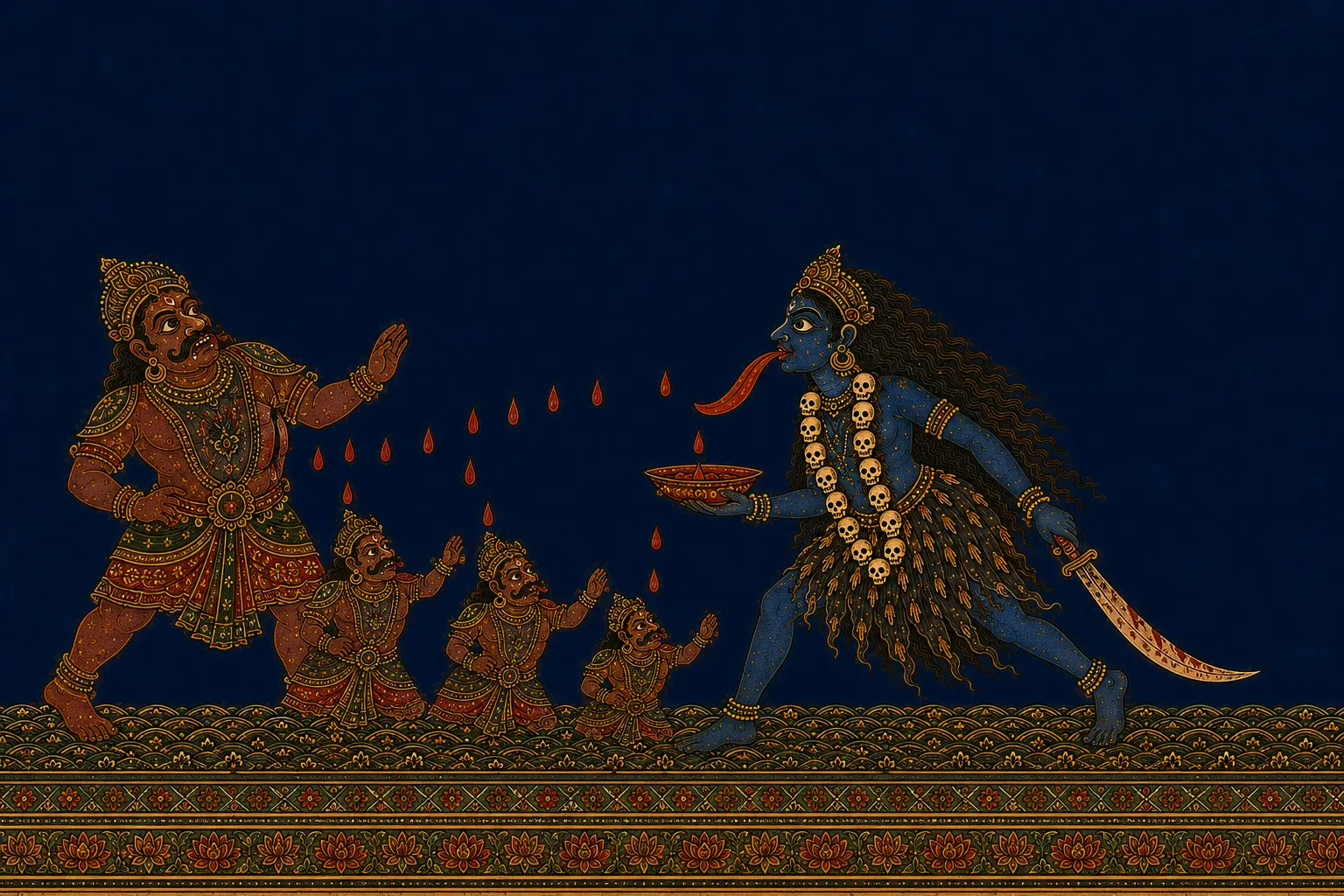
Kali and Raktabija

The Blood That Multiplied

Shiva as messenger

After the deaths of Chanda and Munda, Shumbha deployed his entire asura army.

A fierce power emerged from Ambika's body and sent Shiva to Shumbha with a message: "Give the gods back their heaven, or be ready for war."

By sending Shiva as her envoy, she earned the name Shivaduti.

The powers of the gods

As the asura forces gathered, the power of each god assumed female form and joined the Goddess on the battlefield.

Brahmani — on a swan, with a water-pot. Maheshvari — on a bull, with a trident. Kaumari — on a peacock, with a spear. Vaishnavi — on Garuda, with discus and conch. Varahi — with a boar's face. Narasimhi — with a lion's face. Aindri — on an elephant, with a thunderbolt.

Together they became known as the Sapta Matrikas — the Seven Mothers (Chapter 9).

Raktabija's power

Then Raktabija came to fight.

Every drop of his blood that touched the ground produced another Raktabija exactly like him.

Wounding him only made the danger worse — every blow multiplied him.

The field filled up

The mothers threw every weapon at Raktabija — thunderbolt, trident, discus, spear.

Every blow drew blood, every drop fell to the ground, and from every drop a new Raktabija stood up. Soon the field was full of hundreds and thousands of them.

The gods panicked. The more they struck, the more he grew.

Do not let the blood fall

Then Chandika said to Kali:

"Open your mouth wide. I will strike Raktabija and his doubles. Drink the blood before it reaches the ground, and devour each new demon as it forms."

Kali swept across the field with her tongue outstretched, catching every drop and devouring every new Raktabija as he appeared.

A demon with no blood

Now the blows kept landing, the blood kept flowing — but not a drop reached the ground.

No new double appeared. Gradually, all his blood ran out.

Drained and powerless, he fell. The power that had made him seem invincible had been undone: Kali had denied his blood the ground it needed.

Note: This episode is in the eighth chapter of the Devi Mahatmya. Raktabija's power and Kali's drinking of the blood are both in the original text. The powers that come into the battle are Brahmani, Maheshvari, Kaumari, Vaishnavi, Varahi, Narasimhi and Aindri; Kali-Chamunda fights alongside them. Shiva being made the messenger — "Shivaduti" — is in that text; the Shakta reading takes it as a mark of the Goddess's supremacy.

Source: from several texts, Kali and Raktabija

Now — how much stayed with you?

Fact

What was Raktabija's boon?

  • That no god could kill him
  • That he could change shape at will
  • That from any drop of his blood falling on the ground, another Raktabija exactly like him would be born
  • That only a woman could kill him
Read the whole story — A boon that grew with every wound

His name means "blood-seed" — every drop a seed, and out of each one a new asura grows.

The boon makes him the most dangerous thing on a battlefield: every attempt to kill him multiplies him.

The answer did not come from force — nobody hit him harder. It came from a trick: do not let the blood land.

Why is that?

Why could only Kali solve the Raktabija problem?

  • Because Kali's way of destroying is eating and drinking
  • Because Kali was the fastest runner
  • Because Kali knew about the boon
  • Because only Kali had the skull-staff
Read the whole story — Only the one who eats can stop it

In chapter 6 Kali chews and swallows an army — Durga kills with a trident, Kali eats.

Against Raktabija that difference becomes the point: trident, discus, thunderbolt — every weapon multiplies him. Only drinking stops him.

Each form of the Goddess is for a different kind of problem. Here Kali's fierceness is not an option but a necessity.

Who said it?

"Open your mouth wide. Drink the blood before it reaches the ground." — who said this, and to whom?

  • Shiva, to Kali
  • The gods, to Kali
  • Brahmani, to Kali
  • Chandika (Ambika), to Kali
Read the whole story — A plan made by two goddesses

The answer to Raktabija is a pair's plan: Chandika strikes, Kali drinks. Neither could have won alone.

It is the most practical form of the "one or many" spine of Devi-Charit: the Goddess is in two bodies, working one plan.

In chapter 8 Shumbha will taunt her with exactly this — that she does not fight alone — and she will answer by drawing them all back into herself.

What happened?

What happened when the Mothers struck Raktabija?

  • Raktabija died at once
  • The blood from every wound fell to the ground, and out of every drop a new Raktabija stood up
  • Raktabija split into two pieces
  • The Mothers tired and fell back
Read the whole story — Every blow, one more enemy

It is the most inverted scene in any battle: the better you fight, the more enemies there are.

The gods' panic was earned — they had no answer to it. The Mothers are the gods' own powers, and here those powers were useless.

The answer came from a different kind of goddess — Kali, who is no god's power but a body made out of the Goddess's own anger.

Who am I?

I made Shiva my messenger and sent him to Shumbha — to give the gods back heaven, or fight. In other traditions a goddess is a god's helper; here Shiva is my messenger. Who am I, and how did I get that name?

  • Kali
  • Vaishnavi
  • Shivaduti
  • Brahmani
Read the whole story — A name that reverses the relation

"Shivaduti" simply means "she whose messenger is Shiva". In the Devi Mahatmya the Goddess earns the name from this errand.

It is a sharp form of the spine of Devi-Charit: here Shiva is in the Goddess's service, not the reverse. In Shiv-Mahima, Parvati is Shiva's wife; in Devi-Charit, Shiva is the Goddess's messenger.

The same reversal returns in chapter 13 for Lakshmi and Saraswati — called somebody's wife by one tradition, and an independent power by another.

Riddle

Every drop of my blood doubled me, so to wound me was to increase me. I died when a goddess spread her mouth so wide that not one drop of mine reached the ground. Who am I?

  • Raktabija
  • Mahisha
  • Madhu
  • Shumbha
Read the whole story — A boon that turned against itself

Raktabija is the cleverest asura in Devi-Charit — his boon inverts every ordinary strategy of battle.

But his defeat came out of the same boon: his blood was still making copies — they were simply being made inside Kali's mouth instead of on the ground.

It is like Bhasmasura in Shiv-Mahima: the boon was never revoked, its effect was only turned toward a different place.

Put it in order

Which is the correct order of events?

  • The field filling with Raktabijas → the Mothers arrive → Shivaduti sends her messenger → Kali drinks the blood
  • Kali drinks the blood → Raktabija's boon → the Mothers strike → Raktabija falls
  • Shivaduti sends her messenger → Raktabija falls → the Mothers arrive → Chandika instructs Kali
  • Shumbha brings out his whole army → Ambika sends Shiva as her messenger, earning the name Shivaduti → the gods' powers arrive in the form of the Mothers → Raktabija comes out to fight → the Mothers' blows fill the field with Raktabijas → Chandika tells Kali to spread her tongue → Kali drinks every drop and Raktabija falls bloodless
Read the whole story — From a messenger to a dried-out asura

This chapter has two halves: first the Goddess's side gathers — the Mothers, Shivaduti — and then an asura arrives against whom that whole assembly is useless.

The turn in the middle is Chandika's instruction, where the story swings from "the Mothers against Raktabija" to Kali's tongue.

The chapter ends with Raktabija's fall, but Shumbha and Nishumbha are still standing — they are in the next chapter.

The texts disagree

In this story, are the Mothers — the gods' powers — the Goddess's helpers, or her forms?

  • All texts say they are greater than and separate from the Goddess
  • In the Devi Mahatmya they come out of the gods' bodies and fight alongside her; but in chapter eight she draws them back into herself and says they are all her own forms
  • They are only folk goddesses, not in the Sanskrit texts
  • In every text they are exactly seven
Read the whole story — Helpers, or forms — or both

Here the Mothers come out of the gods' bodies — they are the gods' power, one goddess to each god.

But in the next chapter the Goddess pulls them back into herself. Then they are her forms.

It is the most dramatic form of the "one or many" question, and Devi-Charit opens it separately in chapter 9, the Seven Mothers.

Later tradition

One explanation for Kali's hanging tongue in her images comes from this very story — what is it?

  • That Kali is thirsty and asking for water
  • That Kali is laughing
  • That Kali drank Raktabija's blood with her tongue spread, before it could reach the ground
  • That Kali drank poison, as Shiva did
Read the whole story — One tongue, two explanations

This story's explanation: Kali's spread tongue is the instrument with which she stopped Raktabija's blood — so it became her greatest sign.

In Bengal there is a second and more widespread one: Kali grew so fierce in the slaughter that she did not recognise Shiva under her feet, and on recognising him bit her tongue in shame.

Devi-Charit records both — the first from this chapter, the second from living folk tradition.

Who am I?

We are seven goddesses, or eight. Each of us is the power of one god — Brahma's, Shiva's, Vishnu's, Indra's — and our mounts and weapons are his. Against Raktabija we proved useless. Who are we?

  • The Seven Mothers, the Sapta Matrika
  • The Navadurga, the nine forms
  • The Ten Mahavidyas
  • The Ashta Lakshmi
Read the whole story — Every god's strength, in a woman's form

The Mothers are among the largest claims in Devi-Charit: the gods' strength is in fact a female power, one to each god.

Their uselessness against Raktabija is necessary — it shows that some problems are solved not by the gods' power but by the Goddess's own fierce form, Kali.

The Mothers have their own full story and image-tradition in chapter 9 — here they appear in the Raktabija scene, and in chapter 8 the Goddess draws them back in.