Chapter 9

The Seven Mothers

The Mothers of Battle and Temple

The mothers who entered the battle

In the Devi Mahatmya's battle with Raktabija, several powers of the gods join the fight: Brahmani, Maheshvari, Kaumari, Vaishnavi, Varahi, Narasimhi and Aindri. Kali-Chamunda fights beside them.

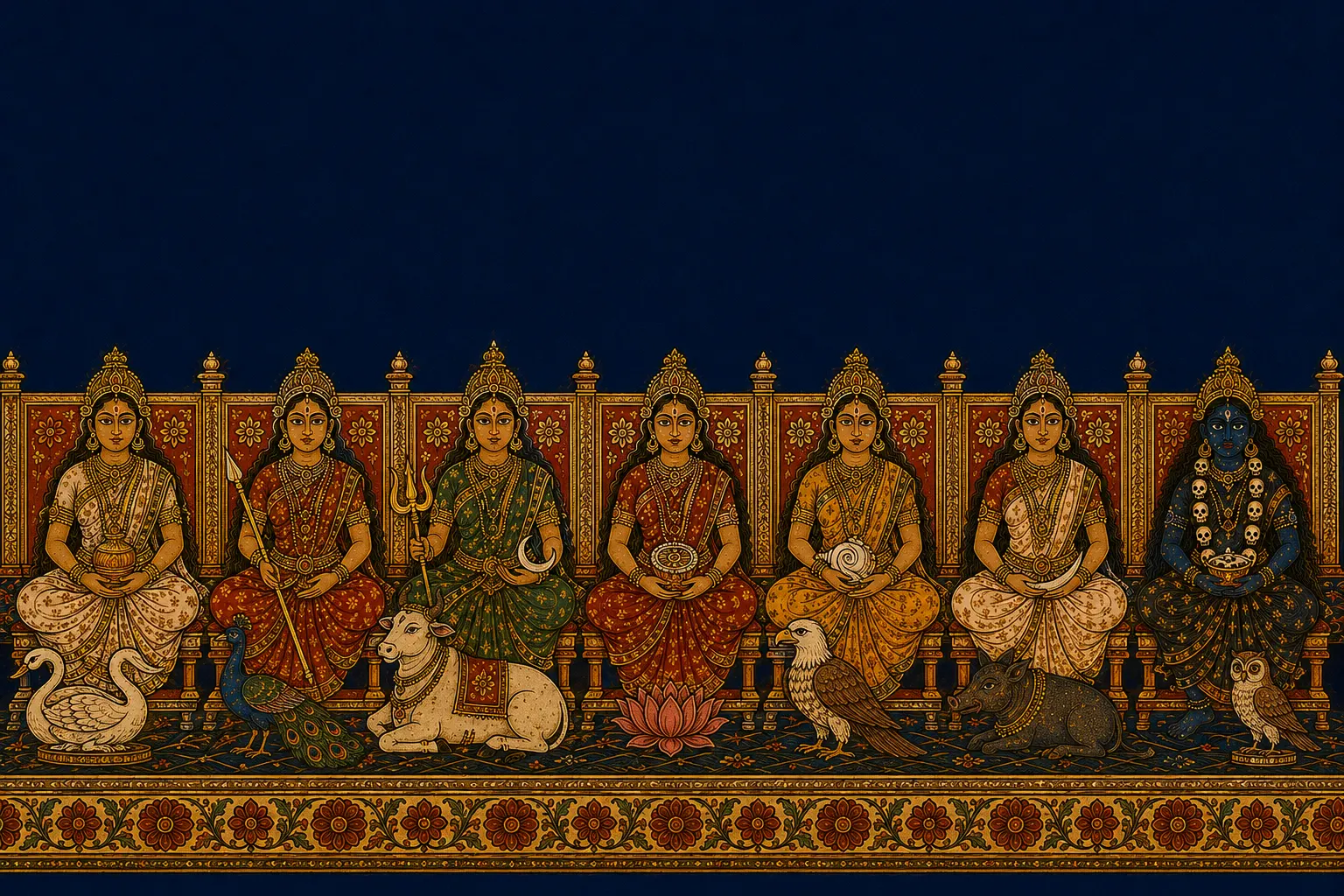
Each carries the mount and weapon of the god whose power she is — Brahmani on a swan with a water-pot, Maheshvari on a bull with a trident, Kaumari on a peacock with a spear, Vaishnavi on Garuda with discus, conch and mace, Varahi boar-faced, Narasimhi lion-faced, Aindri on an elephant with a thunderbolt.

The standard temple list

The "Saptamatrika" group that later became standard in temple art and sculpture has a slightly different list: Brahmani, Maheshvari, Kaumari, Vaishnavi, Varahi, Aindri and Chamunda.

Here Chamunda takes the seventh place instead of Narasimhi.

The textual and iconographic lists therefore differ, although they are often treated as identical.

The blood of Andhaka

The mothers have another major story, and it is tied to Shiva.

A demon named Andhaka was fighting Shiva, and every drop of his blood produced another Andhaka.

In one version preserved in the Matsya Purana, Shiva brings forth the Mothers so that they can drink Andhaka's falling blood. The order of this battle and of the mothers' origin changes from Purana to Purana, so it should not be read simply as another version of the Devi Mahatmya's Raktabija story.

Their hunger remains

But once the mothers had tasted blood, their hunger did not subside.

They ranged through the three worlds devouring living things. The gods were alarmed.

In the tradition tied to the Matsya Purana, Narasimha steps forward, calms them and sets them to protect the world. Other texts tell this differently.

Goddesses of children

One layer of the mothers is older than the Devi Mahatmya.

In the Mahabharata, the *matrigana* — the band of mothers — gather around the boy Skanda. Some protect children; others are "seizers" (*graha*) associated with childhood illness. They must be appeased with offerings, worship and food placed at crossroads.

The Matrikas, then, are more than warriors. They are also bound to birth, illness and death — figures who inspire fear as well as devotion.

Seven on a temple wall

On the walls of old temples the mothers are often found seated in a row — seven, in the same posture, each with her mount.

Virabhadra often appears at one end of the row and Ganesha at the other. At sites such as Ellora, Aihole and Udayagiri, the group appears in recognisable sculptural arrangements. By the Gupta period the group is clearly established in sculpture.

In the Matrikas, motherhood is not simply gentle. They protect and fight, but they are also associated with disease and, in many older traditions, must be kept calm and content.

Note: By the Gupta period (4th–5th century) the sculpture of the Saptamatrika group is clearly established. Their coming into the Devi Mahatmya (in the Raktabija battle) and their merging back into the Goddess (after Shumbha's charge) are both in the original text. The story of Andhaka's killing is found in the Matsya Purana and other Puranic traditions in different forms. Groups of seven or eight matrikas are also found in temples; they are usually identified by their mounts, their posture, and the marks of the gods whose powers they are held to be. "Matrika" means "mother."

Source: from several texts, The Seven Mothers

Now — how much stayed with you?

Fact

How many Mothers are there, and what is each one?

  • Exactly nine, like the nine days of Navaratri
  • Seven, sometimes eight
  • Exactly ten, like the Mahavidyas
  • Countless, one to every household
Read the whole story — Every god's strength, as a mother

The central idea is direct: the gods' strength is in fact a female power, and it is a "mother" — but this mother is not gentle.

Brahmani, Maheshvari, Vaishnavi, Aindri — the names are built with a feminine suffix meaning "the power of" or "the wife of". The names themselves attach them to a god.

Chamunda is the exception — she came not from a god but from the Goddess's own anger (chapter 6). Which is why she is the fiercest of them, the cremation-ground Matrika.

Whose son?

Whose power is the Matrika "Vaishnavi", and what are her mount and weapon?

  • Shiva's; on a bull, with a trident
  • Brahma's; on a swan, with a water-pot
  • Indra's; on an elephant, with the thunderbolt
  • Vishnu's; on Garuda, with discus, conch and mace
Read the whole story — The source is in the name

Every Matrika's name is made from her god's: Vaishnavi (Vishnu), Brahmani (Brahma), Kaumari (Kumara, Kartikeya), Aindri (Indra), Varahi (Varaha).

And each carries the same mount, the same weapon, the same crown as her god. That is how they are told apart in a carving.

It puts the "one or many" question another way: are these seven separate goddesses, or seven names of one, or the seven powers of seven gods? All three answers exist in the tradition.

What happened?

What part did the Mothers play in Shiva's battle with Andhakasura?

  • Andhaka had a boon like Raktabija's
  • The Mothers killed Andhaka outright
  • The Mothers fought on Andhaka's side
  • The Mothers have no part in this story
Read the whole story — A second Raktabija

The Andhaka story — in the Shiva Purana, the Matsya Purana, the Vamana Purana — repeats the Raktabija story with Shiva in the Goddess's place, and the whole company of Mothers in Kali's.

It shows that "do not let the blood land" is not a one-off solution but a recurring strategy — and that it needs a fierce, devouring power to carry out.

The difference is that after Raktabija, Kali stopped. After Andhaka, the Mothers did not.

Why is that?

Why did the Mothers have to be calmed after Andhaka was killed?

  • Because their hunger did not stop once they had tasted blood
  • Because they were angry with Shiva
  • Because the gods wanted their powers back
  • Because they had defeated Shiva
Read the whole story — A hunger that did not go out

This is what is most particular about the Mothers: they are called up for one task, and after the task they do not return on their own.

It is the reverse of chapter 8, where the Goddess gathered every form into herself in a moment. Once the Mothers are separate, they are hard to gather.

So they were given places and worship — not out of fear but for satisfaction. It is another form of the spine of Devi-Charit: the Goddess does not go back, and her many pieces go back even less.

Who am I?

I am one of the seven Mothers, but I am no god's power. I was made from the Goddess's own anger, and I took my name by cutting off two asuras' heads. I am the fiercest of the Mothers, and I belong to the cremation ground. Who am I?

  • Varahi
  • Chamunda
  • Maheshvari
  • Aindri
Read the whole story — One in the row who is unlike the rest

Six of the seven are some god's power — name, mount and weapon all his. Chamunda alone is not.

She comes from the Devi Mahatmya (chapter 6); the other six have roots in an older Vedic and folk tradition.

She looks different in the carvings too — gaunt, all bone, sometimes with a sunken belly, with a vulture or a corpse. The other Mothers are calm, and resemble their gods.

Who said it?

"They shall be given places and worship of their own, so that they stay satisfied." — whose decision was this, after Andhaka was killed?

  • The Goddess's, in chapter 8
  • The Mothers' own
  • Shiva's, in some versions with Narasimha
  • Brahma's
Read the whole story — Satisfaction, not suppression

Worth noticing: Shiva does not defeat the Mothers or bind them. He gives them worship — which binds their hunger to a place and a rule instead.

That is why seven Mothers stand on the wall of every old temple. The place of worship is the outcome of this story.

And it connects to the village goddesses of chapter 14: Shitala and Manasa are also powers that must be kept satisfied — frightening and protecting at once.

Put it in order

Which is the correct order, across the Mothers' stories?

  • The Mothers appearing on temple walls → Raktabija → Andhaka → entering the Goddess
  • The Mahabharata's matriganas, goddesses of children and disease → the Devi Mahatmya, where they come as the gods' powers onto Raktabija's field → entering the Goddess (chapter 8) → the Andhaka battle with Shiva, and then being calmed → the seven-Mother row on temple walls
  • Andhaka → Raktabija → the Mothers entering the Goddess → the Mahabharata's matriganas
  • Raktabija → the Mahabharata's matriganas → Andhaka → entering the Goddess
Read the whole story — From folk to temple

The Mothers' layers run by age: first they were folk "mothers" — of birth, of illness, of the crossroads (the Mahabharata, the Kushana carvings).

Then the Devi Mahatmya made them the gods' powers and joined them to a great story.

Then the Shaiva tradition placed them beside Shiva in the killing of Andhaka.

And at last temple art gave them a fixed row — seven, between Virabhadra and Ganesha.

The texts disagree

Are the Mothers protecting mothers or frightening powers? What do the texts say?

  • All texts say they only protect
  • All texts say they are only warriors
  • Both
  • No text acknowledges the Mothers; they exist only in carvings
Read the whole story — A mother who is not gentle

"Matrika" means little mother, or one of a band of mothers. But in the tradition this is not a mother of tenderness.

In the early tradition the main reason for worshipping them was fear — childhood illness, the dangers of childbirth. The worship was a kind of settlement.

Devi-Charit does not hide the doubleness. The Mothers are the same Goddess, in pieces — and in pieces she is less governable still.

Who am I?

I stand at one end of the seven-Mother row — Shiva's fierce form, thousand-armed, the wrecker of Daksha's sacrifice. At the other end is Ganesha. Who am I?

  • Virabhadra
  • Nandi
  • Kartikeya
  • Bhairava
Read the whole story — Two guards for a row

Sapta-Matrika panels have a fixed arrangement: Virabhadra on one side — the one from chapter 3 of Shiv-Mahima — and Ganesha on the other.

What it means is that the Mothers need a frame — two powerful forms on either side, as though to hold their energy in.

It agrees with the Andhaka story: left alone the Mothers go out of control, so even in stone they are set between two guards.

Later tradition

Where are Sapta-Matrika carvings most found, and from what period?

  • Only in Bengal's temples, from the medieval period
  • Only in the Chola temples of the south
  • Only in modern calendar prints
  • On the walls of old temples across India
Read the whole story — Seven in stone

The Sapta-Matrika may be the oldest group image-tradition of the Goddess — older than single images of Durga or Kali.

Kushana-period sculptures from Mathura carry rows of seven mothers, often unnamed — the idea arrived in stone first, the names and the stories after.

It is an archaeological answer to the "one or many" question: the oldest image of the Goddess is not one, but seven.