Chapter 12

Shakambhari and Durgama

Shatakshi Becomes Shakambhari

The Vedas stolen

A demon named Durgama performed austerities and asked Brahma to place all the Vedic mantras known to the brahmins and gods under his control, and to grant him the power to defeat the gods.

Brahma granted the boon. The Vedas left the mouths of the brahmins and passed to Durgama.

Now no mantra could be remembered, and no sacrifice could be completed.

A hundred years of drought

With the sacrifices stopped, the gods received no offerings and began to weaken.

With the rites disrupted, the order associated with rainfall was lost as well, and the clouds stopped coming.

For a hundred years no rain fell. The rivers dried, the crops failed. People and animals began to die of hunger and thirst.

Tears from a hundred eyes

Those who were left prayed to the Goddess.

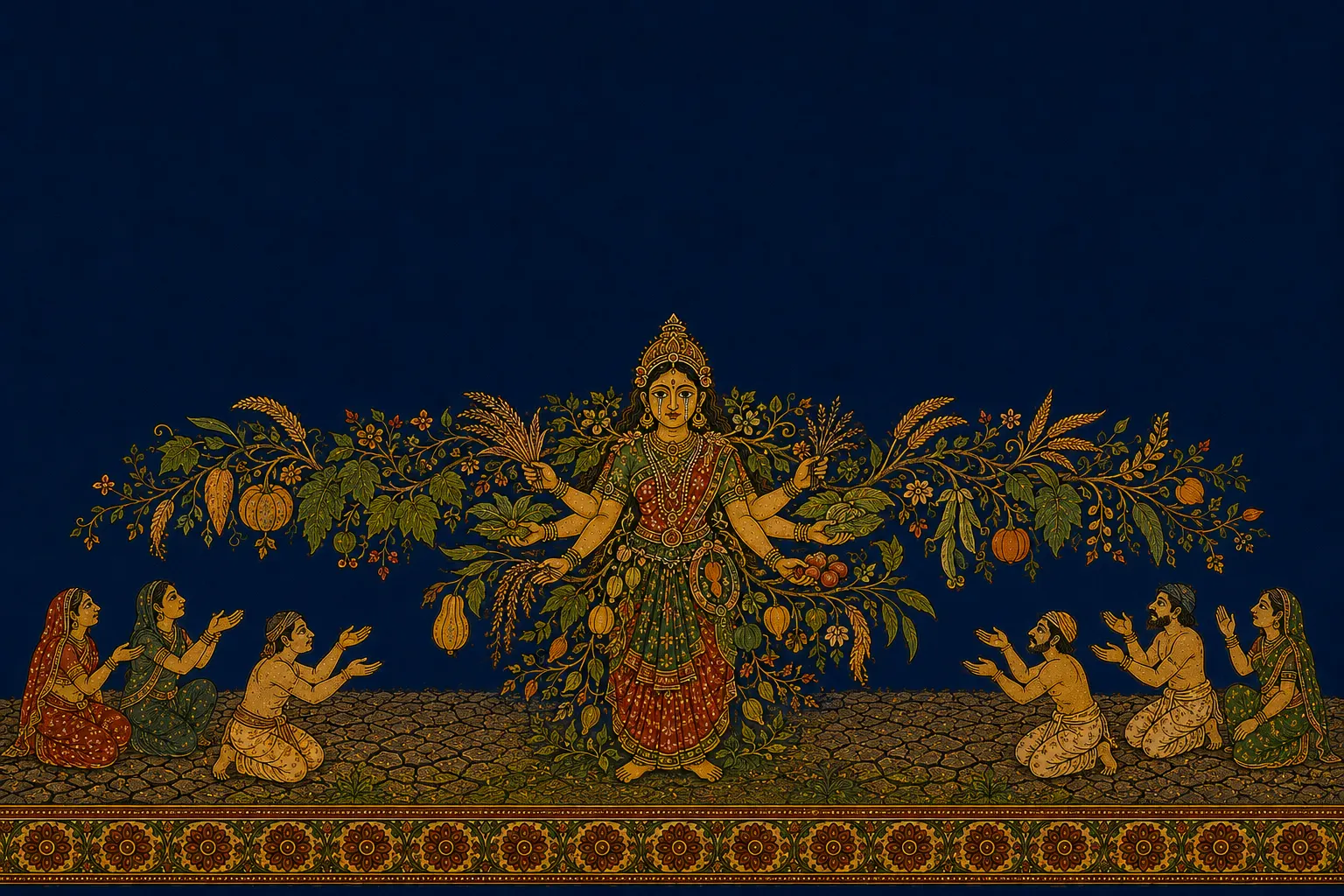
The Goddess appeared, not as a warrior, but as a compassionate presence. Seeing the suffering of the world, she wept from a hundred eyes.

She became known as Shatakshi, the Hundred-Eyed. Her tears poured down without ceasing until water filled the earth once more.

Food from her body

Then the Goddess brought forth food from her own body.

Fruit, greens, vegetables, roots and every kind of edible plant sprang from her body. For this she was named Shakambhari, she who sustains the world with vegetation.

Until the next harvest the Goddess fed the whole world from her body.

The war with Durgama

Durgama learned what had happened and marched against her with a vast army.

Many powers emerged from the Goddess's body — Kalika, Tara, Bhairavi, Bagala, Matangi, Tripurasundari and others. The battle continued for days.

By the tenth day, Durgama's army had been destroyed. On the eleventh, he entered the field himself. The Goddess brought down his horses and charioteer, pierced his eyes and arms, cut down his banner and finally drove five arrows into his chest. Durgama fell.

The Vedas return

The Vedas returned to the brahmins, the sacrifices began again, the rain came back.

After killing Durgama, the Goddess was also called Durga. Tradition brings several meanings together in this name: the slayer of Durgama; one who is impregnable like a fortress (*durga*); and one who rescues devotees from *durgati* — danger and suffering.

This fulfils the promise made after the Narayani Stuti in Chapter 8: the Goddess would appear as Shatakshi and Shakambhari, and would be called Durga after killing Durgama. Here she does more than wage war. She weeps for the world and feeds it from her own body.

Note: The full story of Shakambhari and Durgama is in the Devi Bhagavata Purana; the Devi Mahatmya also speaks of a future hundred-year drought and the name "Shatakshi." Among the powers that come out of the Goddess's body in the Durgama battle are several names from the later Mahavidya list — but in this episode the text does not count them as a fixed group under the name "ten Mahavidyas." Several derivations of the name "Durga" are found in the Puranas. In Rajasthan and several other regions the independent worship of Shakambhari continues today.

Source: from several texts, Shakambhari and Durgama

Now — how much stayed with you?

Fact

What did Durgamasura ask Brahma for?

  • Immortality
  • The four Vedas and their power
  • Rule over the three worlds
  • The gods' weapons
Read the whole story — He asked not for strength but for words

Durgama's cleverness is unlike Mahisha's or Raktabija's: he did not ask for a power with a crack in it. He asked for the Vedas — the knowledge and the procedure the whole order rests on.

Without the Vedas the gods themselves weaken, because their strength comes from the offerings of the sacrifice.

It connects to chapter 1, Vak, the goddess of the word: if the Goddess is the power of speech, then a thief of speech is attacking her directly.

Why is that?

Why did the rain stop when the Vedas were stolen?

  • Because Durgama imprisoned the clouds as well
  • Because the Goddess stopped the rain in anger
  • Because the sun burned hotter
  • Because the mantras that called the rain in the sacrifice were lost along with the Vedas
Read the whole story — Words the weather rested on

In the Vedic view a sacrifice is not only worship — it is the procedure that runs nature. The right mantra, the right offering, and rain comes, and the crop grows.

Durgama took the procedure itself. So the drought is not one season's but a hundred years'.

Which is why the Goddess's first act was not a battle. First she returned the rivers, with tears; then she gave food, out of her body; and the fighting came last of all.

Who am I?

Seeing the world's suffering, I wept from a hundred eyes, and those tears ran in the dry rivers. Then I grew greens and vegetables out of my own body and fed a starving world. My two names come from those two acts. Who am I?

  • Shatakshi, she of the hundred eyes, and Shakambhari, she who bears the vegetables
  • Durga and Chandika
  • Lakshmi and Annapurna
  • Ganga and Yamuna
Read the whole story — A goddess who weeps and who feeds

Shatakshi and Shakambhari are the most unlike forms in Devi-Charit: here the Goddess's strength is not a weapon but tears and food.

"A hundred eyes" means she sees every sorrow of the world at once, and that seeing itself becomes tears, and the tears a river.

It seems very far from the fierce Durga of the Devi Mahatmya — and the tradition holds them to be one. Which is the "one or many" question again: is the goddess who weeps the same as the goddess who kills a buffalo?

Who said it?

"I will become Shatakshi, then Shakambhari, and be called Durga for killing Durgamasura." — where and by whom was this promised?

  • By Brahma, giving Durgama his boon
  • By Shiva, to the gods
  • By the Goddess herself, in the Narayani Stuti of the Devi Mahatmya's eleventh chapter
  • By Narada, to the gods
Read the whole story — A promise kept a chapter later

At its end, in the Narayani Stuti, the Devi Mahatmya has the Goddess list her own future stories — Raktadantika, Shatakshi, Shakambhari, Durga, Bhramari.

This Shakambhari and Durgama story is that promise in full, and it is found not in the Devi Mahatmya's main body but in later chapters and in the Devi Bhagavata.

So the Devi Mahatmya points beyond itself, and Devi-Charit turns those pointers into chapters.

What happened?

What happened when the Goddess's tears fell on the ground?

  • The famine grew worse
  • They became rivers
  • The asura army drowned in the water
  • The ground split open
Read the whole story — Tears that became rivers

The image stands alone in Devi-Charit: the Goddess's sorrow turns directly into the world's relief.

Shatakshi's hundred eyes are not only for seeing — they are for weeping, and that weeping is the cure for a dry earth.

After it comes food out of her body — the Goddess gives water first, then grain. War comes third.

Riddle

One of my names came from killing an asura. That same name also means a fort. And that same name also means "she who takes away sorrow". I am one name with three meanings — which?

  • Chandika
  • Ambika
  • Katyayani
  • Durga
Read the whole story — One name, three roots

The derivation of "Durga" is not one thing in the tradition — three meanings run together, and all three are held to be right.

It is the "one or many" question of Devi-Charit in the form of language: one word, several meanings, and the tradition chooses none of them.

Worth noticing: the most famous of all the Goddess's names comes not from the killing of Mahisha but from this lesser-known story, the killing of Durgama — by one derivation.

Put it in order

Which is the correct order of events?

  • Durgama's austerity and his asking for the Vedas → the Vedas passing from the brahmins to Durgama → sacrifices stopped, a hundred years of drought, the rivers dry → the people's prayer and the Goddess weeping from a hundred eyes as Shatakshi → the rivers returning from her tears → the Goddess as Shakambhari and food from her body → the battle with Durgama and his death → the Vedas returning and the Goddess gaining the name Durga
  • The drought → the Goddess's battle → asking for the Vedas → Shakambhari
  • The name Durga → Shatakshi → Durgama's austerity → the drought
  • Shakambhari → Durgama's austerity → the drought → Shatakshi
Read the whole story — Theft, drought, tears, food, war

The shape of this chapter is quite unlike the battle chapters of the Devi Mahatmya: here the Goddess's first and longest work is saving, not killing.

The turn in the middle is Shatakshi's weeping — where the story swings from the tragedy of the drought to the Goddess's rescue.

The war comes last and is the shortest of it. And even after it she has work — returning the Vedas, setting the order running again.

The texts disagree

Where does the name "Durga" come from, according to the tradition?

  • Only from her being Mahishasura-mardini
  • Only from living on a mountain, a durga
  • More than one derivation runs together
  • The name is in no text, only in folk tradition
Read the whole story — A name without one root

"Durga" in Sanskrit is a word with several senses: difficult, impassable, hard to cross, an inaccessible place.

The Shakta tradition attaches all of them to the Goddess — and the Durgamasura story adds one more, a narrative one.

Devi-Charit does not call any one derivation the real one. It shows that even the greatest of the Goddess's names has no settled origin.

Who am I?

I am the asura who asked not for strength but for the Vedas. Because of me it did not rain for a hundred years. Killing me gave the Goddess her most famous name. Who am I?

  • Mahishasura
  • Raktabija
  • Durgama, Durgamasura
  • Bhandasura
Read the whole story — The asura who stole the order

Durgama is the most intellectual asura in Devi-Charit — he understood that the root of the order is not force but knowledge, the Vedas.

And his defeat came from that same insight: the Goddess first kept the world alive without that knowledge, with tears and food, and then killed him and gave the knowledge back.

It is another form of the spine of Devi-Charit: she does not only kill an enemy — she restores the order he broke, as Shiva has Daksha's sacrifice completed in Shiv-Mahima.

Later tradition

Which pilgrimage site and which date are tied to the goddess Shakambhari?

  • Kamakhya, and the eighth day of Navaratri
  • Vaishno Devi, and Diwali
  • Kalighat, and Kali Puja
  • The Shakambhari Shakti Pitha near Saharanpur, and another in Rajasthan, and Shakambhari Purnima, the full moon of Pausha
Read the whole story — A goddess whose festival is about food

On Shakambhari Purnima the Goddess is offered greens, vegetables and fruit — the very things she grew out of her body in the story.

It is one of her less-celebrated but very old festivals, and its emphasis is not on war or power but on grain and nourishment.

The Shakambhari Pitha near Saharanpur is an ancient Shakta site of north India, where the Goddess is worshipped as the giver of food.