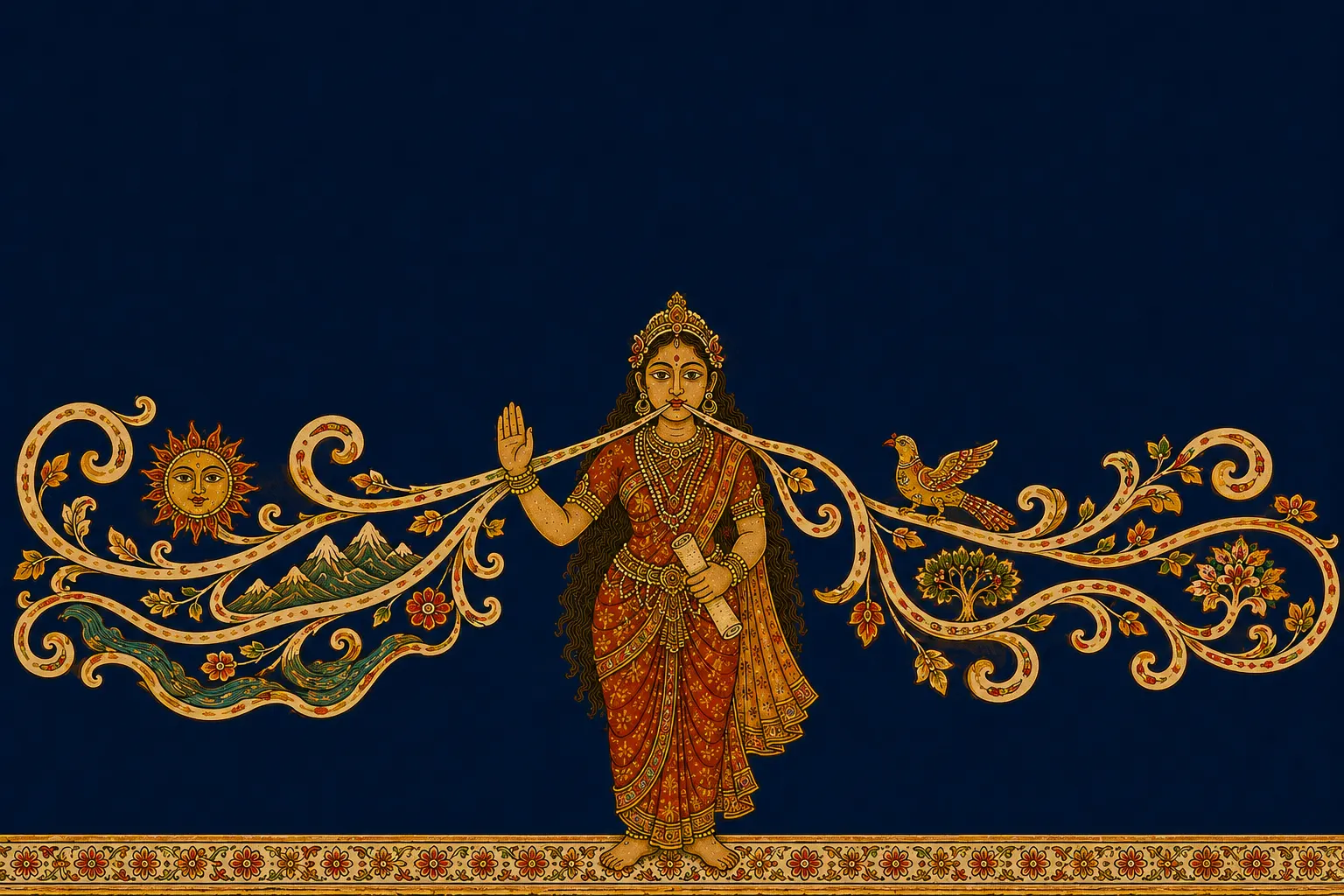
Chapter 1

Vak — I Am

The Goddess's own voice

A voice unlike the others

In most hymns of the Rigveda, a seer addresses a deity with praise or a request — for cattle, rain, children or victory.

But one hymn in the tenth book sounds entirely different. No god is being addressed. The speaker speaks for herself, in the first person, and declares that the gods praised elsewhere in the Rigveda all rest within her.

This is the Devi Sukta, Rigveda 10.125 — centuries older than the later temple traditions of Durga and the fully developed Shakta tradition.

Who was speaking

Tradition identifies the seer of this hymn as Vak Ambhrini — Vak, daughter of Ambhrina. She is one of the few women seers named in the Rigveda.

Vak means speech: the spoken word, the power without which no mantra can take effect and no sacrifice can be completed. In this hymn, Vak speaks as a divine presence that pervades the world.

In this ancient hymn the highest voice is not a war-goddess but Vak — the power of the word itself.

What she says

Vak begins by naming the powers she accompanies and sustains.

"I move with the Rudras, with the Vasus, with the Adityas. I hold up both Mitra and Varuna, Indra and Agni, the twin Ashvins."

"I give wealth to the worshipper who offers the oblation. I am the queen, the gatherer of riches. The gods have set me in many places."

"Whoever eats, sees, breathes or hears a spoken word does so through me. They may not know it, yet they dwell within me."

Not a prayer, but a declaration

Then the hymn turns.

"I bend the bow for Rudra, so that his arrow strikes the one who hates sacred speech. I make war for the people."

"I give birth to the father at the summit of this world. My home is in the waters, in the sea. From there I spread across every creature, and touch the sky above with my brow."

This is not a plea for divine favour. It is a declaration: not "give me," but "I am."

Later Shakta tradition

Centuries later, Shakta traditions came to see this Vedic voice as an early expression of the all-encompassing Goddess celebrated in texts such as the Devi Mahatmya.

The Devi Sukta later gained an important place in Durga Saptashati recitation. In many lineages, it is still recited alongside the Saptashati during Shakta worship and Navaratri.

For Shakta traditions, the hymn makes an important point: the Goddess is not merely a later Puranic development. A powerful, independent feminine voice is already present in Vedic literature. She is not introduced through a husband or a family. She speaks for herself.

The question behind the book

Vak says "I" — one voice, one speaker.

But the goddesses who come after her have a hundred names — Durga, Kali, Chamunda, Lalita, Lakshmi, Saraswati, Manasa. Are they all that one "I," or separate goddesses who were later made one?

This book does not force a single answer. Each chapter follows its own sources and keeps those differences visible.

Note: Tradition identifies Vak Ambhrini, daughter of Ambhrina, as the seer of the Devi Sukta (Rigveda 10.125). The hymn later acquired an important place in Durga Saptashati recitation and is read with the Saptashati in many traditions, but it is not part of the Devi Mahatmya's narrative. Later traditions associated Vak with Saraswati; the hymn itself presents her as an independent speaker, not as the consort of a god.

Source: from several texts, Vak — I Am

Now — how much stayed with you?

Fact

Which text holds the oldest voice of the Goddess?

  • The Devi Sukta of the Rig Veda (Book 10, hymn 125)
  • The Devi Mahatmya (Durga Saptashati)
  • The Devi Bhagavata Purana
  • The Kalika Purana
Read the whole story — One verse in the tenth book

Most of the Rig Veda's verses ask a god for something. The Devi Sukta runs the other way — in it the Goddess speaks for herself, in the first person.

The Shakta tradition treats this as its strongest evidence: the Goddess is as old as the Vedas, and there she is no god's assistant.

This gatha begins here rather than with a battle — because the first one to call herself supreme is a goddess of words.

Who am I?

I speak in one verse of the Rig Veda. I say that Rudra, Indra, Agni and Varuna are all held up inside me, and that whoever breathes does it by leaning on me. Who am I?

  • Saraswati, as she appears in the Rig Veda
  • Vak
  • Ushas, goddess of the dawn
  • Aditi, mother of the gods
Read the whole story — The goddess of the word, who spoke first

Vak means, plainly, "the spoken word". Here she is a goddess — the power without which no mantra and no sacrifice works.

Worth noticing: the first supreme goddess of the Shakta tradition is not a goddess of war but of utterance. Durga and Kali come much later.

Later tradition merges Vak into Saraswati, and Saraswati returns in chapter 13 — carrying the question of whether she is anybody's wife.

Who said it?

By tradition, who composed and spoke the Devi Sukta?

  • The daughter of the sage Ambhrina
  • The sage Vasishtha
  • Vyasa
  • Markandeya
Read the whole story — A woman among the seers

Vedic tradition holds that some verses were composed by women seers — rishikas. Vak Ambhrini is the most famous of them.

There is a fine point here: the composer's name is Vak, and the goddess speaking is also Vak. In the tradition the two become one — the seer becomes the voice of the goddess she is describing.

That is the way the rest of the gatha works too: the goddess and her form, the speaker and the spoken-of, keep collapsing into each other.

Why is that?

Why is the Devi Sukta unlike the rest of the Rig Veda's verses?

  • Because it is the longest verse
  • Because it names no god
  • Because nobody in it asks a god for anything
  • Because it is not in Sanskrit but in some other language
Read the whole story — The one who gives, and does not ask

The usual shape of a Rig Vedic verse is praise, then petition — "O Indra, give us this." The Devi Sukta has no petition at all.

The roles are reversed: the gods are the ones held up, and Vak is the one holding. "To the one who offers oblation, I give the wealth."

That reversal is the spine of the whole of Devi-Charit: the gods make her, call her, ask her — and she gives, without ever becoming theirs.

What happened?

In the Devi Sukta, what does Vak say she does for Rudra?

  • She draws the bow for Rudra, so that his arrow strikes the enemy of the sacred word
  • She completes Rudra's sacrifice
  • She gives birth to Rudra
  • She asks Rudra for a boon
Read the whole story — The bow the goddess draws

This is the most startling line in the hymn: the bow is Rudra's, but the one drawing it is Vak. The weapon is his; the force behind it is hers.

The image returns later in Durga — every god hands her his weapon, and she wields them all at once. The Devi Sukta is the seed of that.

"The enemy of the sacred word" means whoever is hostile to speech, to mantra, to the verse itself. Vak is the goddess of the word, so her enemy is the word's enemy.

Riddle

Every verse in this book asks a god for something — cattle, rain, a son, a victory. Only I am different: I am the one who is asked. Which verse am I?

  • The Purusha Sukta
  • The Nasadiya Sukta
  • The Gayatri mantra
  • The Devi Sukta (Rig Veda 10.125)
Read the whole story — A verse that flows backwards

Among the famous philosophical hymns of the Rig Veda — the Purusha Sukta, the Nasadiya Sukta, the Hiranyagarbha Sukta — no deity declares its own supremacy in the first person.

The Devi Sukta stands alone in having a goddess say "I" and lay claim to the whole of creation.

That is why this gatha starts here — because the strongest argument the Goddess's tradition has is in this one verse.

The texts disagree

Is "the Goddess is the supreme power" an old idea or a later one? What do the texts and the scholars say?

  • All agree the idea did not exist before the Devi Mahatmya (5th–6th century)
  • All agree the idea is as old and as complete as the Vedas
  • The Shakta tradition holds it to be as old as the Vedas, on the strength of the Devi Sukta; many scholars hold that the Vedic Vak was a minor goddess of speech, and that the pan-Indian "Mahadevi" framework was built later, around the Devi Mahatmya, folding many separate goddesses into one
  • The idea exists only in Bengali folk tradition, not in Sanskrit texts
Read the whole story — One voice, or one synthesis

The Shakta argument: the Devi Sukta is in the Vedas, so the supremacy of the Goddess is no later invention.

The scholarly argument: Vedic Vak, Ushas, Aditi and Saraswati were separate minor goddesses. So were Durga, Kali, Parvati and the local village goddesses. Joining them all into one "Mahadevi" is the work of the Devi Mahatmya and what followed it.

Devi-Charit does not call either side right. It records that the question — one or many — comes from inside the tradition itself, and it will return in every chapter.

Later tradition

What place does the Devi Sukta have in Durga Puja and Navaratri today?

  • None; it is only recited in Vedic study
  • It is recited at the end, after the Saptashati
  • It is recited before the reading of the Durga Saptashati
  • It is recited only in South India, not in Bengal
Read the whole story — The verse placed at the front

Several parts are recited before the Devi Mahatmya itself — the Kavacha, the Argala, the Kilaka, and the Devi Sukta. Of these, the Rig Vedic Devi Sukta is the oldest.

Putting it first is itself a claim: the goddess of the Saptashati and the Vak of the Vedas are one, and the line between them is unbroken.

(Tradition also has a separate "Tantrokta Devi Sukta" inside the Devi Mahatmya — "ya devi sarvabhuteshu…" — but the one meant here is the Rig Vedic one, which is the oldest.)

Put it in order

Which is the correct order of events?

  • The Devi Mahatmya is written → the Rig Veda's Devi Sukta → today's Durga Puja
  • Vak's Devi Sukta in the Rig Veda → tradition merges Vak into Saraswati and the Mahadevi → the Devi Mahatmya is written, and puts that same hymn at the front of its worship → today, at Navaratri, it is recited before the Saptashati
  • Today's Durga Puja → the Devi Sukta → the Devi Mahatmya
  • The Devi Bhagavata Purana → the Devi Sukta → the Devi Mahatmya → Durga Puja
Read the whole story — From one verse to a festival

The shape of this chapter is a long line: a single Vedic verse, then something like a thousand years of quiet, then the Devi Mahatmya picking that verse up and setting it in front of itself, then today's Navaratri, where millions recite it before the Saptashati.

The turn in the middle is the Devi Mahatmya. That is where the scattered goddesses are joined into one Mahadevi, and Vak is taken to be that Mahadevi's oldest voice.

Which is why this chapter comes first: the other fourteen are all versions of this one claim.

Whose son?

What does Vak say in the Devi Sukta about herself and "the father"?

  • That she is Brahma's daughter
  • That she is a mind-born daughter of Prajapati
  • That she has no father and is self-born
  • That she "gives birth to the father on the summit of this world"
Read the whole story — The relation turned around

The line is "aham suve pitaram asya murdhan" — "I give birth to the father on the head of this world."

It is not only a poetic line. It is the root of the Shakta tradition: the Goddess is nobody's daughter and nobody's wife — she is the mother of the very "father" other traditions place at the top.

In chapter 13 the same question returns for Lakshmi and Saraswati — made into somebody's wife by Vaishnava and brahminical tradition, and made back into independent powers by the Shakta.