Chapter 6

The moon's curse

One night, a great many laddus, and a rule still kept today

A belly full of laddus

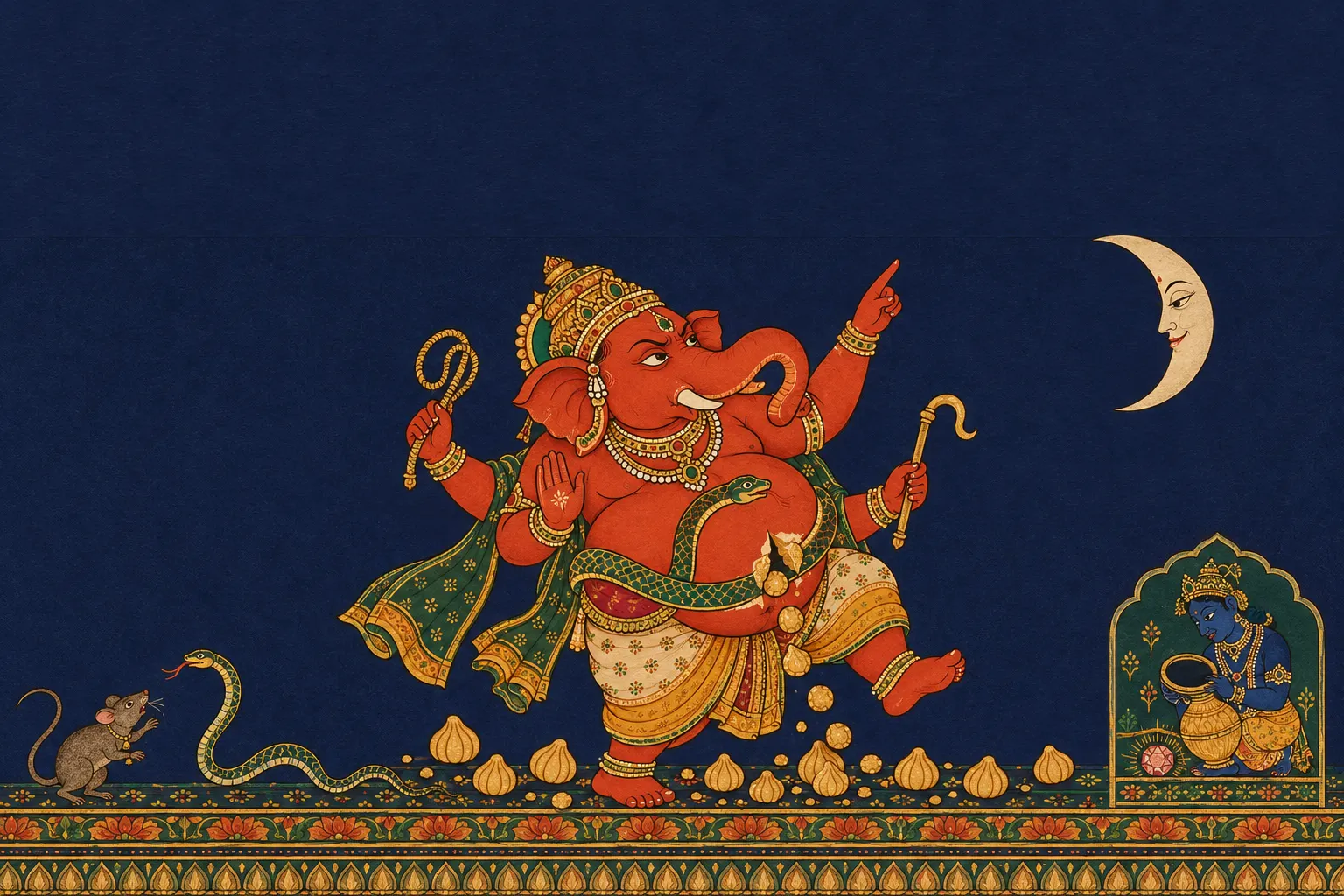
A widely told story, often attributed to the Skanda Purana, says that Ganesha once attended a feast and ate his fill of laddus.

On the way home he rode on his mouse, his belly heavy with food. A snake suddenly crossed their path. The mouse startled and leapt, throwing Ganesha to the ground.

His swollen belly burst open, and the laddus spilled everywhere.

A belt made of a snake

Ganesha calmly gathered them one by one, put them back into his belly, then picked up the same snake and tied it around his waist like a belt so that his stomach would not open again.

This is one traditional explanation for the serpent shown around his belly in Ganesha images.

The moon had watched the whole scene from the sky — and laughed.

Whoever looks at the moon

Ganesha cursed Chandra: "Whoever looks at you will be falsely accused and lose his good name."

The moon and the gods begged him to relent.

Ganesha softened the curse, limiting it to one night each year: Bhadrapada Shukla Chaturthi, the night of Ganesh Chaturthi.

And Krishna was caught by it too

Tradition then connects the curse to Krishna. On one Ganesh Chaturthi, Krishna is said to have accidentally seen the moon's reflection in a bowl of milk.

Soon afterward he was falsely accused in the affair of the Syamantaka jewel. That connection is why a traditional remedy for accidentally seeing the moon on Ganesh Chaturthi is to hear or read the story of the Syamantaka jewel.

Note: The story of the moon's curse is said to come from the Skanda Purana (the exact chapter was not confirmed in this check). Krishna's being caught in the Syamantaka accusation after seeing the moon that day is tied by tradition to this curse — that story is on this site at Krishna-Leela chapter 17. Dates: Ganesh Chaturthi falls on Bhadrapada shukla chaturthi, and many public celebrations culminate with immersion on Anant Chaturdashi (household observances may end earlier); Ganesh Jayanti is on Magha shukla chaturthi (mainly in Maharashtra); Sankashti Chaturthi is the krishna-paksha chaturthi of every month.

Source: from several texts, The moon's curse

Now — how much stayed with you?

What happened?

Why did Ganesha's belly burst on the way back from a feast?

  • Someone struck him
  • He had eaten poison
  • A snake crossed the path, the mouse startled and jumped, and Ganesha fell
  • He tripped while running
Read the whole story — A fall, and laddus

In a widely told moon-curse story, often attributed to the Skanda Purana, Ganesha eats laddus to his heart's content at a feast; the exact chapter has not been securely pinned.

Riding home, his belly full, his balance gone — and the mouse startles at a snake and jumps.

Ganesha falls, and the full belly bursts; all the laddus roll out onto the ground.

Fact

What did Ganesha tie around his belly so it would not open again?

  • A snake
  • A gold girdle
  • A silk sash
  • A rope
Read the whole story — A belt made of a snake

Ganesha got up, gathered every laddu and put them back into his belly.

Then he took that same snake — the one the mouse had startled at — and tied it around his belly like a belt.

This is why many images of Ganesha show a snake wound around his belly — it is a mark of that night.

What happened?

Seeing Ganesha fall and his belly burst, what did the moon do?

  • It helped
  • It turned its face away
  • It hid
  • It laughed
Read the whole story — A laugh, dearly paid

Above in the sky the moon had watched all of it — the fall, the bursting belly, the rolling laddus, the snake-belt.

And the moon laughed.

Ganesha's hand went up, and the next moment a curse came out.

Why is that?

What did Ganesha curse the moon with?

  • That it would go dark forever
  • That whoever looked at it would face false accusation and lose his good name
  • That it would wax and wane every day
  • That it would stop being visible from the earth
Read the whole story — Looking, forbidden

The curse was harsh — whoever looked at the moon would meet with blame he had not earned.

The moon and the gods begged forgiveness.

Ganesha softened a little and limited the curse — to one night only.

Fact

To which one night was the curse limited?

  • The night of Holi
  • Bhadrapada shukla chaturthi
  • The night of Diwali
  • The night of Sharad Purnima
Read the whole story — The night of his own festival

Ganesha bound the curse to the night of Ganesh Chaturthi — Bhadrapada shukla chaturthi.

This is why, still today, seeing the moon on Ganesh Chaturthi is held to be inauspicious — it is called "mithya dosha" or "kalank."

Ganesh Chaturthi begins on Bhadrapada shukla chaturthi; many public celebrations culminate with immersion on Anant Chaturdashi, though household observances may end earlier.

Later tradition

Which god had to bear a great false accusation because of this same curse?

  • Shiva
  • Rama
  • Arjuna
  • Krishna
Read the whole story — The moon, and a jewel

This story is told in full on this site in the seventeenth chapter of Krishna-Leela — the Syamantaka jewel, Prasena's death, and the finger pointed at Krishna.

Tradition ties this false accusation to Ganesha's curse on the moon.

This is why, if the moon is seen on Ganesh Chaturthi, the remedy given is to hear or read the story of the Syamantaka jewel.

What happened?

If the moon is seen by mistake on Ganesh Chaturthi, what remedy does tradition give?

  • Hearing or reading the story of the Syamantaka jewel
  • Keeping a fast
  • Bathing in the Ganga
  • Donating silver
Read the whole story — The story is the remedy

The reasoning is that if even a god like Krishna was caught in this blame, then by speaking his name and hearing his story the blame can be lightened.

In some places another folk remedy runs too — throwing a small stone onto a neighbour's roof, so that a minor false accusation is "spent" in advance.

Behind both remedies is the same thought: not to avoid the blame but to accept it and let it pass.

Fact

What is the difference between Ganesh Jayanti and Ganesh Chaturthi?

  • They are two names for the same festival
  • Jayanti is in spring, Chaturthi in winter
  • Ganesh Jayanti is on Magha shukla chaturthi (mainly in Maharashtra); Ganesh Chaturthi is on Bhadrapada shukla chaturthi
  • Jayanti is only in temples, Chaturthi only in homes
Read the whole story — Two chaturthis

Ganesh Jayanti is held to be Ganesha's "birthday" — in Magha (January–February), and it is celebrated especially in Maharashtra.

Ganesh Chaturthi (Bhadrapada, August–September) is the big ten-day festival with the installing and immersion of the image.

Besides these, the krishna-paksha chaturthi of every month is "Sankashti Chaturthi" — a fast to remove troubles.

Riddle

I laughed just once — and my punishment is that for one night a year I must not be looked at. Who am I?

  • The sun
  • Chandra
  • Rahu
  • Shukra
Read the whole story — A one-night boycott

The moon's laugh was no great crime — but it was a blow to Ganesha's dignity.

The curse was at first full and permanent; on the pleading it shrank to one night.

This is the way of the story — the punishment harsh, but always with room left for a reprieve.

Put it in order

What is the correct order of this story?

  • The moon laughs → Ganesha eats laddus → Ganesha falls → the curse
  • The curse → Ganesha falls → the moon laughs → he eats laddus
  • Ganesha falls → he ties the snake as a belt → he eats laddus → the moon laughs
  • Ganesha eats laddus at a feast → the mouse startles at a snake, Ganesha falls → he ties the snake as a belt → the moon laughs → the curse
Read the whole story — The laugh comes last

The whole story opens as a comic scene — the full belly, the unsteady walk, the frightened mouse.

It is only after the snake-belt is tied that the moon laughs — so the laugh is the last cause of the insult, not the first.

And the curse is the direct answer to that laugh — without delay.