Chapter 4

Two brothers, one fruit

A divine fruit, two brothers, and the condition of circling the world

Narada's mango

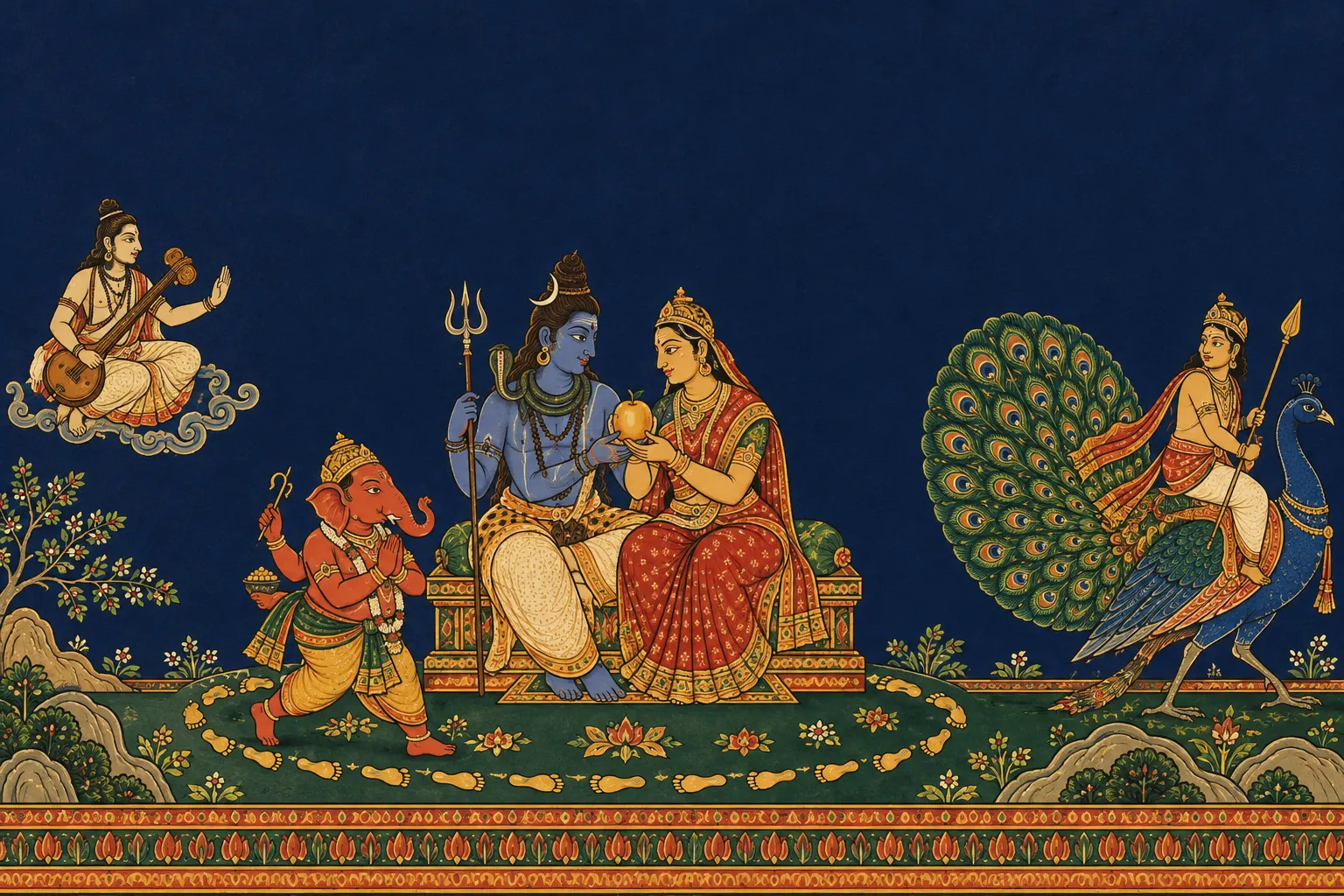
Narada arrived before Shiva and Parvati carrying a golden fruit. The story is especially famous in the Tamil Kanda Puranam tradition, where the fruit is remembered as a mango.

"This is no ordinary fruit," Narada said. "Whoever eats it will gain immortality and supreme knowledge."

Shiva showed it to his two sons, Ganesha and Kartikeya. Both wanted it, but the fruit could not be divided.

So Shiva proposed a contest: whoever travelled around the whole world three times and returned first would win it.

One flew, one walked

Kartikeya did not hesitate. He mounted his peacock and shot away, crossing mountains, rivers and seas.

Ganesha stayed where he was. His own vehicle was a mouse; trying to outrun a peacock made little sense. After a moment, he rose and walked once around Shiva and Parvati. Then a second time. Then a third time.

"You are my whole world," he told them. "To circle you is to circle the world."

Shiva accepted the argument and gave him the fruit. By the time Kartikeya returned from his journey, exhausted, the contest was over.

Two sisters, two sons

Another contest followed in a different set of traditions, this time over marriage. Both brothers wished to marry the two daughters of Prajapati.

The Shiva Purana names them Siddhi and Buddhi; the Brahmavaivarta Purana gives Riddhi and Siddhi. Ganesha wins this contest as well. Later traditions give him two sons, Kshema and Labha — or, in some North Indian tellings, Shubha and Labha.

Kartikeya, by contrast, leaves for the south. In the Tamil tradition he reaches the hill of Palani, gives up his ornaments and fine clothes, and takes the form of a young ascetic with only a loincloth and his spear. There he is worshipped as Murugan, Dandayudhapani.

The householder of the north, the celibate of the south

The difference survives in later regional traditions.

In much of North India, Ganesha is imagined as a householder, accompanied by Riddhi and Siddhi and associated with prosperity in the home.

In many South Indian traditions he is a brahmachari, unmarried and celibate. But the divide is not absolute: southern traditions also include forms of Ganesha with consorts.

Both ideas remain part of the living tradition.

Note: The mango and the circling-contest belong above all to the Tamil Kanda Puranam and later South Indian tradition (the Sanskrit Skanda Purana has related stories); the fruit grants immortality and supreme knowledge. Ganesha's consorts are named differently by different sources — Siddhi, Buddhi and Riddhi in varying combinations — and some traditions hold him unmarried; the sons are Kshema and Labha (or Shubha and Labha). The householder Ganesha of the north and the celibate Ganesha of much of the south are a real traditional difference — but not a clean north–south line, since consort forms are found in the south too. Kartikeya's losing and going to Palani is tied to the Tamil story of Murugan / Dandayudhapani.

Source: from several texts, Two brothers, one fruit

Now — how much stayed with you?

Fact

What was Narada's special fruit understood to represent in the best-known Tamil telling?

  • Only long life
  • Knowledge or wisdom
  • A kingdom
  • Great wealth
Read the whole story — A fruit that could not be shared

In the Tamil Kanda Puranam tradition Narada brings a golden fruit — remembered as a mango; related world-circling variants occur elsewhere too.

There was one fruit, and both sons wanted it. Dividing it was out of the question.

So Shiva set a condition — whoever is first to go three times around the whole world.

What happened?

How did Ganesha complete three circuits of the world?

  • He rode his mouse fast
  • He held Kartikeya back
  • He circled it in his mind through meditation
  • He circled his parents three times
Read the whole story — Winning the world sitting still

Kartikeya set off on his peacock like the wind — oceans, mountains, rivers falling away behind him.

Ganesha simply walked three circles around his parents and said, hands folded, that to circle them is to circle the whole world.

Shiva smiled and gave him the fruit. When Kartikeya returned, it was gone.

Who am I?

I set off on my peacock to go around the whole world, and when I returned I found the fruit had already gone to my brother. Who am I?

  • Ganesha
  • Indra
  • Kartikeya
  • Nandi
Read the whole story — The one who actually ran

Kartikeya (Skanda, Murugan) is Shiva and Parvati's other son, and his mount is a peacock.

In this contest he honestly went around the whole world — and still lost.

On returning he argued that he had covered more distance, but Ganesha's reading was accepted.

The texts disagree

What names are given to Ganesha's consorts in different texts?

  • Siddhi, Buddhi and Riddhi
  • Only "Radha" in every text
  • Every text agrees on "Riddhi and Siddhi"
  • Ganesha has no consort in any text
Read the whole story — Names that keep shifting

The Shiva Purana names Ganesha's wives Siddhi and Buddhi; the Brahmavaivarta Purana, Riddhi and Siddhi.

Riddhi means material abundance, Siddhi spiritual attainment — so they are also read as symbols.

And in much of South India Ganesha is held to be a brahmachari — with no consort.

Fact

This mango-and-circling contest belongs above all to which tradition?

  • The Braj tradition of North India
  • The Mangal-kavya tradition of Bengal
  • It is only in modern TV serials
  • The Tamil Kanda Puranam and South Indian tradition
Read the whole story — A story of the south

The Kanda Puranam is a great Tamil text centred on Kartikeya (Murugan) — and this mango-and-circling story is found there in fullest detail.

The Sanskrit Skanda Purana also has contest-and-circling episodes, but the "mango" form is best known in South India.

This is why Kartikeya's going south is tied to this story.

Why is that?

Why does Ganesha's marital status look different in North and South India?

  • Because Ganesha is not worshipped in the south
  • Because Hindu tradition was never of one mind on Ganesha's marital status
  • Because in the north Ganesha is not held to be Shiva's son
  • Because in the south Ganesha is worshipped in female form
Read the whole story — One god, two houses

In North India Ganesha is a householder — Riddhi and Siddhi at his side, bringing prosperity into the home. Married gods are seated indoors.

In much of the south he is a brahmachari — "the learned one with no wife to distract him," his power coming from his celibacy.

But it is not a clean north–south line — consort forms are found in the south too. Both traditions are alive.

Whose son?

Kartikeya, who lost the contest and went to Palani, is worshipped in the Tamil tradition under what name?

  • Ganapati
  • Murugan, Dandayudhapani
  • Ayyappa
  • Nataraja
Read the whole story — The ascetic of Palani

Kartikeya loses and goes south, to the hill of Palani — takes off his ornaments and robes, and is left with a loincloth and his spear.

In the Tamil tradition it is here that he is Murugan, Dandayudhapani ("the one with the staff-weapon in hand").

This reversal — Ganesha the householder, Kartikeya the celibate — is deeply tied to the story of the south.

Later tradition

Who are said to be Ganesha's sons in tradition?

  • Ganesha is held to have no sons
  • Rama and Lakshmana
  • Nala and Nila
  • Kshema and Labha (Shubha and Labha in some North Indian tellings)
Read the whole story — Shubha and Labha

Where Ganesha is held to be a householder, two sons are named from the consorts — Kshema (welfare) and Labha (gain), or Shubha and Labha.

"Shubh-Labh" is why the words are written on shop and house walls — it is a symbol of the Ganesha household's prosperity.

In the celibate tradition of the south this whole family side does not appear.

Riddle

I did not win the mango — I did not even move. And yet I won the whole world, just sitting there. Who am I?

  • Ganesha
  • Kartikeya
  • Narada
  • Nandi
Read the whole story — A clever answer

The condition was three circuits of the world. Ganesha caught not the words of the condition but its meaning.

"My parents are my world" — this argument is seen in the story as a test of wit, not a race.

This is why Ganesha is held to be the god of intelligence and discernment — not of strength.

Put it in order

What is the correct order of this story?

  • The condition is set → Narada brings the fruit → Ganesha wins → Kartikeya sets off
  • Kartikeya sets off → Narada brings the fruit → the condition → Ganesha circles
  • Narada brings the fruit → the condition is set → Kartikeya sets off on his peacock → Ganesha circles his parents → Ganesha wins
  • Ganesha circles his parents → Narada brings the fruit → Kartikeya sets off → the condition
Read the whole story — The fruit first, then the condition

The story begins with Narada's arrival — the fruit comes first, the dispute after.

The moment the condition is set Kartikeya is off; Ganesha rises then.

Everyone knows the end, but the order hides one thing: Ganesha did not wait for Kartikeya to return — he made his claim the moment he had walked the circle.