
Chapter 5
The broken tusk
He has one tusk broken — because he broke it himself
Someone who can write it down is needed
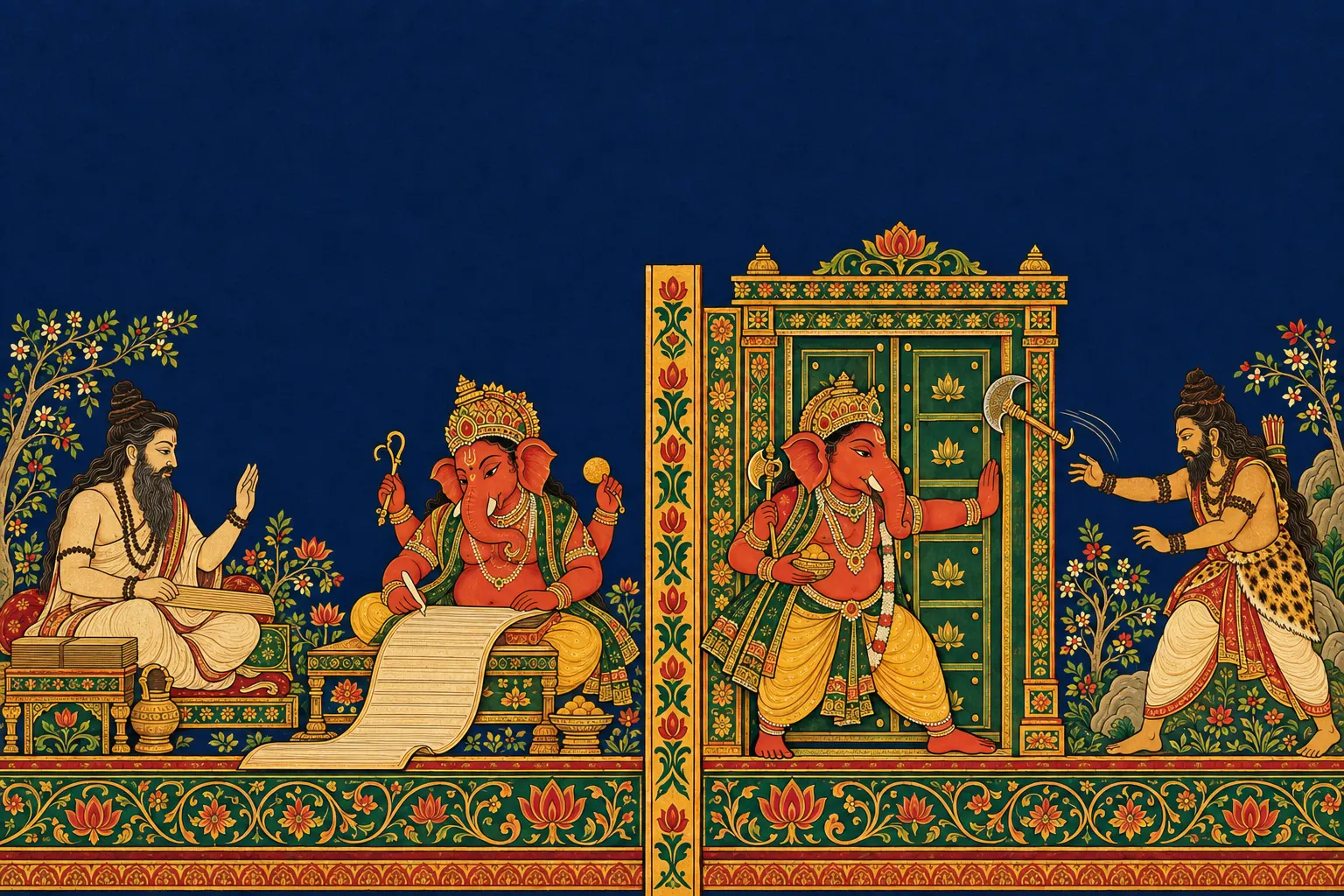
Vyasa had the Mahabharata in his mind, but he needed someone capable of writing it down as quickly as he could compose it. Brahma advised him to call Ganesha.
Ganesha agreed, but on one condition: "I will write only if my pen never stops. You must continue speaking without pause."
Vyasa answered with a condition of his own. "Then you must not write a single line until you have understood its meaning completely."
The arrangement gave Vyasa a way to keep pace. Whenever he needed time to think ahead, he could dictate a particularly difficult or tightly constructed verse. Ganesha would pause to understand it, and Vyasa would use those moments to compose what came next.
The pen broke, the tusk broke
A later popular addition to this story says that Ganesha's reed pen eventually snapped.
Stopping would have broken his agreement, so he immediately broke off one of his own tusks and used it as a writing implement. From this comes the familiar image of Ekadanta, "the one-tusked."
There is an important textual distinction here. The Ganesha-as-scribe episode itself is not part of the constituted text of the Mahabharata's critical edition; V. S. Sukthankar treated it as a later interpolation.
The dramatic detail in which the tusk becomes a pen is later still.
At the gate of Kailasa
Another tradition explains the broken tusk very differently.
In the Brahmanda and Brahmavaivarta Puranas, Parashurama comes to Kailasa to see Shiva while Shiva is in meditation. Ganesha is guarding the entrance and refuses to let him pass.
Parashurama, furious, hurls his axe at him. Ganesha could have resisted the weapon, but recognises it as an axe given to Parashurama by Shiva.
Rather than dishonour his father's gift, he accepts the blow. The axe strikes his tusk and breaks it.
One tusk, two reasons
In one story the tusk is sacrificed so that an epic can be written.
In the other, it is lost out of respect for Shiva's weapon.
Tradition kept both explanations — one image, two very different meanings.
Note: The story of writing down the Mahabharata is found in the introduction to the Adiparvan, but that section is not in BORI's critical edition — Sukthankar, editing the Adiparvan (1933), removed it as an interpolation; it survives only in some regional Sanskrit recensions. The dramatic detail of breaking off the tusk to keep writing is a further later layer on that same story. The Parashurama story is in the Brahmanda Purana and the Brahmavaivarta Purana (Ganesha Khanda, chapter 43). The two stories give the one broken tusk opposite meanings — a sacrifice for knowledge, and respect for a father's weapon.
Source: from several texts, The broken tusk