
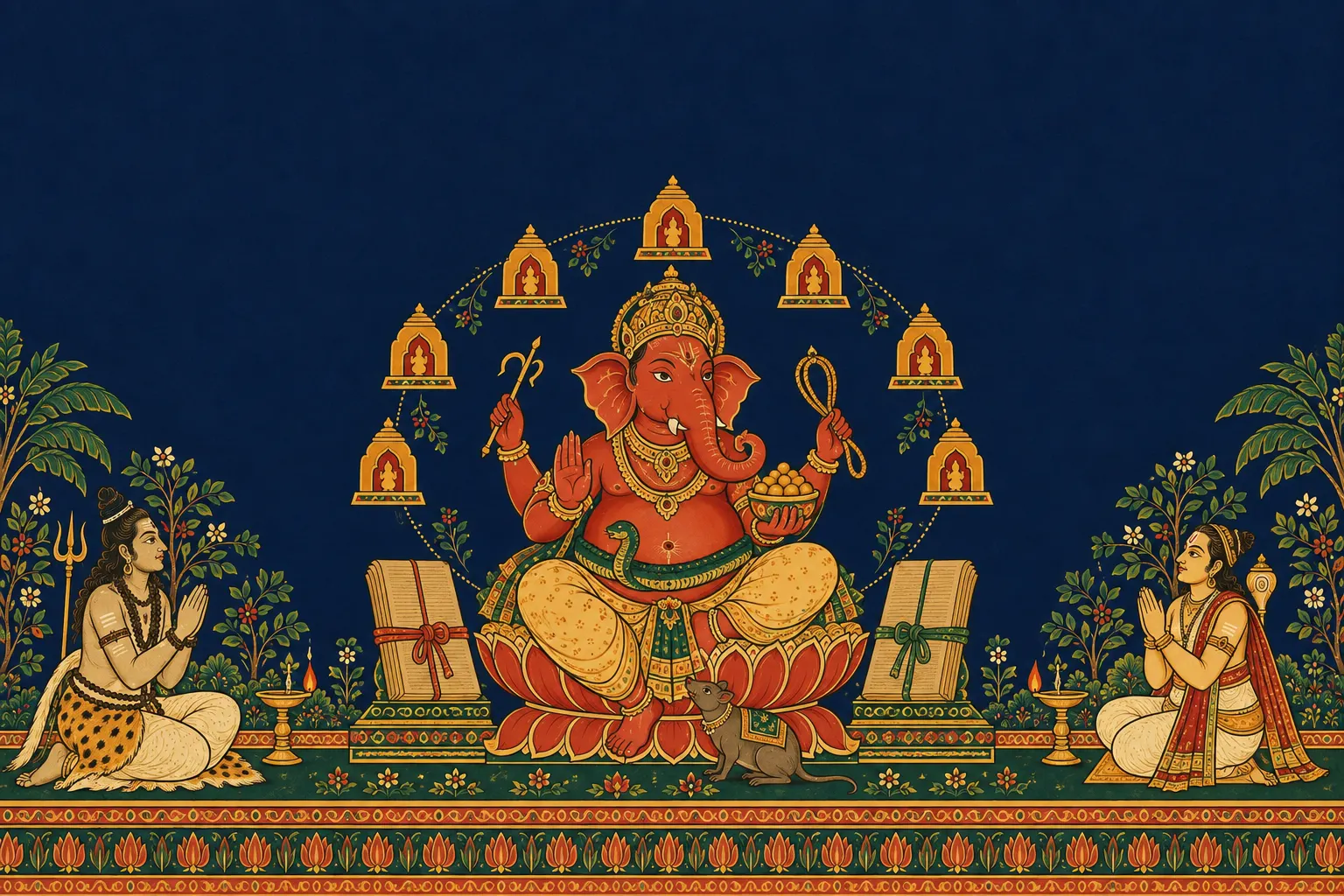
Chapter 8
Ganapati — why he comes first
The name spoken before every worship, and the tradition that held him to be the Supreme itself
Before every worship
Before a wedding, a house-warming, a journey, an examination or almost any new undertaking, Ganesha is traditionally invoked first.
One explanation lies in the familiar Puranic boon that gives him precedence in worship.
But the practice was also reinforced by a later religious tradition in which Ganesha was not merely one god among others, but the highest reality itself.
The Ganapatyas — for whom he alone is Brahman
The Ganapatyas were devotees who regarded Ganesha as Para-Brahman, the supreme reality, rather than simply as Shiva's son.
The sect is clearly attested from the early medieval period and became influential in some regions before gradually declining. Scholars do not agree on the exact period of its rise or peak. The Ganapatya tradition helped strengthen the custom of invoking Ganesha first, although it was not the only reason that custom spread so widely.
One important text associated with this tradition is the Ganapati Atharvashirsha, with declarations such as "tvam brahma tvam vishnus tvam rudrah…" It is recited as an Upanishadic text, but it is much later than the ancient Upanishads, probably dating to around the sixteenth or seventeenth century.
Two Puranas, eight incarnations
Only two Puranas are devoted entirely to Ganesha: the Ganesha Purana and the Mudgala Purana, both classed as Upapuranas.
The Mudgala Purana describes eight forms or incarnations of Ganesha, each associated with the defeat of an inner flaw — jealousy, pride, delusion, greed, anger, desire, attachment and egotism.
In these stories, the demons outside the self become faults within it.
Eight temples, one circuit
Maharashtra has another famous group of eight: the Ashtavinayaka temples at Morgaon, Theur, Siddhatek, Ranjangaon, Ozar, Lenyadri, Mahad and Pali.
These eight shrines have nothing to do with the Mudgala Purana's eight incarnations beyond sharing the same number.
And once again, the old Rigvedic verse returns: "gananam tva ganapatim." Ganapatya tradition reads it as foundational to Ganesha worship, while historically the Rigvedic verse is addressed to Brahmanaspati, later associated with Brihaspati. The tradition and the textual history are not identical, and both are worth keeping in view.
Note: The Ganapatya traditions held Ganesha to be Para-Brahman; they are clearly attested from the early medieval period, though scholars disagree on when they rose and peaked. The practice of remembering Ganesha first in every worship should not be tied to this one sect alone. The Ganesha Purana and the Mudgala Purana — both Upapuranas — are the only ones devoted to Ganesha alone. The Mudgala Purana's eight incarnations destroy eight inner faults (matsara, mada, moha, lobha, krodha, kama, mamata, ahamkara). The Ganapati Atharvashirsha is a composition of around the 16th–17th century. Maharashtra's Ashtavinayaka pilgrimage (Morgaon and the other seven self-manifested temples) is a separate thing from the Mudgala Purana's eight incarnations. The Rigveda verse (2.23.1) with "ganapati" in it is there addressed to Brahmanaspati.
Source: from several texts, Ganapati — why he comes first