
Chapter 3
The head — why an elephant's
The son blocked his own father, the head was lost, and an elephant's head was brought from the north
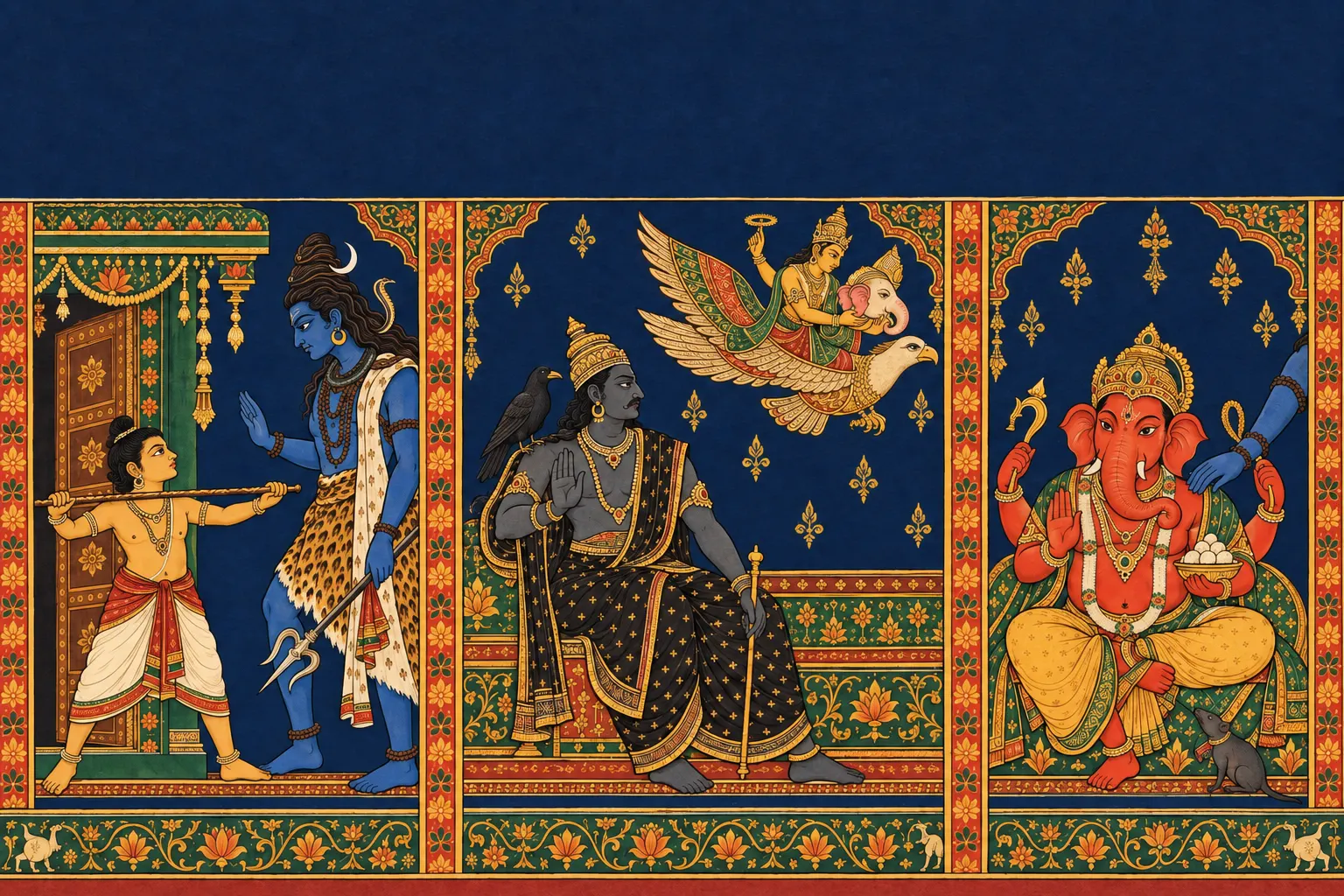
The son at the door
Shiva returned home and found a boy standing at the door — a boy he had never seen before.
"Move," Shiva said. "This is my house."
"My mother told me not to let anyone in," the boy replied, lowering his staff across the doorway.
Shiva's ganas tried to force their way past him. The boy drove them back. Vishnu came. Indra came. Still no one could get through. At last Shiva lost patience. He raised his trident and, with a single blow, severed the boy's head.
Then Parvati came out. Her grief turned at once to fury. The story says her rage shook creation itself. "Bring him back to life," she demanded, "or I will destroy everything."
With its head to the north
In the Shiva Purana version, Shiva sends the ganas north with an urgent command: bring back the head of the first creature they find sleeping with its head facing north.
They find an elephant. Different tellings identify it differently — sometimes as an unnamed elephant, sometimes as Airavata or Airavata's calf, and in some traditions as Gajasura.
The head is brought back, placed on the boy's body, and life is restored. He rises again with the face of an elephant.
In this version, Shiva then makes him lord of the ganas: Ganesha, Ganapati.
Or else, Shani's gaze
The Brahmavaivarta Purana tells another story altogether. Here there is no clash at the door and no blow from Shiva's trident.
The gods come to see the newborn child, and Shani comes with them — but keeps his gaze lowered.
"My sight is cursed," he warns. "Whatever I look at directly is destroyed. I will not look at this child."
Parvati insists that he look at her son. Shani finally raises his eyes, and the infant's head is burned away and flies toward Goloka. Vishnu then mounts Garuda, travels north, returns with an elephant's head and joins it to the body.
Lord of the hosts
The two traditions reach the same familiar image by different routes.
In the Shiva Purana account, the restored child is also granted precedence in worship.
Before other rites and undertakings begin, his name is to be invoked first.
The boy who once guarded a doorway becomes the god called upon to open every door.
Note: There are two major accounts of the beheading and the elephant head. Shiva Purana: Shiva, not knowing the boy is his son, takes his head with the trident; the ganas bring an elephant's head from the north (which elephant — unnamed, Airavata, or Gajasura — differs by text). Brahmavaivarta Purana: Shani's cursed gaze burns the head away, and Vishnu brings an elephant's head from the north on Garuda. The Varaha Purana has no beheading at all — there Shiva shapes a very handsome youth from his own radiance and, seeing the other gods' envy and unease, himself gives him a pot-belly and an elephant's face. Note: Gajasura (the elephant-formed Shiva-devotee asura whose head goes to Ganesha in some tellings) and Gajamukhasura (the asura Ganesha fights later, Chapter 7) are two different figures.
Source: from several texts, The head — why an elephant's