Chapter 2

The birth — and its several stories

One infant, and at least four different accounts of how he was born

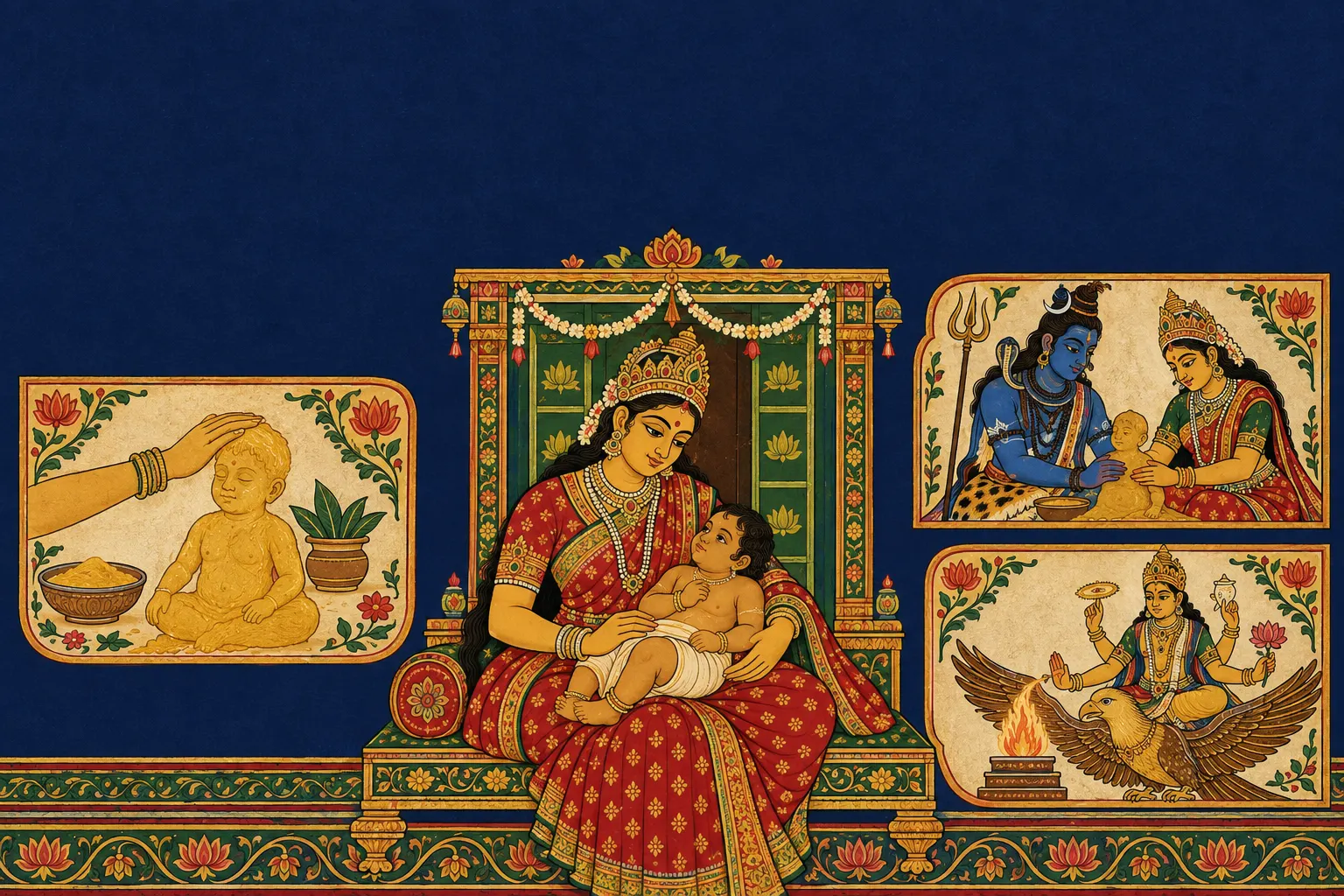
The son made from a paste

The best-known birth story comes from the Shiva Purana. Parvati is preparing to bathe, with Nandi stationed outside. But Nandi belongs to Shiva, and Parvati knows he will never truly bar Shiva's way. So she takes the paste from her own body — traditionally described as a mixture of turmeric and oil — shapes it into a boy, and gives him life.

She seats him at the door, to guard the threshold, with a small staff in his hand.

"Do not let anyone enter until I tell you," she says. "No one."

The boy obeys.

Or else, Shiva made him

The Linga Purana tells a very different story.

There, Ganesha is created by Shiva in response to the gods' request for a being who can obstruct the wicked and remove obstacles for the righteous.

Shiva brings forth a radiant form from himself and gives him that role.

The Matsya Purana, and another passage of the Shiva Purana, offer yet another version: Ganesha is created by Shiva and Parvati together.

Vishnu's boon

The Brahmavaivarta Purana goes in a different direction again.

At Shiva's suggestion, Parvati undertakes the year-long punyaka vrata to please Vishnu and obtain a son.

When the vow is complete, Vishnu appears and promises, "In every kalpa, I will be born as your son." Ganesha is then born as a beautiful infant.

The gods hear the news and come to see the child — a visit that leads directly into the head story told in the next chapter.

The one thing every story keeps

These traditions disagree not only about who created Ganesha, but also about why he appeared.

In the Shiva Purana, he begins as Parvati's personal doorkeeper. In the Linga Purana, he is a divine power connected from the beginning with obstacles. In the Brahmavaivarta Purana, his birth fulfils Parvati's desire for a son.

The god is the same; the reasons for his birth are not.

Note: Ganesha's birth is told in several irreconcilable ways. Shiva Purana (Rudrasamhita): Parvati alone, from the unguent paste of her own body. Linga Purana: Shiva, at the prayer of the gods, as a placer and remover of obstacles. Matsya Purana (154) and a passage of the Shiva Purana: Shiva and Parvati together. Brahmavaivarta Purana: after Parvati's punyaka vrata, Vishnu grants that he will be her son in every kalpa. The Varaha Purana has yet another form in which the elephant head is there from birth (see the next chapter). No one version is declared "the right one" here.

Source: from several texts, The birth — and its several stories

Now — how much stayed with you?

Who am I?

In the Shiva Purana's story, I made a son from the unguent paste of my own body and breathed life into him. Who am I?

  • Parvati
  • Rohini
  • Aditi
  • Yashoda
Read the whole story — The son made from a paste

This story from the Shiva Purana (Rudrasamhita) is the one most often told — Parvati was about to bathe and needed a doorkeeper she could trust.

Nandi was Shiva's, so he would not do. So Parvati shaped a boy from the turmeric-and-oil coating of her own body.

This birth from the mother alone is the root of the first clash between Ganesha and Shiva.

The texts disagree

On who bore or made Ganesha, what do the Puranas say?

  • All the Puranas agree that Parvati did
  • They all say Vishnu did
  • They differ: Parvati alone in one, Shiva in another, both together in another, Vishnu's boon in another
  • No Purana has a birth story
Read the whole story — One infant, four stories

Shiva Purana: Parvati alone, from the paste. Linga Purana: Shiva, at the prayer of the gods. Matsya Purana and a passage of the Shiva Purana: the two together.

Brahmavaivarta Purana: after Parvati's year-long vow, Vishnu grants that he will be her son in every kalpa.

None of these can be called "the real one" — this telling records all four.

Fact

In the Brahmavaivarta Purana's story, whom did Parvati propitiate to get a son?

  • Shiva
  • Vishnu
  • Brahma
  • Agni
Read the whole story — Vishnu's boon

The Brahmavaivarta Purana's birth story is unlike all the rest — here Ganesha comes not from a paste but from a boon.

When the vow is complete Vishnu appears, and Ganesha is born as a beautiful infant.

Then the gods come to see him — and from there begins the next turn of the head story (see the next chapter).

What happened?

In the Shiva Purana, what task did Parvati give the boy?

  • To cook for Shiva
  • To guard a mountain
  • To graze the cows
  • To guard the door
Read the whole story — A doorkeeper

Parvati's order was clear: "Until I say so, let no one in. No one at all."

The boy had a small staff in his hand, and he sat down on the threshold.

This very obedience will cost him his life — because "no one at all" included Shiva.

Whose son?

In the Linga Purana's birth story, whose creation is Ganesha?

  • Parvati's
  • Brahma's
  • Shiva's
  • Vishvakarma's
Read the whole story — Shiva's creation

In the Linga Purana the gods wanted someone who would place obstacles in the path of the wicked and remove them for the good.

Shiva brought forth a radiant form from himself and gave it that task.

Note: here Ganesha's role is "placing and removing obstacles" from birth — a direct link to the Vinayaka-spirit of the grhyasutras.

Why is that?

Which statement best describes the different birth stories as a group?

  • They do not share one single purpose: the doorkeeper role belongs especially to the Shiva Purana, while the other accounts give Ganesha different reasons for appearing
  • In all four, Ganesha is born at night
  • In all four, Shani is present
  • In all four, Vishnu grants a boon
Read the whole story — Several births, several purposes

The Shiva Purana makes him Parvati's private doorkeeper.

The Linga Purana gives him an obstacle-related role; the Brahmavaivarta fulfils Parvati's desire for a son; the Varaha gives another creation story.

What unites them is Ganesha, not one identical function.

Riddle

I am an infant, and there are at least four different stories of my birth — one says my mother made me, one my father, one both, one says I came from a boon. Who am I?

  • Kartikeya
  • Hanuman
  • Balarama
  • Ganesha
Read the whole story — Four doors, one room

Different Puranas give different reasons why Ganesha appeared, not just who made him.

In the Shiva Purana he is Parvati's private doorkeeper; in the Linga Purana a placer and remover of obstacles; in the Brahmavaivarta an incarnation of Vishnu.

Later tradition did not pick one birth story — it gave one god a place in several religious stories.

Later tradition

What is most different about the Varaha Purana's birth story?

  • Ganesha is not born at all
  • The elephant head is there from birth
  • Ganesha has two heads
  • Ganesha is born in female form
Read the whole story — An uncut elephant head

In the Varaha Purana, Shiva shapes a very handsome youth from his own radiance.

The other gods grow uneasy at his beauty, and Shiva himself gives him a large belly and an elephant's face.

So the dramatic "head cut off" story of the Shiva Purana and the Brahmavaivarta is not in every Purana.

Put it in order

What is the correct order of the Shiva Purana's birth story?

  • Parvati makes the boy → Shiva returns → the boy stops Shiva → Parvati goes to bathe
  • Parvati goes to bathe → she makes a boy from the paste → she breathes life in → she sets him at the door
  • Shiva makes the boy → Parvati breathes life in → the boy sits at the door → the bath
  • The boy sits at the door → Parvati makes him → the bath → life
Read the whole story — The start of an afternoon

The Shiva Purana's story is a household one — Parvati needs to bathe, and there is no one to trust.

The unguent (a paste of turmeric and oil) was from her own body, and the boy was made of it.

This is why in this story Ganesha is entirely Parvati's — Shiva has yet to even recognise him.

Fact

What do the Matsya Purana and a passage of the Shiva Purana say about Ganesha's birth?

  • That Ganesha is self-existent, made by no one
  • That Ganesha rose from fire
  • That Ganesha came from the churning of the ocean
  • That Shiva and Parvati made him together
Read the whole story — The two of them together

The Matsya Purana (154) and part of the Shiva Purana give a third route — neither Parvati alone nor Shiva alone.

It is the middle path between the stories that make Parvati the sole maker and those that make Shiva.

Four different answers, and the telling picks none — that is the real point of this chapter.