Chapter 7

Gajamukhasura and the mouse

A demon no weapon could kill, and a cursed gandharva — both ended in the same place

A wrong step in Indra's court

The Ganesha Purana tells of a gandharva named Krauncha. One day, while hurrying through Indra's court, he stepped on a sage's foot.

The offended sage cursed him on the spot: "Become a mouse."

Krauncha was transformed into an enormous mouse.

In Parashara's ashram

He eventually reached the ashram of the sage Parashara, where the young Ganesha was staying.

The mouse caused havoc. It tore through fields, brought down trees and gnawed its way through whatever it could find.

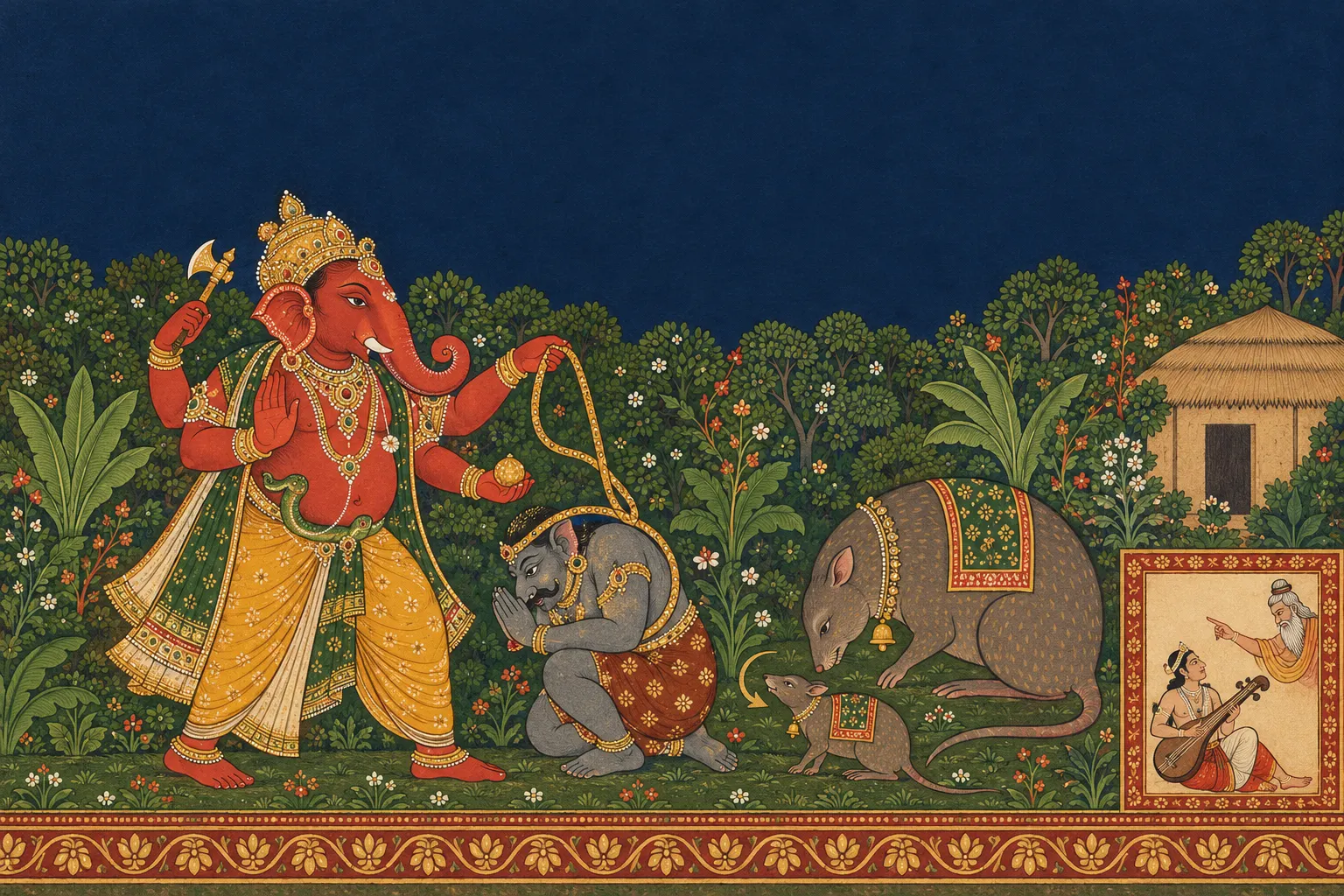
Ganesha cast his pasha, the noose he carries as a weapon, and caught the animal around the neck. Dragged before Ganesha, Krauncha surrendered. But when Ganesha climbed onto his back, the mouse could not bear his weight and begged him to become lighter. Ganesha reduced his size, and the subdued mouse became his vehicle.

The one no weapon could kill

A different tradition gives the mouse another origin. In that story, Gajamukhasura is an asura protected by a boon: no ordinary weapon can kill him.

Ganesha fights him, and when conventional weapons fail, he breaks off one of his own tusks and hurls the broken tusk as a weapon.

Gajamukhasura is defeated and transformed into a mouse, which then becomes Ganesha's mount.

The largest, upon the smallest

The stories disagree about who the mouse once was, but they end with the same image: the immense Ganesha riding a tiny creature.

Later interpretation found symbolism in that contrast. A mouse slips into hidden places and gnaws without rest; it came to represent restless desire, the wandering mind or the ego. The great god rides above it, keeping the small, persistent force under control.

Note: Two different origins are given for the mouse. Ganesha Purana: the gandharva Krauncha stepped on a sage's foot (Vamadeva, in tradition) and was cursed into a mouse; as a mouse he wrecks Parashara's ashram, where Ganesha subdues him with the noose. The other story: Gajamukhasura, an asura who cannot be killed by weapons, whom Ganesha defeats by throwing his own broken tusk, and turns into a mouse. Both end with the mouse as the mount. The sage's name could not be firmly confirmed in this check.

Source: from several texts, Gajamukhasura and the mouse

Now — how much stayed with you?

Who am I?

I was a gandharva. In Indra's court, in my hurry, I set my foot on a sage's foot, and a curse turned me into a mouse. Who am I?

  • Krauncha
  • Narada
  • Chitraratha
  • Tumburu
Read the whole story — A wrong step

In the Ganesha Purana's story, Krauncha, summoned to Indra's court, hurries forward.

His foot comes down on a sage's foot (Vamadeva, in tradition), and the sage curses him in anger.

Krauncha turns into a huge mouse where he stands — and here the story of the mouse begins.

What happened?

What did the huge mouse do in the sage Parashara's ashram?

  • It sat quietly in a corner
  • It guarded the ashram
  • It served the sage
  • It laid waste to fields, brought down trees, and gnawed through everything
Read the whole story — An uproar that would not stop

This was no ordinary mouse — huge, and gnawing without pause.

Parashara's ashram, where the child Ganesha was living in those days, was tormented by the havoc.

Then Ganesha himself resolved to stop it.

Fact

With what did Ganesha subdue the huge mouse?

  • With his goad
  • With his noose
  • With his axe
  • With his discus
Read the whole story — The loop of the noose

The noose stays in one of Ganesha's four hands — a loop of rope, a symbol of binding and taming.

Ganesha whirled it and threw it, and it fell around the mouse's neck.

The mouse was dragged forward and gave in.

What happened?

What happened when Ganesha climbed onto the mouse?

  • The mouse ran off
  • The mouse could not bear his weight and begged to be made lighter; so Ganesha drew in his own size
  • The mouse grew bigger
  • Nothing happened, the mouse walked off comfortably
Read the whole story — Weight, and surrender

Even after it gave in, one problem remained — Ganesha is huge, and the mouse small.

When Ganesha sat on it, the mouse was crushed and prayed to be made lighter.

Ganesha drew in his own size — and the tamed mouse became his mount. This balance between the large and the small is the heart of the story.

The texts disagree

What are the two different origins of Ganesha's mouse?

  • In one he was always a mouse, in the other an elephant
  • In one he was Shiva's mount
  • Both stories are the same
  • One: Krauncha, a cursed gandharva; the other: Gajamukhasura, a defeated asura whom Ganesha turned into a mouse
Read the whole story — Two causes, one mount

In the Ganesha Purana tradition the mouse is the cursed gandharva Krauncha.

In a separate, later story the mouse is really Gajamukhasura — the asura Ganesha defeats in battle and then turns into a mouse.

The two stories should be kept apart — they give two different roots for one mount.

Who am I?

I had the boon that no weapon could kill me. And yet Ganesha defeated me — and turned me into a mouse. Who am I?

  • Gajamukhasura
  • Gajasura
  • Mahishasura
  • Tarakasura
Read the whole story — An asura no weapon could kill

Gajamukhasura had the protection that ordinary weapons would have no effect on him.

So Ganesha threw his own broken tusk at him — which is not a weapon but a part of his own body.

Defeated, he became a mouse, and was joined to Ganesha as his mount.

Fact

In the Gajamukhasura story, what did Ganesha throw at him when no weapon worked?

  • His goad
  • His noose
  • His broken tusk
  • A laddu
Read the whole story — Not a weapon, but his own part

Gajamukhasura's boon was against "weapons" — and a tusk is not a weapon.

This cleverness is the turn of the story: Ganesha broke the terms of the boon in its own language.

In this separate legend the tusk itself becomes the weapon; it should not be sequenced after the scribe or Parashurama explanations, which are alternative stories for the same iconographic feature.

Later tradition

What is the mouse, Ganesha's mount, usually read as a symbol of?

  • Strength and speed
  • Desire, the restless mind, or the ego brought under control
  • Wealth and prosperity
  • Purity
Read the whole story — The thing that gnaws quietly

The mouse is the creature that gnaws away in the dark, quietly, without pause — like desires and the restless mind.

Ganesha rides it — that is, it is under his control, not destroyed.

This symbolic meaning is not the story's original events but a later reading — yet it has gone deep in Ganesha thought.

Riddle

I am among the greatest of the gods, and I ride the smallest thing there is — and that small thing carries me. Which pair is this?

  • Shiva and Nandi
  • Vishnu and Garuda
  • Kartikeya and the peacock
  • Ganesha and the mouse
Read the whole story — The vast, and the tiny

The Ganesha-mouse pair is the most unusual in Hindu divine imagery — no other deity-and-mount has so great a difference in size.

It is read to mean that when even the greatest power masters the smallest, most restless thing, that small thing carries it forward.

This is why in images the mouse is often shown facing Ganesha, hands folded — not frightened, but devoted.

Put it in order

What is the correct order of the Krauncha story?

  • Krauncha becomes a mouse → Indra's court → foot on the sage's foot → Ganesha catches him
  • Havoc in Parashara's ashram → Indra's court → the curse → Ganesha catches him
  • In Indra's court Krauncha steps on the sage's foot → a curse makes him a mouse → havoc in Parashara's ashram → Ganesha catches him with the noose → he becomes the mount
  • Ganesha catches him → Krauncha steps on the sage's foot → the curse → he becomes the mount
Read the whole story — A mistake, a curse, then service

The story begins with a small carelessness — a gandharva's hurried step.

The curse makes him a mouse, and the mouse causes havoc — only then does Ganesha step in.

In the end that same troublesome mouse, tamed, becomes the mount — every figure finds its place in the end.