Chapter 1

Vinayaka — the one who used to block the way

The god you now invoke first was once the thing you performed a rite to keep away

A different kind of prayer

For several nights, the head of the household had barely slept. His dreams were filled with disturbing images: men with shaved heads, camels, and the sensation of drowning. His son was wasting away. Tasks that seemed almost complete kept collapsing at the last moment.

The priest gave the trouble a name: the Vinayakas. "There are four," he said. "Shalakatankata, Kushmandarajaputra, Usmita and Devayajana. When they take hold of someone, obstacles begin to appear in everything that person tries to do."

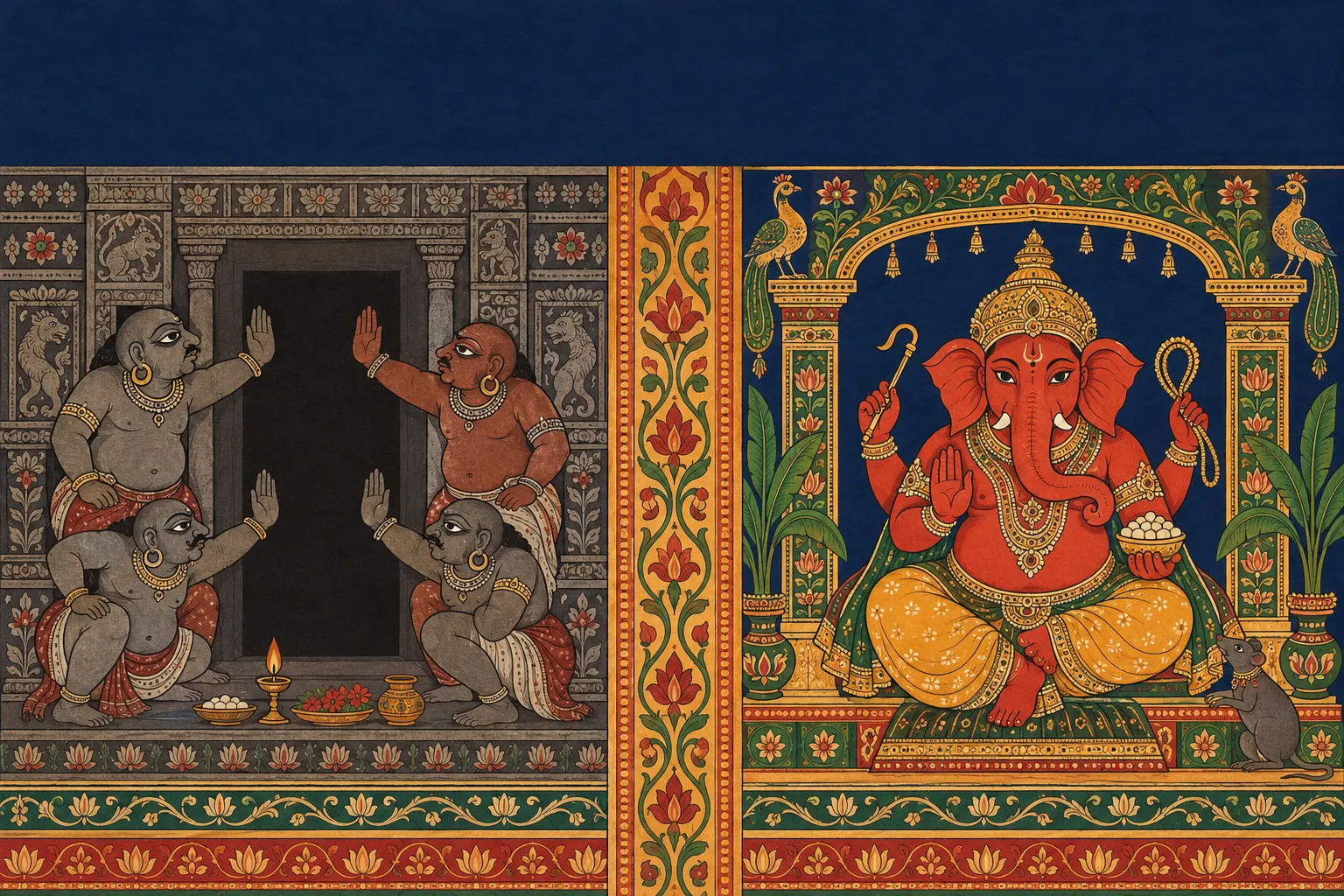
He then prescribed the rite found in the Manava Grhyasutra. At night, food was to be placed at a crossroads or on the threshold of the house: rice, meat, flowers and a lamp. Offerings were made, prayers were spoken, and the Vinayakas were asked to leave.

This was not worship in search of a blessing. It was a ritual to be rid of them.

Yajnavalkya's page

Centuries later, the Yajnavalkya Smriti presents a very different picture.

A single Vinayaka now comes to the foreground: Ganapati, appointed lord of the ganas by Rudra and Brahma. Other names still appear in the rite, but the focus has shifted toward one divine figure.

The text continues to describe the effects of Vinayaka affliction — bad dreams, the feeling of being followed, promising work suddenly going wrong.

Yet Vinayaka is no longer merely a troublesome presence. He has entered the world of the gods.

The wall at Udayagiri

Around the same period, the elephant-headed deity begins to appear clearly in surviving art.

At Udayagiri, near Vidisha in Madhya Pradesh, a fifth-century Gupta sculpture is among the oldest securely dated images of Ganesha. The same cave complex also contains a relief of the Seven Mothers, or Saptamatrikas, a group with which early Ganesha imagery is often associated.

Another important fifth-century image survives at Bhumara near Bharhut: round-bellied, one-tusked, holding a goad and a noose, with a bowl of sweets in his lap.

By the fourth and fifth centuries, the figure is unmistakably the Ganesha we recognise today.

The one who blocked the way now opens it

Now his name is invoked at the beginning of worship and before new undertakings. He is Vighnaharta, the remover of obstacles.

The reversal is striking: a power once feared for causing obstruction becomes the god called upon to clear the way.

A Rigvedic verse, "gananam tva ganapatim havamahe," is still recited in Ganesha worship. But in the Rigveda itself, the verse is addressed to Brahmanaspati, later closely associated with Brihaspati, not to the elephant-headed Ganesha.

Later tradition adopted the verse for him. Historical scholarship treats that as a later association. Both parts of that history belong to the story.

Note: The Vinayakas are first named in the Manava Grhyasutra (2.14), where they are four troublesome spirits and a rite is prescribed to be rid of them. In the Yajnavalkya Smriti (roughly 3rd–5th century) a singular Vinayaka — Ganapati — is appointed lord of the ganas by Rudra and Brahma (the same rite later invokes six names); this is where the turn shows, where a demon becomes a god. The oldest securely dated images of the benign elephant-headed god are Gupta — Udayagiri Cave 6 (whose cave complex also holds a Saptamatrika relief) and the Bhumara temple, both 5th century. The Rigveda verse (2.23.1) with "ganapati" in it is there addressed to Brahmanaspati (whom later tradition associates with Brihaspati); later Ganesha worship adopted it, and scholars treat it as a later borrowing. Some scholars read Ganesha as a coming-together of the Vinayaka obstacle-spirits of early ritual literature, elephant/yaksha imagery, and the Matrika context — the debate is still open.

Source: from several texts, Vinayaka — the one who used to block the way

Now — how much stayed with you?

Fact

In which text does the name "Vinayaka" first appear?

  • The Rigveda
  • The Bhagavad Gita
  • The Ganesha Purana
  • The Manava Grhyasutra
Read the whole story — A page of a grhyasutra

Grhyasutras are handbooks of household ritual — weddings, name-givings, funerals. The Manava Grhyasutra (2.14) gives a rite for appeasing the Vinayakas.

There they are four — Shalakatankata, Kushmandarajaputra, Usmita, Devayajana — and they take hold of a person and spoil everything he does.

So Ganesha's oldest shadow is not that of a god but of a problem.

What happened?

In the earliest tradition, why were the Vinayakas worshipped?

  • To be rid of them
  • To please them and gain a boon
  • For a good harvest
  • To win a war
Read the whole story — A prayer to be released

The Manava Grhyasutra's rite is plain: at a crossroads or on the threshold of the house, set out rice, meat, flowers and a lamp at night, bathe them, offer to them — and say, leave.

It lists the symptoms of being seized by a Vinayaka too: bad dreams, repeated failure, the feeling that someone is walking behind you.

The god now remembered before every task was once worshipped in order to keep him away.

Fact

How many Vinayakas does the Manava Grhyasutra name?

  • One
  • Two
  • Four
  • Sixteen
Read the whole story — Four, then one

The Yajnavalkya Smriti foregrounds a singular Vinayaka appointed by Rudra and Brahma as lord of the ganas.

Later in the same rite it invokes six names — Mita, Sammita, Shala, Katankata, Kushmanda and Rajaputra — not simply the same four as the Manava Grhyasutra.

So the shift is toward a singular Ganapati-Vinayaka, not simply "four spirits plus one leader."

Why is that?

What is the biggest change in the Yajnavalkya Smriti's treatment of the Vinayakas?

  • They vanish
  • A singular Vinayaka is appointed by Rudra and Brahma as lord of the ganas and as a power that can obstruct human undertakings
  • Their number grows to sixteen
  • They are declared sons of Shiva
Read the whole story — From plural Vinayakas toward one Ganapati

Yajnavalkya Smriti 1.271 speaks of a singular Vinayaka appointed lord of the ganas by Rudra and Brahma.

The troublesome side remains: the following verses still describe possession, bad dreams and failed undertakings.

Later in the rite six Vinayaka names are invoked, so "one leader over the same four" is too simple.

Fact

Where is the oldest securely dated image of the elephant-headed god?

  • Konark, 13th century
  • A seal from Mohenjo-daro
  • A mural at Ajanta
  • Udayagiri Cave 6, Vidisha
Read the whole story — The wall at Udayagiri

At Udayagiri Cave 6 near Vidisha, an early-5th-century Ganesha belongs to a securely dated Gupta sculptural programme.

The same cave complex also contains a Saptamatrika relief; Bhumara provides another important 5th-century Ganesha image, but not a second matching Matrika group.

By the Gupta period the elephant-headed Ganesha is clearly established in religious art.

Who am I?

I was once only a troublesome spirit, one people performed a rite to be rid of. Now I am remembered before every worship. Who am I?

  • Shani
  • Rahu
  • Vinayaka
  • A yaksha
Read the whole story — The one who blocked the way now opens it

The biggest turn in Ganesha's story is this — a power that placed obstacles becoming the god who removes them.

The name "Vighnesha" holds both meanings — lord of obstacles, who may place them or lift them.

This is why he is propitiated before every new undertaking: the one who alone can lodge a stone in the road can also clear it.

Why is that?

Why is there no scholarly agreement on Ganesha's historical origin?

  • Because several strands may come together
  • Because all the texts were destroyed
  • Because Ganesha is mentioned in only one text
  • Because no ancient image of him has been found
Read the whole story — A meeting of strands

Ganesha was probably made from several things at once — the Vinayaka-spirits of the grhyasutras, an elephant-faced yaksha, and the family of the Seven Mothers he sits with in the earliest images.

Because of this there is no one clean answer to "when and how did Ganesha come to be."

This telling does not hide that uncertainty — it treats it as part of the story.

The texts disagree

The verse recited before worship, "gananam tva ganapatim havamahe," is originally addressed to whom?

  • Originally to Ganesha
  • It is in no Veda at all
  • It is addressed to Indra
  • In the Rigveda it is addressed to Brahmanaspati
Read the whole story — A borrowed verse

In Rigveda 2.23.1, ganapati is an epithet of Brahmanaspati; later tradition closely associates Brahmanaspati with Brihaspati.

The Ganapatya tradition takes this verse for its own root; modern scholars treat it as a later borrowing.

This telling keeps both, without calling one "the right one."

Put it in order

What is the correct historical order of how Ganesha came to be?

  • Gupta-age images → Vinayakas as troublesome spirits → one made their leader → first in every worship
  • Four troublesome Vinayakas in early ritual literature → a singular Vinayaka/Ganapati appointed lord of the ganas in the Yajnavalkya Smriti → Gupta-age Ganesha images → the widespread convention of invoking him first
  • First in every worship → Gupta-age images → Vinayaka spirits → one leader
  • One leader → Vinayaka spirits → first in every worship → Gupta-age images
Read the whole story — A journey of centuries

This is not one story but a change over several hundred years — from the grhyasutras (troublesome spirits) to the Gupta age (a gentle god) and then to full stories in the Puranas.

Each stage does not entirely erase the last — the name "Vighnesha" still carries the obstacle-placing side today.

This slow transformation is what makes the god so unusual.

Later tradition

At Udayagiri Cave 6, which goddess-group appears in the same early sculptural programme as Ganesha?

  • The nine planets
  • The Seven Mothers
  • The ten avatars
  • The twelve jyotirlingas
Read the whole story — With the Mothers

The Seven Mothers — Brahmi, Maheshvari, Kaumari, Vaishnavi, Varahi, Indrani, Chamunda — are a band of goddesses, and at Udayagiri Ganesha is placed with them.

This pairing is one reason some scholars discuss a Matrika strand in Ganesha's origins, rather than a purely Shaiva one.

Being Shiva's son — the birth, the elephant head, Kartikeya as a brother — that whole frame was added later, in the Puranas.