Chapter 9

The elephant god, across the world

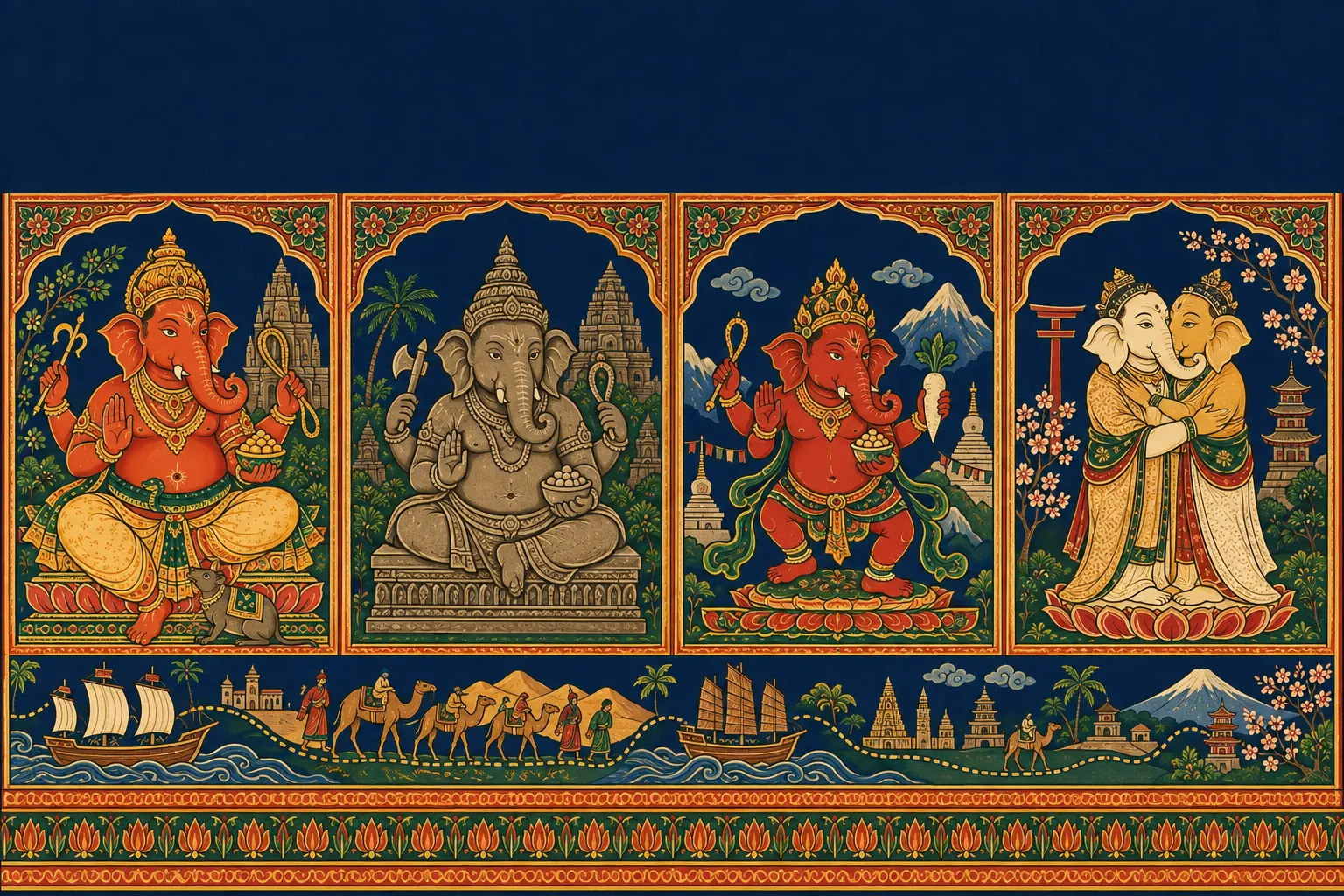
He travelled with the traders — into Buddhism, across Southeast Asia, and as far as Japan

The god of the traders

Ganesha travelled beyond India along the same routes that carried Sanskrit, temple culture and Hindu and Buddhist traditions across Asia. Trade played a major role, alongside royal patronage and networks of Shaiva and Buddhist communities.

By around the tenth century, Ganesha had become especially important to merchants and caravan leaders, and his image often travelled where they did.

Southeast Asia

His presence outside India, however, is older than that. By the sixth and seventh centuries, images and inscriptions of Ganesha appear across parts of Southeast Asia — in Funan and Chenla, later in Srivijaya and Khmer territories, and in Champa, Java, Bali and Myanmar.

He was sometimes placed at the rear of temples or near difficult passages and crossroads, places where a remover of obstacles had an obvious role.

In Thailand he is still worshipped as Phra Phikanet, associated especially with the arts and commerce.

In Buddhism

Buddhist traditions gave Ganesha more than one role. In some contexts he appears as a protector or wealth deity; in others he is treated as an obstacle that must be subdued.

Tibetan Buddhist art, for example, includes a red Ganapati associated with wealth, but also images in which he is trampled beneath Vighnantaka — the obstacle overcome.

In Japan, a pair

In Japan he became Kangiten, also known as Shoten, entering Japanese esoteric Buddhism through traditions that had first developed in China. The figure became associated especially with the Shingon and Tendai schools. Kukai, the founder of Shingon in Japan, received his major esoteric initiation from the master Huiguo in Chang'an and also encountered Sanskrit learning there through figures such as the Gandharan monk Prajna.

The most distinctive Japanese form of Kangiten is a paired image: two elephant-headed figures facing and embracing one another. Such images are often kept hidden from public view. Kangiten continues to be worshipped in Japanese temples as a deity connected with bliss, prosperity and difficult wishes. Ganesha also entered Jain religious practice. From around the ninth century onward, especially in western India, he appears in Jain contexts as well. By then the elephant-headed remover of obstacles belonged to more than one religious world.

Note: Ganesha spread beyond India along mixed routes of trade, royal patronage, and Saiva and Buddhist networks. By the 6th–7th centuries his images and inscriptions appear across Southeast Asia — Funan, Chenla, Srivijaya, the Khmer empire, Champa, Java, Bali and Myanmar; in Thailand he is still worshipped today as Phra Phikanet. In Buddhist art he appears in two opposite roles — an obstacle to be subdued, and, elsewhere, a protector and wealth-deity (Tibet's Maharakta Ganapati). In Japan he is Kangiten, or Shoten — arriving in the 8th–9th centuries with the Shingon-Tendai esoteric Buddhist tradition that Kukai established, whose own decisive initiation came from master Huiguo at Chang'an, Prajna being only a contact. The Jain tradition, too, has worshipped Ganesha since about the 9th century, especially in Rajasthan and Gujarat.

Source: from several texts, The elephant god, across the world

Now — how much stayed with you?

Fact

From about the 10th century, Ganesha became particularly the god of whom?

  • Kings and warriors
  • Merchants and caravan-leaders
  • Farmers
  • Sailors alone
Read the whole story — The god of the traders

The obstacle-removing god naturally became the god of those with the most obstacles in their path — the traders.

Where the Indian traders went, Ganesha went with them — in the shop, in the caravan, at the port.

Merchant networks were one later channel of Ganesha's wider spread, but they cannot explain his 8th–9th-century transmission to Japan, which came through esoteric Buddhist networks via China.

Fact

By when do Ganesha's images and inscriptions turn up in Southeast Asia?

  • By the 19th century
  • By the 6th–7th centuries
  • By the 15th century
  • They never reached there
Read the whole story — Across the sea, early

Ganesha's images turn up quite early in Cambodia, in the Champa region of today's Vietnam, in Java, Bali and Myanmar.

He spread along the same networks that carried Sanskrit, temple culture and Hindu-Buddhist worship across Asia.

His role shifted with place and time — a Shaiva deity in one place, a protector in another, tied to learning and royal power in a third.

What happened?

Where was Ganesha's image often placed in Southeast Asian temples?

  • Right in the centre of the sanctum
  • On the temple spire
  • Outside the temple, in a river
  • At the back of the temple, or at dangerous places like passes and crossings
Read the whole story — Guarding the way

Ganesha was often placed where people pass — near a door, at a bend in the road, at a mountain pass.

The purpose was the same as in India — to clear the obstacles of those passing.

So abroad too his identity stayed that of "Vighnaharta," the remover of obstacles.

Fact

By what name is Ganesha worshipped in Thailand today?

  • Phra Phikanet
  • Ganapati Maharaj
  • Shoten
  • Vinayakar
Read the whole story — The Ganesha of Bangkok

In Thailand Ganesha worship is a living tradition — shrines outside shopping malls, an image in a film studio, a large shrine near Bangkok's Central World.

There he is tied especially to the arts, dance, music and commerce.

This shows that Ganesha is not only in old sculptures — he is still in the life of Southeast Asia today.

Who am I?

In Japan I am called Kangiten or Shoten, and my most distinctive form is a pair — two elephant-headed figures holding each other in an embrace. Who am I?

  • Hanuman
  • Narasimha
  • Ganesha
  • Airavata
Read the whole story — The Ganesha of Japan

Kangiten reached Japan in the 8th and 9th centuries, with the esoteric Buddhist tradition.

The embracing dual form is a development of the Japanese tradition itself — it is read as a symbol of the union of opposites.

He is worshipped still in about 250 temples, often with images kept hidden — a god of prosperity, worldly success and hard-to-grant wishes.

Fact

How did Kangiten reach Japan?

  • Through traders who came directly from India
  • With the Shingon-Tendai esoteric Buddhist tradition that had reached China first; Kukai established it in Japan
  • Through Portuguese sailors
  • Via Korea, without Buddhism
Read the whole story — Japan by way of China

Esoteric Buddhism reached China first, and from there Japan.

Kukai (Kobo Daishi) founded the Shingon sect in Japan.

Kangiten is one of several Indian deities absorbed into Japanese Buddhism; what is especially distinctive is the secretive, paired elephant-headed form that developed there.

The texts disagree

From whom did Kukai take his decisive esoteric Buddhist initiation?

  • From the Gandharan monk Prajna
  • Directly from the Buddha in a dream
  • At Nalanda
  • From master Huiguo at Chang'an
Read the whole story — A small but necessary distinction

Popular accounts often say Kukai got this knowledge "from Prajna of Gandhara."

But historically his decisive initiation was from master Huiguo at Chang'an (today's Xi'an).

Prajna was among the Sanskrit-scholar monks Kukai had contact with — no more, no less. This telling keeps that distinction clear.

What happened?

In which two opposite roles does Ganesha appear in Buddhist art?

  • King and beggar
  • Teacher and pupil
  • An obstacle to be subdued, and a protector
  • Sun and moon
Read the whole story — Obstacle and protector both

In the Buddhist tradition Ganesha (Vinayaka) stands on both sides.

In one place he is the obstacle a bodhisattva or protector-deity subdues — in Tibet, a form trodden under Vighnantaka.

And in another he is himself a protector and wealth-deity — Tibet's red Maharakta Ganapati.

Later tradition

By roughly when does surviving evidence begin to show Ganesha in Jain art and worship?

  • By the early medieval period, with examples commonly dated around the 9th century, especially in western India
  • Never
  • From the time of Mahavira
  • Only from the 20th century
Read the whole story — Ganesha in Jain art

In early-medieval evidence, often dated around the 9th century, Ganesha finds a place in the Jain art and worship of western India as an auspicious, protective deity.

Jain teachers like Hemachandra list his names in their lexicons.

But his standing there is not like that in the Hindu Ganapatya tradition — he is not Para-Brahman, but a helper deity.

Why is that?

How did Ganesha reach as far as Japan?

  • By a single trade route
  • Only through Buddhist monks
  • He never reached there, that is a different deity
  • Through trade, royal patronage, and Shaiva and Buddhist networks
Read the whole story — Many roads, one god

Ganesha's spread across Asia cannot be put down to any one thing.

Traders carried him with them; kings brought him into their temples; both the Shaiva and Buddhist traditions took him up.

This is why Ganesha's image is found today from India to Java, Tibet and Japan — a little different in each place, but the same in recognition.