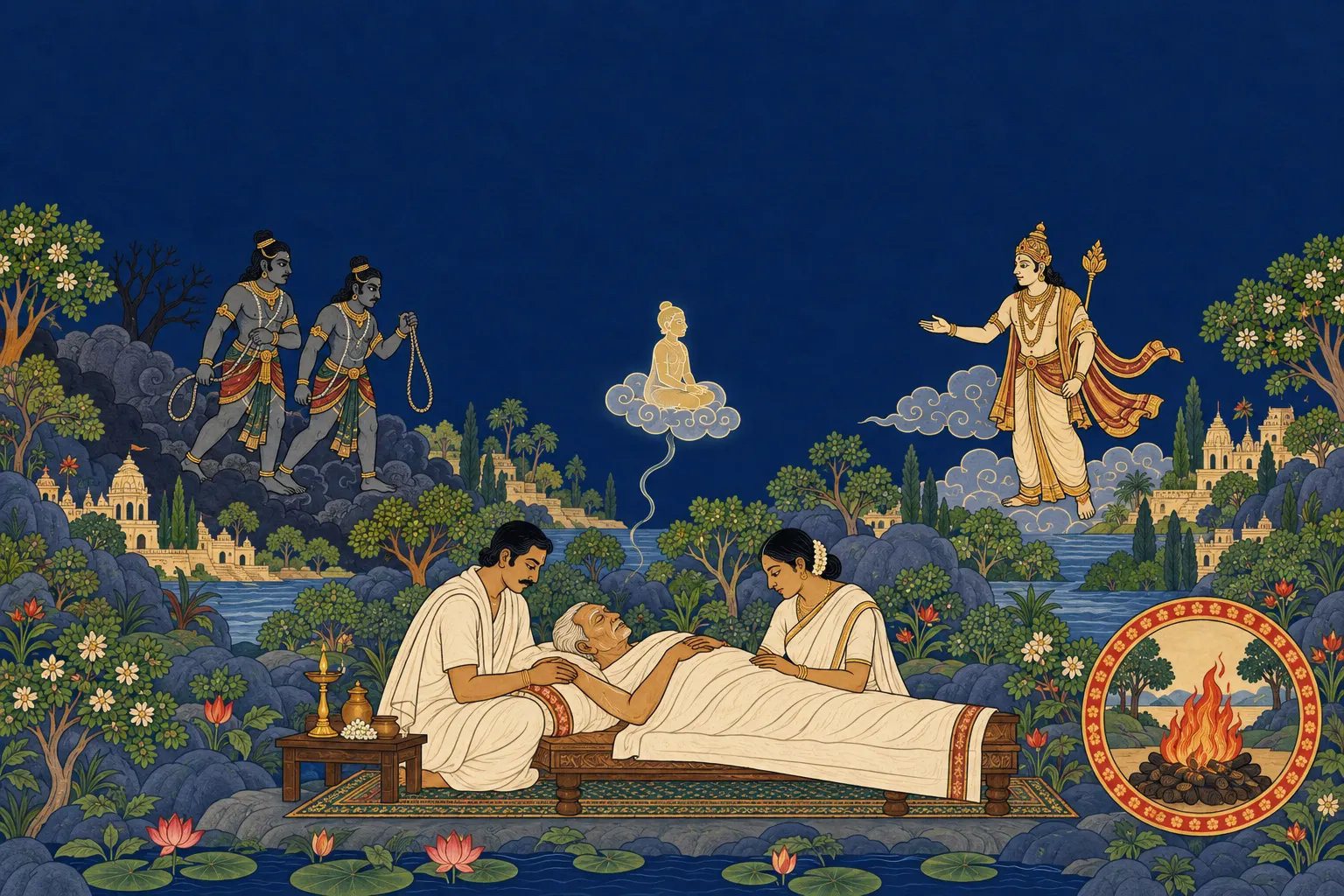
Chapter 2

The last breath

What the text says happens in the body, and at the door, in the last hour of a life

The signs

The text begins earlier than the death — with the signs that it is near.

Some are of the body. Some are in dreams. Some are stranger: the dying cannot see the tip of their own nose, or their reflection, or a certain star.

These belong to an old diagnostic craft — arishta, the reading of the body's last messages. The text sets them down plainly, without dread.

The last hour

At the end, it says, the person wants to speak and cannot.

The senses draw inward and go out one by one, like lamps. A heaviness comes. Sometimes, in the last clear moment, the whole world is seen at once, as one thing.

Then the messengers come to fetch the traveller.

For a person who lived cruelly, the text says, they come as the Yamadutas: dark, red-eyed, a noose in hand, terrible to see. For a person who lived well, the same journey and Yama's realm are described as gentle, not terrifying. Who arrives at the door is the first consequence of how a life was spent.

What sets out

The body stays behind. It is given to the fire — the antyeshti, the "last offering", the true final rite of a life.

What sets out is small — the texts give it the size of a thumb — and carried by a subtle body, a kind of travelling form, until the rites of the living build it a fuller one.

The journey begins.

Note: The Garuda Purana's account of the near-death signs (arishta) overlaps the Ayurvedic arishta-lakshana literature — bodily symptoms, ominous dreams, and perceptual failures (inability to see one's nose-tip, reflection, or the pole star) taken as signs that death is close. It describes the collapse of the senses at death, a possible moment of total clarity, and the arrival of Yama's messengers — fierce and frightening for the wicked, gentle for the good. The departing soul is conventionally described as thumb-sized and is carried by a subtle "ativahika" body until the funeral offerings (see chapter 3) form a new "preta" body. The antyeshti (cremation) is treated as the last of the life-cycle rites.

Source: the Preta-Kalpa of the Garuda Purana (with the Vedic and Upanishadic accounts for contrast), The last breath

Now — how much stayed with you?

Fact

What are the signs that death is near called?

  • Samskara
  • Arishta
  • Prayaschitta
  • Shraddha
Read the whole story — The signs

The text begins before the death, with the signs that it is near.

Some are of the body, some in dreams, some stranger still.

This reading of the body's last messages is called arishta.

Fact

Which of these is named as an omen that death is close?

  • Losing one's appetite
  • Dreaming of water
  • A ringing in the ears
  • No longer being able to see the tip of one's own nose, one's reflection, or a certain star
Read the whole story — What the dying cannot see

Among the omens are perceptual failures.

The dying cannot see the tip of their own nose, or their reflection, or the pole star.

These belong to an old diagnostic craft.

What happened?

What does the text say happens in the last hour?

  • Speech fails though the person wants to speak; the senses go out one by one; sometimes the whole world is seen at once
  • The person becomes suddenly strong
  • The person feels nothing at all
  • The body grows cold from the head down
Read the whole story — The last hour

At the end, the person wants to speak and cannot.

The senses draw inward and go out like lamps.

Sometimes, in the last clear moment, the whole world is seen as one thing.

Who am I?

We are dark, red-eyed, a noose in hand, terrible to see — and we come for those who lived cruelly. Who are we?

  • The Maruts
  • The Ashvins
  • The Yamadutas
  • The Rudras
Read the whole story — The messengers

For a person who lived cruelly, the text says, the Yamadutas come.

They are dark, red-eyed, with a noose, terrible to see.

For a person who lived well, the same journey is described as gentle.

The texts disagree

Do the righteous and the wicked have the same experience of the journey?

  • Yes, it is identical for everyone
  • Only the wicked make the journey at all
  • Only the righteous make the journey
  • No
Read the whole story — Two experiences

Who arrives at the door is the first consequence of how a life was spent.

For the cruel, the escort is the Yamadutas.

For the good, the same journey and Yama's realm are described as benign.

Fact

What is the departing soul conventionally said to be the size of?

  • A grain of rice
  • A thumb
  • A hand's span
  • A child
Read the whole story — The size of what leaves

The body stays behind and is given to the fire.

What sets out is small — the texts give it the size of a thumb.

It is carried by a subtle body until the rites build it a fuller one.

Fact

The subtle "travelling body" that carries the soul on the journey is called?

  • The sthula body
  • The karana body
  • The ativahika body
  • The linga body
Read the whole story — The travelling form

What leaves is carried by a subtle body, a kind of travelling form.

It is called the ativahika — the "transported" body.

It serves until the funeral offerings form a new preta body.

Fact

What is the cremation rite called?

  • The antyeshti
  • The upanayana
  • The namakarana
  • The vivaha
Read the whole story — The last offering

The body is given to the fire.

This is the antyeshti, the "last offering".

It is treated as the true final rite of a life.

Why is that?

Why is the antyeshti called the "last" sacrifice?

  • Because it is the final rite in the sequence of life-cycle samskaras
  • Because it is the most expensive
  • Because no priest will do another for that family
  • Because it must be done last in the day
Read the whole story — The end of the sequence

A life is marked by a sequence of samskaras, from before birth onward.

The antyeshti is the last of them.

After it, what remains is the work of the living for the dead.

Riddle

I leave the body at the moment of death and carry you along the road until the rites of your family build you a new body. What am I?

  • The gross body
  • The pinda
  • The subtle, "transported" body
  • The shadow
Read the whole story — What carries you

At death the gross body is left for the fire.

A subtle body carries what departs.

It lasts until the ten days of offerings form a new preta body.