Chapter 7

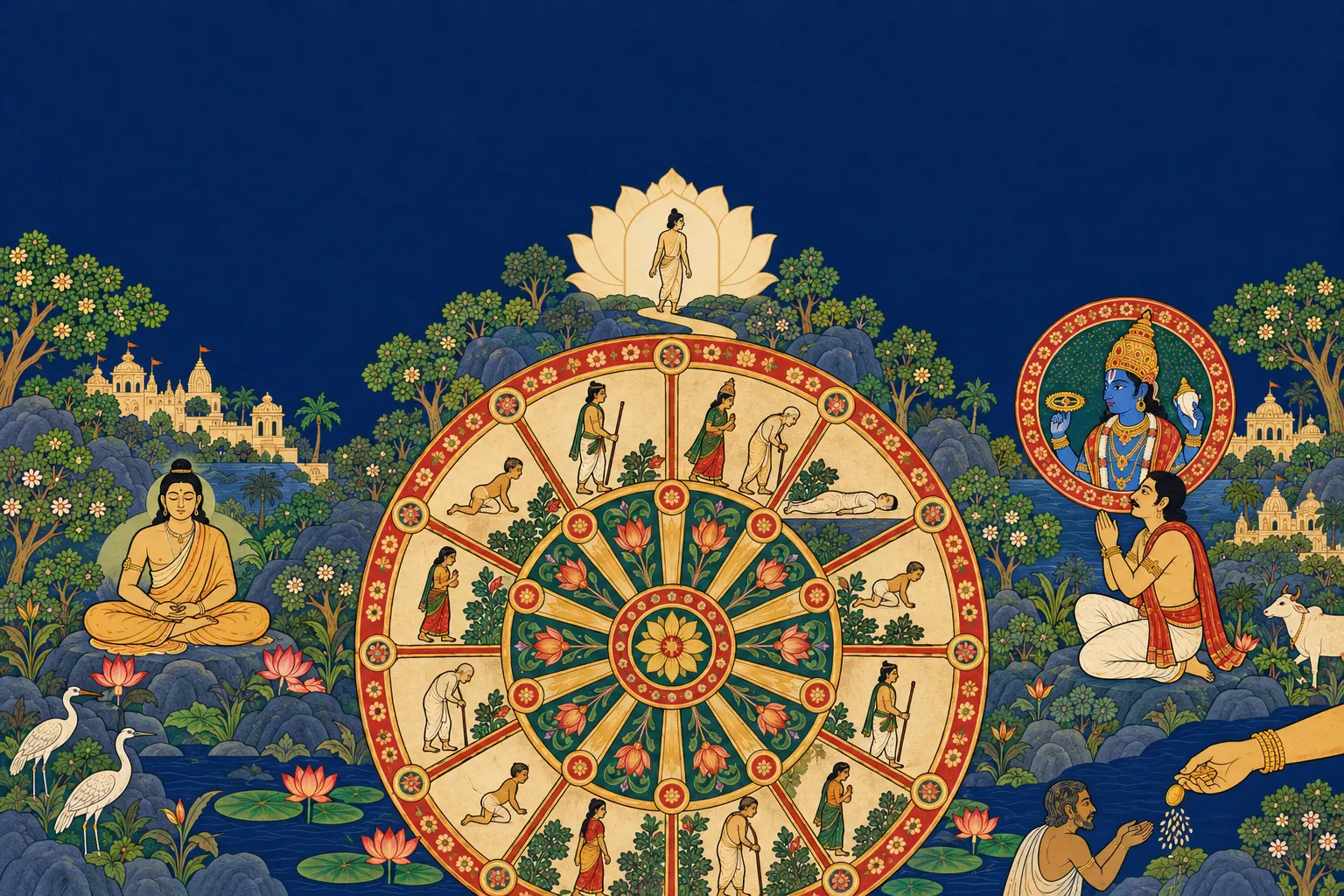
The wheel, and the way off it

After mapping the journey in extraordinary detail, the death-text turns to how to leave the cycle altogether

Rebirth is the ordinary end

For almost everyone, the text says, none of this is final — not the hells, and not the good worlds either.

Merit runs out, karmic consequences are exhausted, and the traveller comes back into another birth. This later Puranic cycle echoes the older Upanishadic idea of return, the path of the fathers.

It is not a punishment. It is simply the wheel, turning as it turns.

The ways off

The same text names the ways out.

One is knowledge — seeing that what you are was never the body, and never the thing the ledger was keeping score on. When that is truly seen, there is nothing left for Yama's clerks to weigh.

One is devotion, and this is the Garuda Purana's own emphasis: the name of Vishnu held at the last breath, the love that the messengers of Yama have no claim against.

Giving has a different place. The text praises charity from honestly earned wealth as a great dharma that improves one's course in this world and the next; it is not offered here as the equal of liberating knowledge.

The last word

So the death-text that draws this detailed a map of the afterlife ends by pointing past it — turning from the journey to liberation and the direct knowledge of truth.

All those chapters of road, river, gate and ledger — and then the quiet note that all of it is scaffolding, built for the person who is still inside the journey.

The one who knows, or the one who loves, is already home. The point of the map was always the road that leads off it.

Note: The Garuda Purana frames the entire post-mortem process as applying to the bound soul; for almost all beings the after-death states (hells and heavens alike) are temporary and end in rebirth — the Upanishadic pitriyana. It presents liberation primarily through knowledge of truth and non-attachment (developed especially in the edition-specific Brahma-Khanda, which moves from saguna to nirguna meditation under a teacher), while its Vaishnava passages also make strong salvific claims for devotion to Vishnu and remembrance of the divine name at death. Dana — charity from righteously earned wealth — is repeatedly praised as exceptionally meritorious for this world and the next, but is not a third coequal route to moksha. The popular sixteen-chapter Garuda-purana-saroddhara closes by turning from the afterlife journey to liberation; the fuller text circulates in several structures.

Source: the Preta-Kalpa of the Garuda Purana (with the Vedic and Upanishadic accounts for contrast), The wheel, and the way off it

Now — how much stayed with you?

What happened?

For almost everyone, are the after-death states final?

  • Yes
  • No
  • Only hell is temporary
  • Only heaven is temporary
Read the whole story — Nothing is final

For almost everyone, none of this is final — not the hells, and not the good worlds.

Merit runs out; karmic consequences are exhausted.

The traveller comes back into another birth.

Fact

The ordinary cycle of return echoes which older Upanishadic route?

  • The devayana, the path of the gods
  • The path of the sun
  • The pitriyana, the path of the fathers
  • The path of fire
Read the whole story — The path that loops

The path of the gods is the road from which there is no return.

The path of the fathers circles back to another birth.

The ordinary cycle of rebirth echoes that older idea.

Fact

What is the first exit from the cycle that the text names?

  • Knowledge
  • More offerings
  • A longer stay in heaven
  • A better birth
Read the whole story — Knowledge

One exit is knowledge.

Seeing that what you are was never the body, and never the thing the ledger scored.

When that is truly seen, there is nothing left for Yama's clerks.

Fact

Which path does the Garuda Purana give as its own stated emphasis?

  • Devotion (bhakti) to Vishnu
  • Fasting
  • Pilgrimage alone
  • Silence
Read the whole story — Devotion

The Garuda Purana's Vaishnava passages make strong claims for devotion.

The name of Vishnu, held at the last breath.

The love that the messengers of Yama have no claim against.

The texts disagree

Is charity (dana) a third route to liberation, equal to knowledge and devotion?

  • Yes, the text ranks the three equally
  • No
  • No
  • The text never mentions charity
Read the whole story — Giving has a different place

The text praises charity from honestly earned wealth as a great dharma.

It improves one's course in this world and the next.

But it is not offered here as the equal of liberating knowledge.

Fact

Which edition-specific part of the Purana develops the teaching on knowledge, moving from saguna to nirguna meditation under a teacher?

  • The Preta-Khanda
  • The Brahma-Khanda
  • The Achara-Khanda
  • The Sarga-Khanda
Read the whole story — The Brahma-Khanda

The teaching on liberating knowledge is developed especially in the Brahma-Khanda.

It moves from meditation on form to meditation on the formless, under a teacher.

That part appears only in one edition.

Later tradition

The popular short version of this material, with sixteen chapters, is called?

  • The Preta-Gita
  • The Yama-Samhita
  • The Antya-Kalpa
  • The Garuda-purana-saroddhara
Read the whole story — The short version

Much of what people read as "the Garuda Purana" is a compact retelling.

The popular sixteen-chapter version is the Garuda-purana-saroddhara.

The fuller text circulates in several structures.

Why is that?

Why does the book "point past" its own map at the end?

  • Because the whole apparatus is for the person still inside the journey; the one who knows or loves is already out
  • Because the map was wrong
  • Because the author lost interest
  • Because the reader is expected to stop reading
Read the whole story — Past the map

Chapter after chapter — or sixteen in the Saroddhara — of road, river, gate and ledger.

Then the quiet note that all of it is scaffolding.

It is built for the person who is still inside the journey.

Riddle

I spend chapter after chapter on the road, the river and the court — and then I say the road is only for those still walking it. What am I?

  • The Bhagavad Gita
  • The Ramayana
  • The Garuda Purana's death-text
  • The Manusmriti
Read the whole story — The book that points past itself

The death-text draws the most detailed map of the afterlife.

Then it turns from the journey to liberation and the direct knowledge of truth.

The point of the map was always the road that leads off it.

Riddle

Knowledge or love takes you off me for good; merit only moves you to a better place on me. What am I?

  • The Vaitarani
  • Yama's court
  • The Brahma-Khanda
  • The wheel
Read the whole story — The wheel

Merit and good action can lift you to a better birth or a heaven.

But that is still a place on the wheel.

Knowledge and devotion are what take you off it.