
Chapter 1
Why this book is read
Of all the accounts of what happens after death, this is the most detailed — and one of the latest; the epic begins by saying so
A book for the worst days
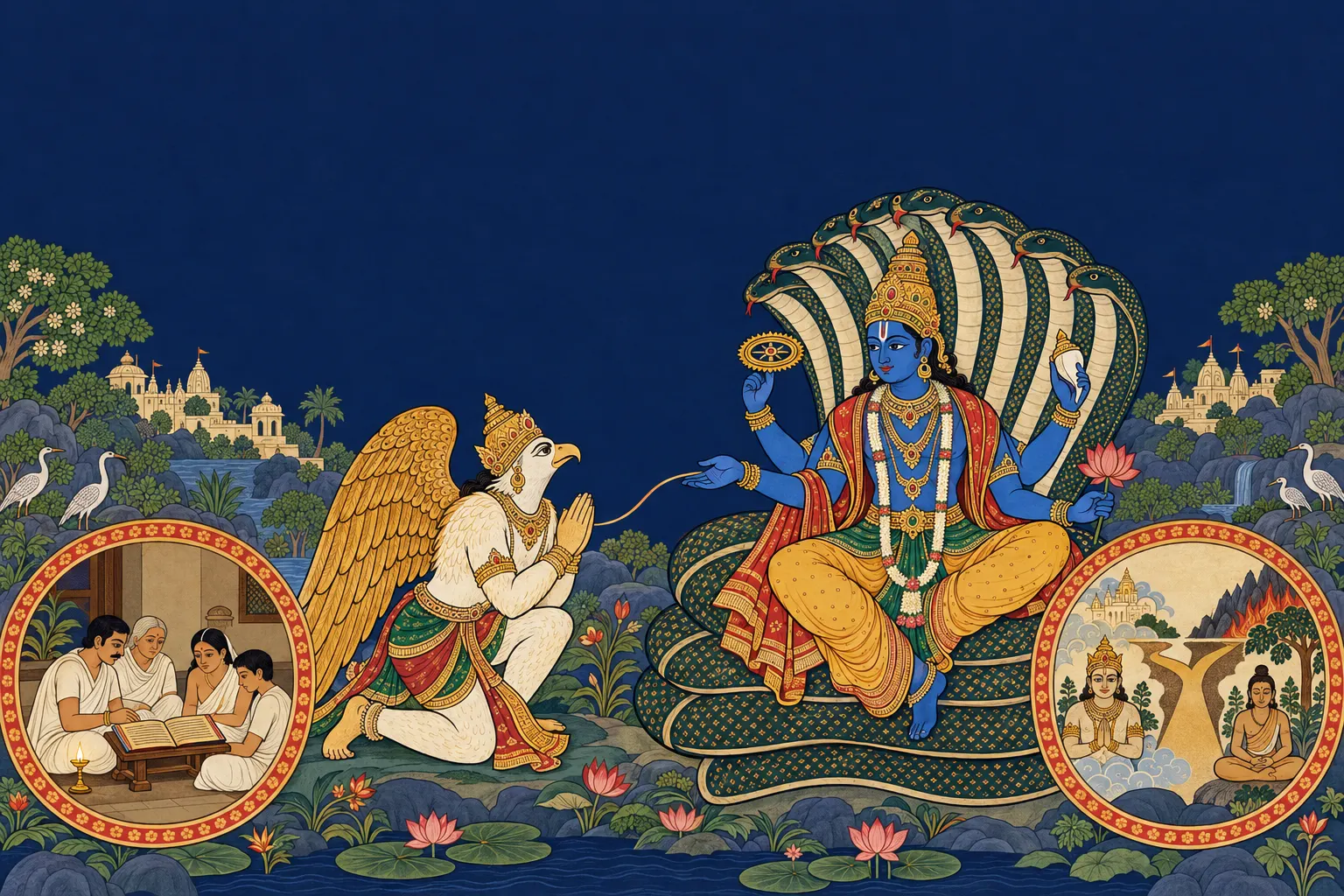
In many Hindu communities the Garuda Purana — especially its death-related material — is read aloud during the days of mourning after a death.
It is read then because it is about exactly that — what is happening, in those days, to the person who has gone.
Few Hindu texts map the post-death journey in such sustained detail.
One account among several
It is not the only account, and it is worth knowing the others before this one begins.
The oldest Vedic layer knows Yama as the ancestral king who first found the road the dead take. The later Upanishads describe the path of smoke — the path of the fathers — that leads to the ancestral world and eventually loops back to rebirth.
They also speak of a second road, the path of the gods, from which there is no return. In the Katha Upanishad a boy named Nachiketa stands in Yama's house and asks him what death is.
And through all of it runs the older idea that no state after death is final — merit is spent, debt is paid, and the traveller is born again.
A late book, and it says so
The Garuda Purana is a Vaishnava text transmitted in substantially different recensions. The common printed form has a large Purva or Achara section and a smaller Uttara or Preta section; one important printed edition also adds a Brahma-Khanda.
It was composed late, most likely between the ninth and eleventh centuries. The death-related Preta-Kalpa is the smaller, later stratum of the surviving text, and its size and contents vary considerably between recensions.
It is vivid because it has a job to do: to give a grieving household something to hold, and a reason the holding matters.
Read it as the most detailed map, then — not the first one drawn, and not the only one.
Note: The Garuda Purana is a Vaishnava Mahapurana usually dated c. 850–1000 CE, transmitted in substantially different recensions. The surviving text is commonly printed with a Purva/Achara-Khanda and a smaller Uttara/Preta-Khanda; the Venkateshvara (Bombay) edition also contains a Brahma-Khanda. The Preta material is generally regarded as a later stratum, and its extent varies considerably across recensions. Earlier ideas of the afterlife differ: the Rigvedic Yama is the ancestral king who found the road of the dead; the explicit devayana and pitriyana, including the smoke-path, are formulated in the Chandogya and Brihadaranyaka Upanishads; the Katha Upanishad gives Nachiketa's dialogue with Yama. The through-line of the tradition is that after-death states are temporary and end in rebirth or release.
Source: the Preta-Kalpa of the Garuda Purana (with the Vedic and Upanishadic accounts for contrast), Why this book is read