Chapter 5

The hells

The text imagines countless hells and names twenty-one as especially dreadful — but no one stays in them forever

The list

The death-text tradition speaks of eighty-four lakhs of hells and singles out twenty-one as the most dreadful. The neat catalogue of twenty-eight belongs to another text, the Bhagavata Purana.

There is Tamisra and Andhatamisra, the dark and the blind-dark. Vaitarani is here too — the dreadful river again, now on the road to Yama. Which punishment answers which wrong is told differently from one recension to the next; there is no single fixed list.

The names go on: Kumbhipaka, Raurava, the forest whose leaves are swords. The text describes the punishments. It is not a pleasant read, and it is not meant to be.

This much is worth stating and no more. The internet has made a spectacle of this chapter; the text is better than its reputation.

Why it is not the point

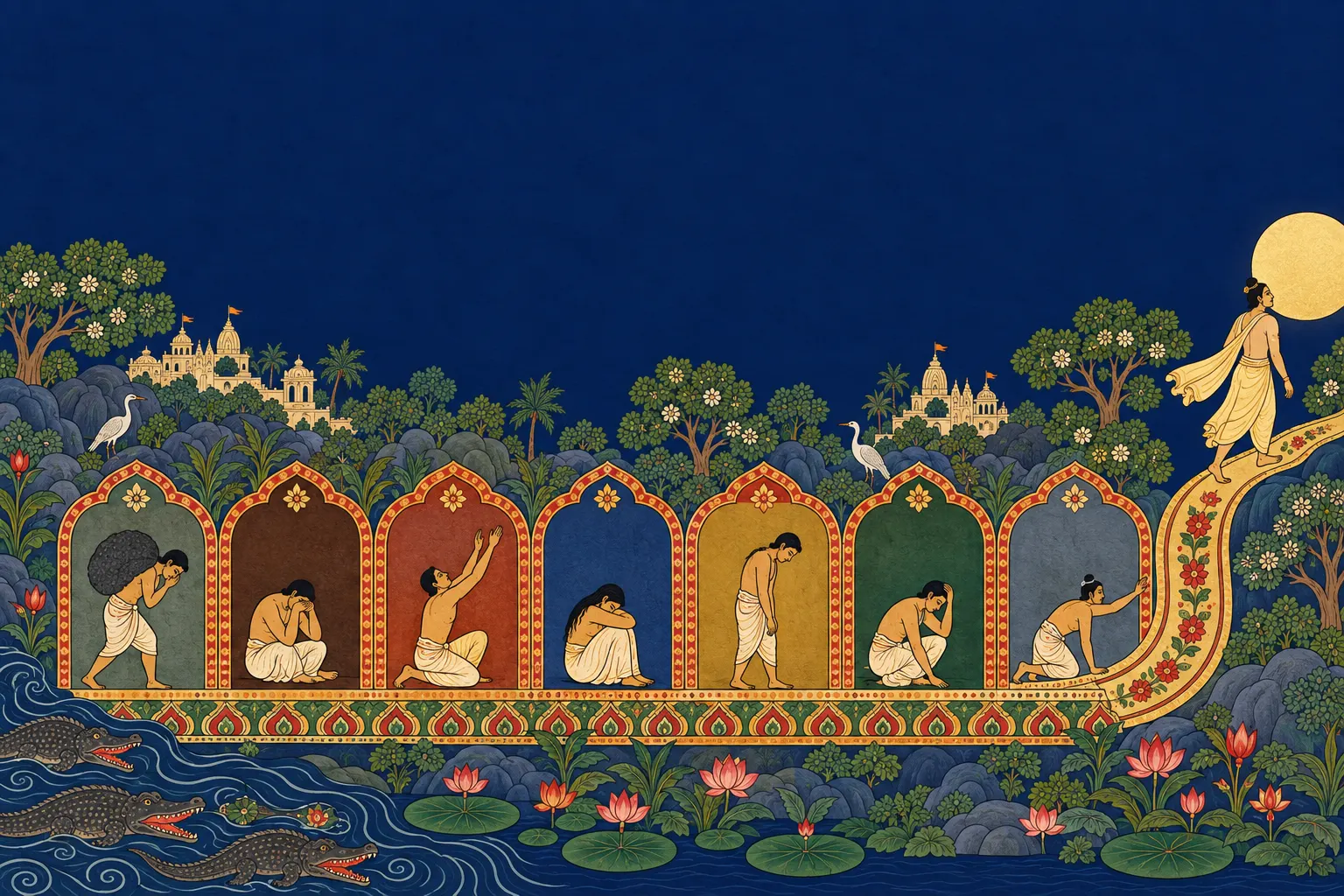
Because here is what the same text says, and says clearly: the hells are finite.

The term is served. The weight of the act is discharged. And then the being leaves — reborn, or moved upward. Not one of them is forever.

This is a ledger being brought to balance, not a sentence without end. A reader who grew up on eternal punishment should stop on that difference, because the text means it.

The suffering is a correction, and a correction stops when it is done.

What the note must add

Two things belong beside this chapter rather than inside it.

One: many readers, and some scholars, have read the Preta-Kalpa's hells as fear put to use — a machine for turning dread into gifts for priests; the view is old, and it is set down here without a verdict. Two: the text can be severe about death by one's own hand, and about death before its time; lived responses and funeral practice vary considerably by region, community and period, and this is not the last word.

Note: The Garuda death-text tradition speaks of eighty-four lakhs of hells and singles out twenty-one as especially dreadful, among them Tamisra, Raurava and Kumbhipaka; exact lists and offence-to-hell correspondences vary by recension. The familiar fixed catalogue of 28 narakas belongs especially to the Bhagavata Purana (5.26) and is not imported here. Crucially, the text presents these states as finite: once the karmic debt is discharged, the being is reborn or ascends — none of the hells is eternal. Two framing points: the vivid punishment-catalogue has been read, by some modern readers and scholars, as fear-based religion oriented toward dana (gift-giving) to brahmins; and the text's harshness toward suicide and untimely death (akala-mrityu) has been handled variously in lived tradition. This chapter is deliberately brief on the punishments themselves.

Source: the Preta-Kalpa of the Garuda Purana (with the Vedic and Upanishadic accounts for contrast), The hells

Now — how much stayed with you?

The texts disagree

How many hells does the Garuda death-text speak of?

  • Exactly seven
  • Exactly twenty-eight
  • Eighty-four lakhs, with twenty-one singled out as especially dreadful
  • Just one
Read the whole story — Countless hells

The death-text tradition speaks of eighty-four lakhs of hells.

It singles out twenty-one as the most dreadful.

Exact lists vary from one recension to the next.

Fact

The famous fixed catalogue of twenty-eight narakas belongs especially to which text?

  • The Garuda Purana
  • The Katha Upanishad
  • The Manusmriti
  • The Bhagavata Purana (5.26)
Read the whole story — Not this book's list

The neat list of twenty-eight narakas is especially associated with the Bhagavata Purana.

The Garuda death-text is not built on that list.

It speaks instead of countless hells with twenty-one singled out.

Fact

Which of these is a naraka named in the text?

  • Vaikuntha
  • Kumbhipaka
  • Kailasa
  • Goloka
Read the whole story — Some of the names

Among the hells are Tamisra and Andhatamisra — the dark and the blind-dark.

Others are Raurava, Kumbhipaka, and the forest whose leaves are swords.

The text describes the punishments; it is not a pleasant read, and not meant to be.

What happened?

After the karmic debt is discharged in a hell, what happens to the being?

  • It stays there forever
  • It is destroyed
  • It is reborn, or moves upward
  • It becomes a Yamaduta
Read the whole story — No one stays

The term is served. The weight of the act is discharged.

And then the being leaves — reborn, or moved upward.

Not one of the hells lasts forever.

Why is that?

Why does this telling insist that no hell is "forever"?

  • Because the hells are finite and corrective
  • Because the text never mentions punishment
  • Because Yama forgets
  • Because the family can buy a release
Read the whole story — A ledger, not a sentence

The hells are finite.

This is a ledger being brought to balance, not a sentence without end.

The suffering is a correction, and a correction stops when it is done.

The texts disagree

Is the match of a particular sin to a particular hell fixed?

  • No
  • Yes, it is exact and universal
  • Yes, the Manusmriti fixes it
  • There are no sins listed at all
Read the whole story — No single list

The text names hells and describes punishments.

But which punishment answers which wrong varies between recensions.

There is no single fixed list.

Later tradition

How have some modern readers and scholars read this chapter of the text?

  • As a lost medical treatise
  • As a forgery by a rival sect
  • As fear-based teaching tied to prescriptions of dana and dakshina, including gifts to brahmins
  • As pure allegory with no ritual use
Read the whole story — The critique, stated neutrally

Some modern readers and scholars interpret the Preta-Kalpa's hell material as fear linked to prescriptions of dana and dakshina.

On that reading, vivid punishments reinforce the importance of ritual giving, including gifts to brahmins.

This is a recorded critique of the text, not the verdict of this epic.

Fact

How does the text treat death by one's own hand, and death before its time?

  • Gently, with no censure
  • Severely
  • It does not mention them
  • As the same as any other death
Read the whole story — Akala-mrityu

The text can be severe about suicide and untimely death.

Lived responses and funeral practice vary considerably.

This is not the last word.

Riddle

I am a river of filth on the road in chapter three, and I am also counted among the dreadful hells. What am I?

  • The Ganga
  • Kumbhipaka
  • The Sarasvati
  • The Vaitarani
Read the whole story — River and hell

The Vaitarani is the foul river crossed on the road to Yama.

It appears again here, among the dreadful places.

The cow-gift on earth is what carries a person across it.

Why is that?

Why does this chapter stay so brief on the punishments themselves?

  • Because the point is that the hells end, not the detail of the suffering
  • Because the text says almost nothing about them
  • Because the punishments are secret
  • Because they are the same as in every other religion
Read the whole story — Restraint is the point

The internet has made a spectacle of this chapter.

The text is better than its reputation.

The thing to carry away is that no one stays.