
Chapter 3
The thirteen days
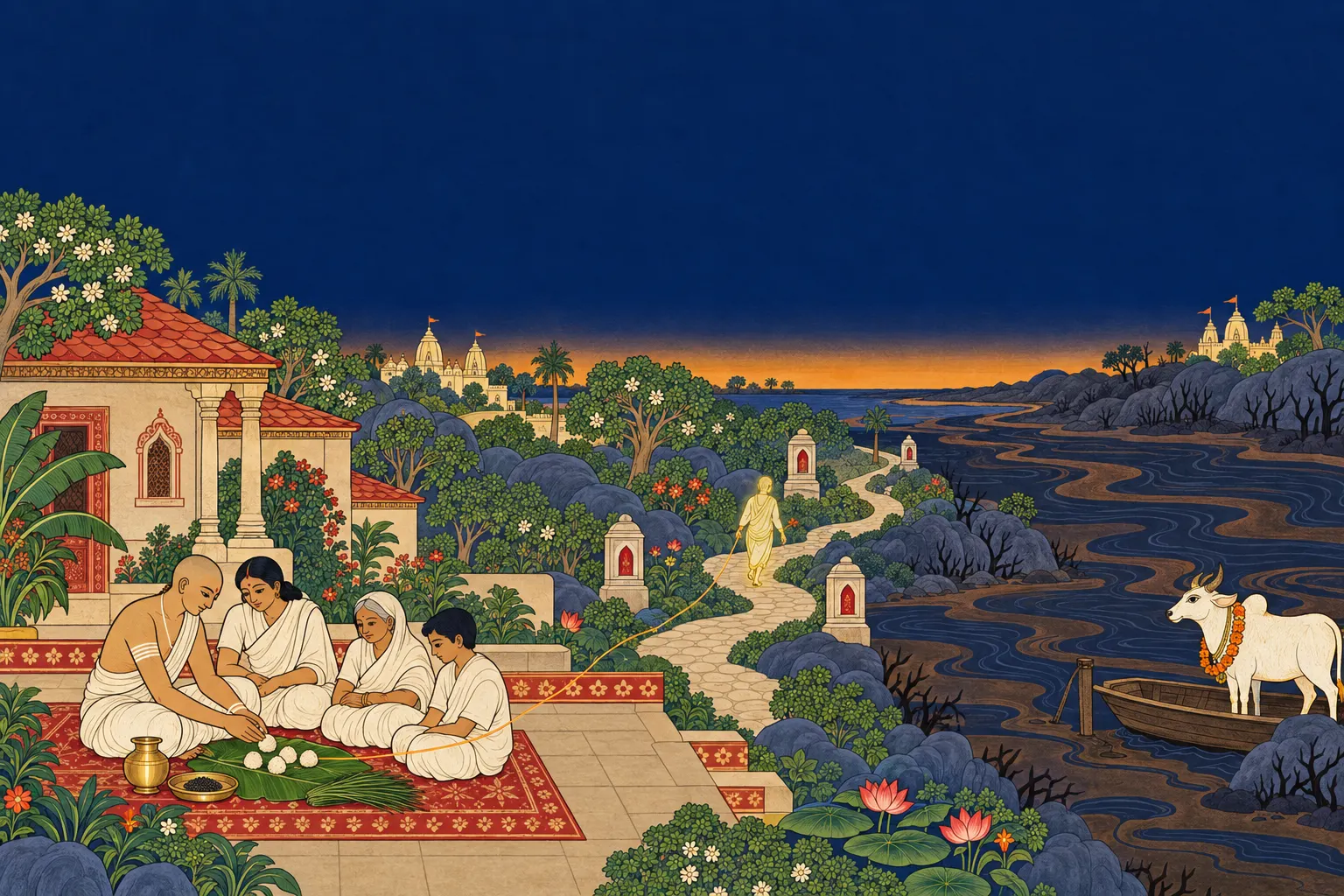
While the family in the courtyard makes the offerings, the text follows the traveller on the road
Rice, and a body made of it
For ten days after the death, the family offers a pinda each day — a ball of cooked rice, set out with water.
The text says each day's offering builds a part of the one who has gone: a body being made, at a distance, by hands that loved him.
By the tenth day the body is complete. And with it comes the first thing it feels: hunger, and thirst.
That is why the water is never left out of the offering.
The road
The traveller walks. The road is long — the text counts sixteen stages of it — and the better part of a year is spent on the walking.
Partway lies a river to cross: the Vaitarani, wide and foul, running with everything a body throws off.
Those for whom a cow was given on earth, the text says, cross it as if by boat. The rest go through it.
It is the plainest join between the two halves of this book: the gift made by the living is the ferry under the one who has died.
The eleventh day, and the twelfth
On the eleventh day there is a larger rite. On the twelfth comes the one that changes the traveller's standing.
It is called sapindikarana — the joining. Until it, the dead is a preta, a spirit still between places. After it, he takes his seat among the ancestors, the pitris, and is a preta no longer.
In much of North India the mourning lifts on the thirteenth day. Elsewhere it is the tenth, or the sixteenth. The count is not fixed; the turn it marks is.
Note: For the first ten days after death the chief mourner offers a daily pinda (rice-ball) with water; the tradition holds that these successively form a new subtle "preta" body, complete by the tenth day, at which point it experiences hunger and thirst. The Preta-Kalpa describes the onward journey to Yama's realm as taking about a year, measured in sixteen stages or "cities". The river Vaitarani, crossed on the way, is described as a torrent of blood, pus and filth; the gift of a cow (vaitarani godana) during the rites is said to carry the deceased across. The eleventh-day shraddha and the twelfth-day sapindikarana — which merges the newly dead with the ancestral line, ending the preta state and beginning the pitri state — are core to the rite. The mourning period (10, 11, 12, 13, or 16 days) varies by region and community.
Source: the Preta-Kalpa of the Garuda Purana (with the Vedic and Upanishadic accounts for contrast), The thirteen days