
Chapter 4
Yama's court
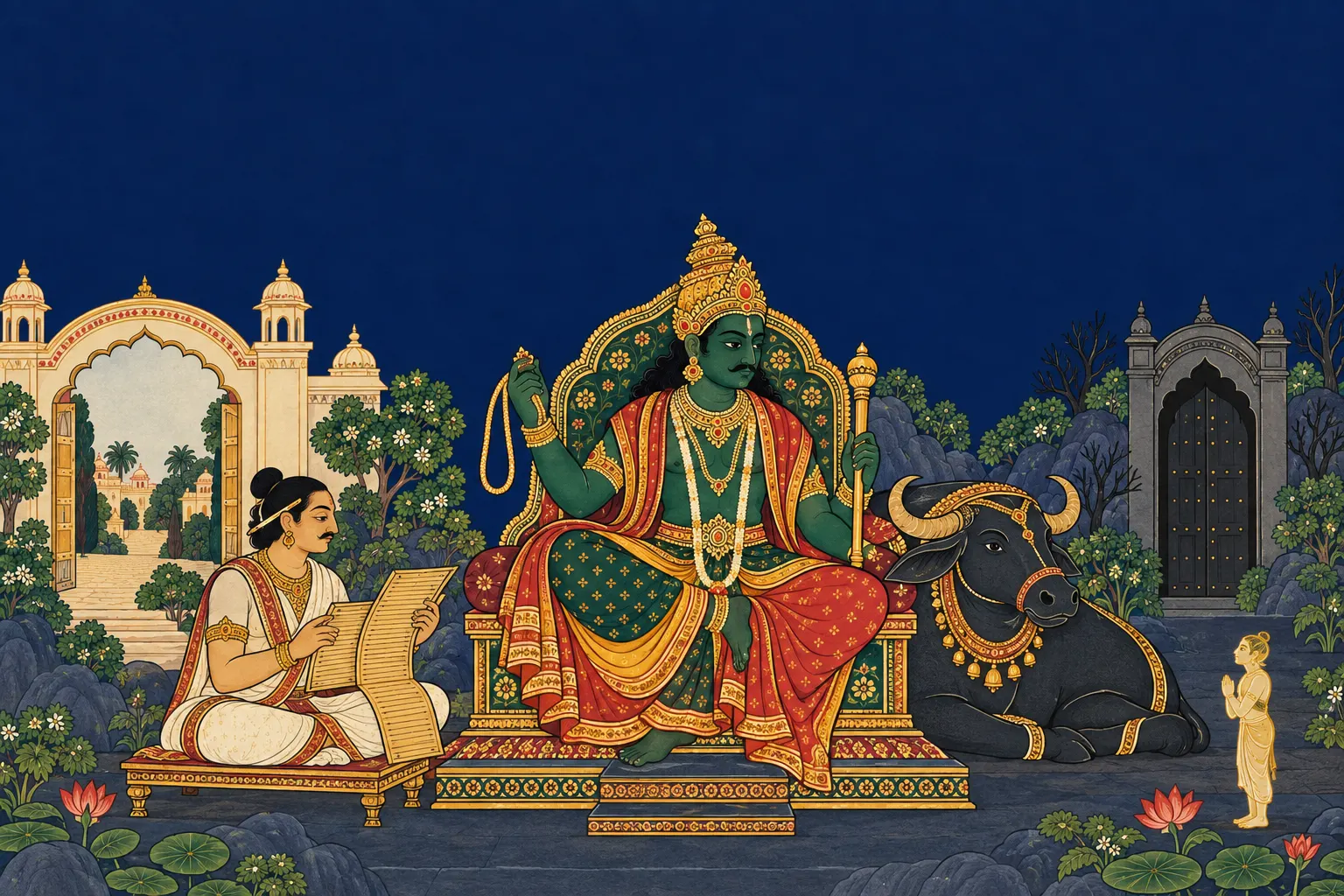
At the end of the road is not a torturer but a clerk, and a book
Two ways in
The road ends at a city, and a gate.
The texts say the good enter by an easy road and find Yama much as the Vedas first knew him — a just king, not fearful to look at. The rest are brought the long way, and see only the terror.
It is the same city. What differs is the road taken to it, and the road was the life.
The book
Inside waits Chitragupta, Yama's record-keeper, with the account.
He reads it out. Every act is in it, kept without omission — the deeds, and what they came to.
The Shravanas testify to what was done in thought, word and deed. There is the assembly of Yama, the Sabha, where the account is heard.
Nothing new is told at this trial. It is only the person's own life, read back to them in order. The judgement was finished while it was still being lived.
Dharmaraja
One of Yama's central titles is Dharmaraja — king of dharma, of the way things must be.
He is not a devil, and this is not damnation. He is the office where consequence is administered, and the sentence, whatever it is, has an end.
Other stories bring mortals face to face with Yama. Savitri followed him as he carried Satyavan's life away, and argued her husband back. Nachiketa waited at Yama's house and questioned him. Markandeya was the boy the noose could not close on.
Note: In the Garuda Purana, Yama's city has several gates; the righteous are said to enter by the easier ones and to perceive Yama as benign, while the wicked are taken a harsher route. Chitragupta, Yama's scribe, keeps and reports the record of every being's acts before Yama's assembly (sabha); the Shravanas give testimony about acts of mind, speech and body. Yama's epithet Dharmaraja ("king of dharma / justice") frames him as an administrator of karmic consequence rather than an adversary, and the punishments that follow are finite (chapter 5). Cross-references on this site: Savitri's recovery of Satyavan from Yama (Mahabharata, Vana Parva); Markandeya, spared death (Shiv-Mahima); Nachiketa's dialogue with Yama (Katha Upanishad).
Source: the Preta-Kalpa of the Garuda Purana (with the Vedic and Upanishadic accounts for contrast), Yama's court