Chapter 8

Dharma's Face

The gods arrived just before the fire, and only then did it become clear that the outcaste who had been his master was Dharma himself — and a king refused heaven

Just before the fire

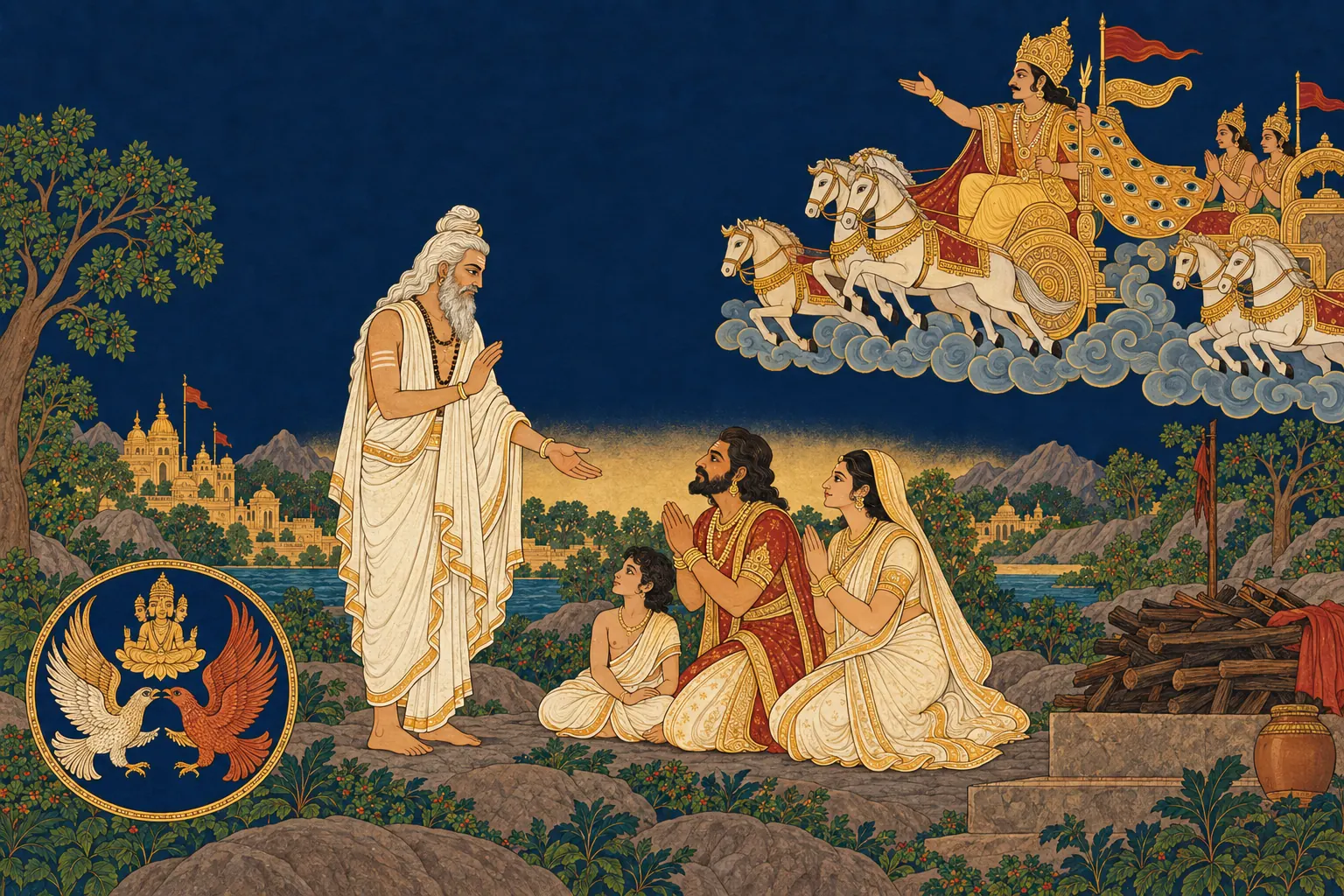
The fire had already been lit, and Harishchandra was about to step into it, when Indra and the gods descended from the sky.

The outcaste came forward, and his form changed. "I am Dharma," he said. "It was I who took this outcaste's form, pleased by your patience, your restraint and your truthfulness."

In the Devi Bhagavata, In Devi Bhagavata 7.27, Dharma goes further and claims that he had been the outcaste, the brahmin and the snake whose bite had killed Rohitashva — even though 7.22 had identified the old brahmin as Kaushika, Vishvamitra in disguise. The final chapter thus gathers several parts of the ordeal under Dharma's own claim.

Nectar

Indra rained nectar and flowers on the pyre. And Rohitashva sat up — healthy, calm, just as he had been before.

Husband and wife embraced their son.

Not without his people

Indra said: come to heaven with your wife and son, O king. You have won it by your own deeds.

Harishchandra refused. "How can I go to heaven and leave my people in sorrow?" he said. "The killing of a brahmin, the killing of a guru, the killing of a cow, the killing of a woman — abandoning one's own dependants is said to be a sin equal to these." This list is the Markandeya Purana's; the Devi Bhagavata's list is a little different — killing a brahmin, killing a woman, drinking liquor, and killing a cow.

Then he asked one more thing: let my merit belong to all of them too.

Indra agreed. In the Markandeya Purana, Indra descended to earth with ten million divine chariots and called out to the people of Ayodhya; then Vishvamitra and the gods crowned Rohitashva king, and after that the people — with their children, servants and families — went to heaven together with Harishchandra.

The ending

Tradition is not entirely of one mind about how this story ends.

In both Puranas, Rohitashva is placed on the throne of Ayodhya, and Harishchandra goes to heaven. In the Markandeya Purana, once Indra has given his consent, Vishvamitra and the gods crown Rohitashva, and then the people go to heaven with the king. The Devi Bhagavata likewise hands the kingdom to Rohitashva and then describes Harishchandra's ascent. Some later retellings have a different ending, in which Harishchandra returns to earth and rules again. This site has kept these apart and has not called either one final.

The quarrel

The Markandeya Purana does not end the story here. After this, Vasishtha and Vishvamitra fall into a quarrel between themselves. Each curses the other, and they become huge birds, and fight.

Brahma comes between them and stops them, and says that Vishvamitra did Harishchandra no wrong; because of him the king reached heaven, and in that sense Vishvamitra was his benefactor.

Today

Gandhi saw a play about Harishchandra as a child. In his autobiography he wrote that it settled into his heart, and that he mentally reenacted Harishchandra's story countless times. He himself wrote that the play gave him the ideal of holding to truth the way Harishchandra did, and of bearing every trial for it.

In 1913 Dadasaheb Phalke made "Raja Harishchandra", which is held to be India's first full-length feature film.

And in Kashi there is still a ghat that carries his name.

Note: The final episode is in the Markandeya Purana (chapter 8, and after it the Vasishtha–Vishvamitra quarrel in chapter 9) and the Devi Bhagavata (7.27). In the Markandeya, Dharma says he came in the form of the outcaste; in the Devi Bhagavata he is said to have been the outcaste, the brahmin, and the snake, all three. Both Puranas end on the same order: in the Markandeya, Vishvamitra and the gods crown Rohitashva, and then the people go to heaven with the king; the Devi Bhagavata likewise hands the kingdom to Rohitashva before describing his ascent. In some later retellings Harishchandra returns to rule again; this is a separate tradition, and neither has been called final here. The claim of being the first feature film is generally made about "Raja Harishchandra" (1913); "Shree Pundalik" (1912) is sometimes also discussed, and its standing as "first" is disputed. Gandhi speaks in his autobiography of a play, without naming any single production. The English lines are a natural retelling of the Sanskrit, not a word-for-word translation.

Source: from the Aitareya Brahmana, the Markandeya Purana and the Devi Bhagavata, Dharma's Face

Now — how much stayed with you?

Who am I?

I came to Kashi as an outcaste. I bought Harishchandra, made him work at the cremation ground for twelve months, and in the end showed my true form. Who am I?

  • Yama
  • Narada
  • Dharma
  • Indra
Read the whole story — The outcaste who tested him

Dharma himself had come in the form of the outcaste.

He said he had come because he was pleased by Harishchandra's patience, restraint and truthfulness.

Harishchandra did not know this until the very end.

But 7.22, within this same story, names that same old brahmin as a form of Vishvamitra — the text does not resolve this tension.

The texts disagree

What does Dharma claim, at the end, in Devi Bhagavata 7.27?

  • That he was the outcaste, the brahmin, and the snake
  • That he was only in the form of the outcaste
  • That he was Vishvamitra
  • That he came in the form of Indra
Read the whole story — Dharma's many forms

In the Devi Bhagavata's final chapter, Dharma says the whole test was his.

He says he came as the outcaste, the brahmin, and the snake, all three.

The final chapter ties Dharma to the outcaste, the brahmin and the snake; but 7.22 names the old brahmin as a form of Vishvamitra, so both layers of the text need to be kept on record together.

What happened?

How was Rohitashva brought back to life on the pyre?

  • Dharma gave a boon
  • Vishvamitra recited a mantra
  • Narada gave him the sanjivani herb
  • Indra rained nectar and flowers on the pyre
Read the whole story — A rain of nectar

Indra rained nectar and flowers on Rohitashva's pyre.

Rohitashva sat up, healthy and calm.

Husband and wife embraced him.

Why is that?

Why did Harishchandra refuse Indra's invitation to heaven?

  • Because he did not believe in heaven
  • Because he did not want to leave his people in sorrow
  • Because he wanted the kingdom of Ayodhya back
  • Because Vishvamitra forbade it
Read the whole story — Not without his people

Indra said heaven had been won through his own deeds.

Harishchandra said he could not leave his people behind.

In his own words, abandoning one's dependants is close to the gravest sin.

Who said it?

"How can I go to heaven and leave my people in sorrow?" — who said this to whom?

  • Harishchandra to Indra
  • Shaivya to Harishchandra
  • Vishvamitra to Indra
  • Dharma to Harishchandra
Read the whole story — A king's refusal

Indra had extended the invitation to heaven.

Harishchandra said he could not leave his people in sorrow.

He then asked that his merit be shared among them.

Fact

According to the Markandeya Purana, how many divine chariots did Indra come to earth with?

  • A thousand
  • A hundred thousand
  • A hundred
  • Ten million
Read the whole story — Ten million chariots

In the Markandeya Purana, once Harishchandra's prayer was granted, Indra came to earth with ten million divine chariots.

All the people of Ayodhya, with their children, servants and women, rose to heaven with the king.

The king did not keep his merit for himself alone.

The texts disagree

How do the two Puranas arrange the order of the kingdom and the ascent to heaven?

  • In the Markandeya everyone goes to heaven and there is no arrangement for the kingdom; in the Devi Bhagavata the kingdom is handed to the son
  • In both, Rohitashva is placed on the throne of Ayodhya and Harishchandra goes to heaven; the ending where he returns to rule again belongs to some later retellings
  • In both, Harishchandra returns to Ayodhya and continues to rule
  • In neither is there any arrangement for the kingdom
Read the whole story — The kingdom first, heaven after

In the Markandeya, once Indra has given his consent, Vishvamitra and the gods crown Rohitashva, and then the people go to heaven with the king.

The Devi Bhagavata also hands the kingdom to Rohitashva before describing Harishchandra's ascent.

In some later retellings Harishchandra returns to earth and rules again — this site has kept that apart.

What happened?

What did Brahma explain in the quarrel between Vasishtha and Vishvamitra?

  • That Vishvamitra was wrong
  • That Harishchandra had made a mistake
  • That Vishvamitra did Harishchandra no wrong; because of him the king reached heaven, so he was his benefactor
  • That both would have to withdraw their curses
Read the whole story — Brahma's word

Vasishtha and Vishvamitra cursed each other and became huge birds, and fought.

Brahma stopped them and said Vishvamitra had done the king no wrong, because it was through him that Harishchandra reached heaven.

Brahma therefore describes Vishvamitra as Harishchandra's benefactor rather than his enemy.

Later tradition

What story is the film held to be India's first full-length feature film built on?

  • The Ramayana
  • Krishna-Leela
  • Savitri
  • Raja Harishchandra (1913, Dadasaheb Phalke)
Read the whole story — Cinema's first story

Dadasaheb Phalke's "Raja Harishchandra" (1913) is held to be India's first full-length feature film.

This puts Harishchandra's story right at the centre of the early history of Indian feature cinema.

It was later made into films again and again, in several languages.

Later tradition

Where did Gandhi come across Harishchandra's story, and what effect did it have on him?

  • From a play he saw as a child, and it settled into his heart
  • From reading the Ramayana
  • From a school textbook
  • From hearing it from his father
Read the whole story — The effect of a play

Gandhi saw a play about Harishchandra as a child.

In his autobiography he wrote that he mentally reenacted Harishchandra's story countless times.

He himself wrote that this play gave him the ideal of holding to truth the way Harishchandra did, and of bearing every trial for it; it is natural to connect this to his later truth-centred life.