Chapter 1

Two Harishchandras

Two very different stories about a king with the same name — one that unfolds on a Vedic sacrificial ground, and one that ends at a cremation ghat in Kashi — and the old rivalry standing behind both of them

One king, one name

Harishchandra was a king of the Ikshvaku line — the same line Rama would later be born into. In the Puranic genealogies his name sits a few generations above Sagara.

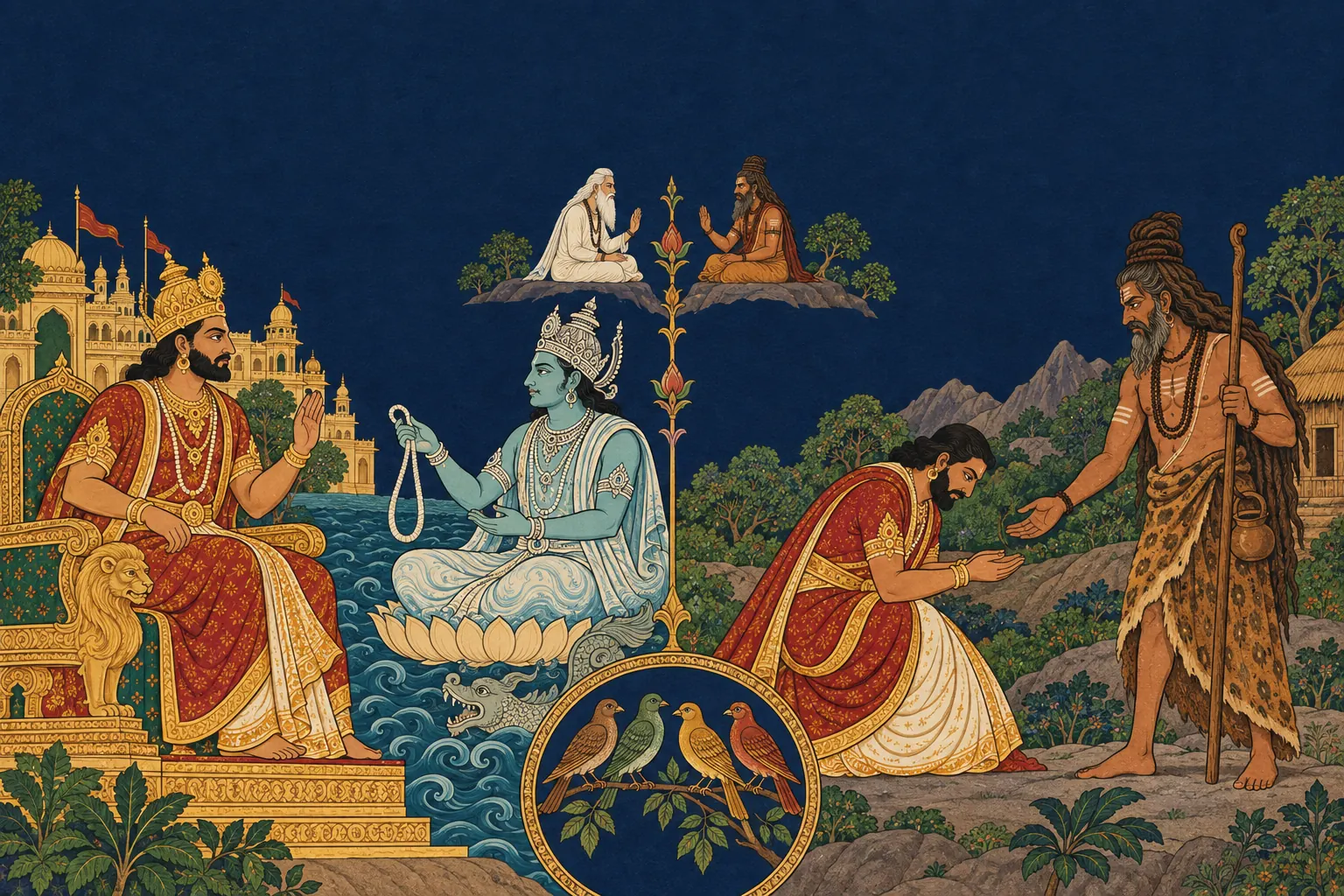
Two distinct narrative traditions are associated with Harishchandra. Treating them as small variations of one story is not right: the Aitareya Brahmana centres on a vow to Varuna and a son offered in sacrifice, while the Markandeya Purana centres on Vishvamitra's test and Harishchandra's commitment to truth. Later tradition, above all the Devi Bhagavata, brings the two into one long Harishchandra story.

The first story is the older one. It is found in the Aitareya Brahmana, a text that explains the procedures of Vedic sacrifices, dated to the Vedic layer of the first millennium BCE. In it Harishchandra is a father who vowed to give his own son to Varuna, and then kept trying to get out of it.

The second is the one everyone remembers. It is in the Markandeya Purana, and told at greater length still in the Devi Bhagavata — texts written centuries after the first story. In it Harishchandra is the king who gives up his kingdom, his wife, his son and his status rather than abandon truth, and ends up working as a cremation-ground servant to an outcaste in Kashi.

An assembly of birds

The Markandeya Purana tells the second story in an unusual setting. The sage Jaimini had four questions about the Mahabharata. The ones who answered him were four wise birds who lived on Mount Vindhya and had been brahmins in an earlier life.

The fourth question was about Draupadi's five sons: how, with the Pandavas and Krishna alive, were they killed the way they were, and why were they never married and left no children?

In answer, the birds told the story of Harishchandra. Within the Markandeya Purana this story does not begin on its own; it arrives as the answer to Jaimini's fourth question — and that is exactly how its thread reaches all the way into the Mahabharata.

Two sages

Behind this story stand two sages whose rivalry runs through the whole of Puranic literature: Vasishtha and Vishvamitra. Vasishtha is held to have been a brahmarshi by birth. Vishvamitra was a kshatriya king who became a sage through his own austerities.

In the Devi Bhagavata this rivalry becomes the direct cause of the story. It keeps both stories together, and tells Harishchandra's tale in two parts: first the old Shunahshepa story, in which Vishvamitra also appears, and then Vishvamitra's quarrel with Harishchandra, which runs from the loss of the kingdom to the cremation ground.

The whole story can also be read this way: an old argument between two sages, fought out on the body of a king.

Note: Harishchandra's older story is in the Aitareya Brahmana (7.13–18); the second, the one everyone knows, is in the Markandeya Purana (chapters seven and eight, sometimes nine as well) and told at greater length in the Devi Bhagavata (canto 7, chapters 14–27). These are two very different story threads; treating them as small variations of one story is not right — and this chapter has kept them apart. Within the Markandeya Purana this story is told by the birds in answer to Jaimini's fourth question; the Devi Bhagavata sets both stories in one continuous thread. This site has deliberately not repeated the passage at the end of the first story where the text names the peoples descended from Vishvamitra's cursed sons; readers can find it in the Aitareya Brahmana itself, and later readers have found this origin story uncomfortable. The story's dates are scholarly estimates. The English dialogue lines are flowing paraphrases of the Sanskrit verses, not word-for-word translations.

Source: from the Aitareya Brahmana, the Markandeya Purana and the Devi Bhagavata, Two Harishchandras

Now — how much stayed with you?

Fact

Which dynasty did Harishchandra belong to?

  • Of the Yadava line
  • Of the Kuru line
  • Of the Ikshvaku line
  • Of the Paurava branch of the Lunar line
Read the whole story — A king of Rama's line

Harishchandra belonged to the Ikshvaku line — the same line Rama would later join.

In the Puranic genealogies his name sits a few generations before Sagara.

This is why the story is often called "a story of the Solar line".

Fact

Which text carries the oldest story of Harishchandra?

  • The Aitareya Brahmana
  • The Markandeya Purana
  • The Ramayana
  • The Mahabharata
Read the whole story — The oldest layer

The Aitareya Brahmana is a prose text tied to the Rigveda, explaining sacrificial procedures and the stories behind them.

In it, Harishchandra, the vow to Varuna and the Shunahshepa story appear together.

The story everyone remembers today is many centuries later than this one.

The texts disagree

What is the biggest difference between Harishchandra's two stories?

  • Nothing
  • The first story is later and the second older
  • In the first Harishchandra goes to Kashi, in the second to the forest
  • The first is built on a vow to sacrifice a son, the second on Vishvamitra's test
Read the whole story — Two stories, one name

In the Aitareya Brahmana there is a father who vowed to give his son to Varuna, and kept trying to get out of it.

In the Markandeya Purana there is a king who loses everything in Vishvamitra's test.

Both share the king's name and the Ikshvaku line, and Vishvamitra appears in both; but the centre of the story, the setting and the central conflict are all different.

What happened?

Where did Jaimini take his four questions, and whom did he meet?

  • To a hermitage in the Himalayas, to Vasishtha
  • To Mount Vindhya, to four wise birds
  • To a cremation ground in Kashi, to an outcaste
  • To Naimisharanya, to Suta
Read the whole story — The sage who asked

Jaimini had four questions in mind about the Mahabharata.

He went to the Vindhya mountains, where four wise birds lived.

The birds answered every question, and Harishchandra's story falls inside one of those answers.

Why is that?

Why is Harishchandra's story told in the Markandeya Purana at all?

  • Because it answers the question about Draupadi's five sons
  • Because Harishchandra's funeral rites had to be performed
  • Because Jaimini had asked about truth
  • Because Vishvamitra had asked for it to be told
Read the whole story — A story that answers a question

The fourth question was: how were Draupadi's five sons killed the way they were, with the Pandavas and Krishna alive, and why did they never marry or leave children?

In answer, the birds tell Harishchandra's story — and inside it comes the curse on five gods.

Within the Markandeya Purana, this story does not begin on its own; it arrives as the answer to Jaimini's fourth question, joined to the Mahabharata.

Who am I?

I was a kshatriya king who became a sage through austerity. My name appears in both of Harishchandra's main story traditions, and my long rivalry with Vasishtha runs through many stories. Who am I?

  • Narada
  • Jaimini
  • Parashurama
  • Vishvamitra
Read the whole story — One sage in both stories

In the Aitareya Brahmana, Vishvamitra adopts Shunahshepa as his own son.

In the Puranas, that same Vishvamitra strips Harishchandra of everything.

This is one reason tradition has kept the two stories near each other.

The texts disagree

How does the Devi Bhagavata tell Harishchandra's story?

  • Only the Aitareya story, with no test at all
  • It keeps both together
  • Only the cremation-ground story, without Shunahshepa
  • It does not mention Harishchandra at all
Read the whole story — Where the two stories meet

In the seventh canto of the Devi Bhagavata, this story comes at length.

There, the Shunahshepa story and Harishchandra's test are joined into one continuous thread.

In other words, tradition itself joined the two — which is exactly why this chapter has kept them apart to show that.

Put it in order

Put the sources of Harishchandra's story in order from oldest to newest.

  • Markandeya Purana → Aitareya Brahmana → Devi Bhagavata
  • Devi Bhagavata → Markandeya Purana → Aitareya Brahmana
  • Aitareya Brahmana → Markandeya Purana → Devi Bhagavata
  • Aitareya Brahmana → Devi Bhagavata → Markandeya Purana
Read the whole story — Three layers

At the bottom is the Aitareya Brahmana, dated to the Vedic layer of the first millennium BCE.

After it comes the Markandeya Purana, and later still the Devi Bhagavata, which tells the story at the greatest length.

These dates are scholarly estimates, so only the order is treated as solid here, not the years.

Fact

In the test story, which city's cremation ground does Harishchandra have to work at?

  • Mathura's
  • Ujjain's
  • Ayodhya's
  • Kashi's (Varanasi's)
Read the whole story — The ghat at Kashi

In the Puranic story the king has to become the servant of an outcaste at a cremation ground in Kashi.

A ghat in Varanasi is still called Harishchandra Ghat today.

This story is told at length in the chapters ahead.

Riddle

I am the story of a king with one name, but two very different forms, centuries apart. In one a father tries to break his own promise; in the other a king gives up everything to keep his. What am I?

  • The story of Harishchandra
  • A story from the Ramayana
  • The story of Satyavan
  • The story of Shunahshepa
Read the whole story — One name, two promises

In the first story the promise is made to Varuna, and the father tries to get out of it.

In the second the promise is made to Vishvamitra, and the king gives up everything to keep it.

This is why hearing the name "Harishchandra" usually brings only the second story to mind, even though the first is the older one.