Chapter 3

A Cry in the Forest

A hunt, a cry, and a single moment's mistake — which broke a sage's penance, and asked a king for his entire kingdom

A kingdom like this

Harishchandra was a rajarshi of the Treta age, king of Ayodhya. The text says that in his kingdom there was no famine, no sickness spread, and no one died before their time. The people were devoted to dharma, and the king was known for his truthfulness.

His wife was Shaivya, and his son Rohitashva — still a child. This is different from the grown Rohita of the Aitareya Brahmana, who fled to the forest; the two share only a name.

The cry

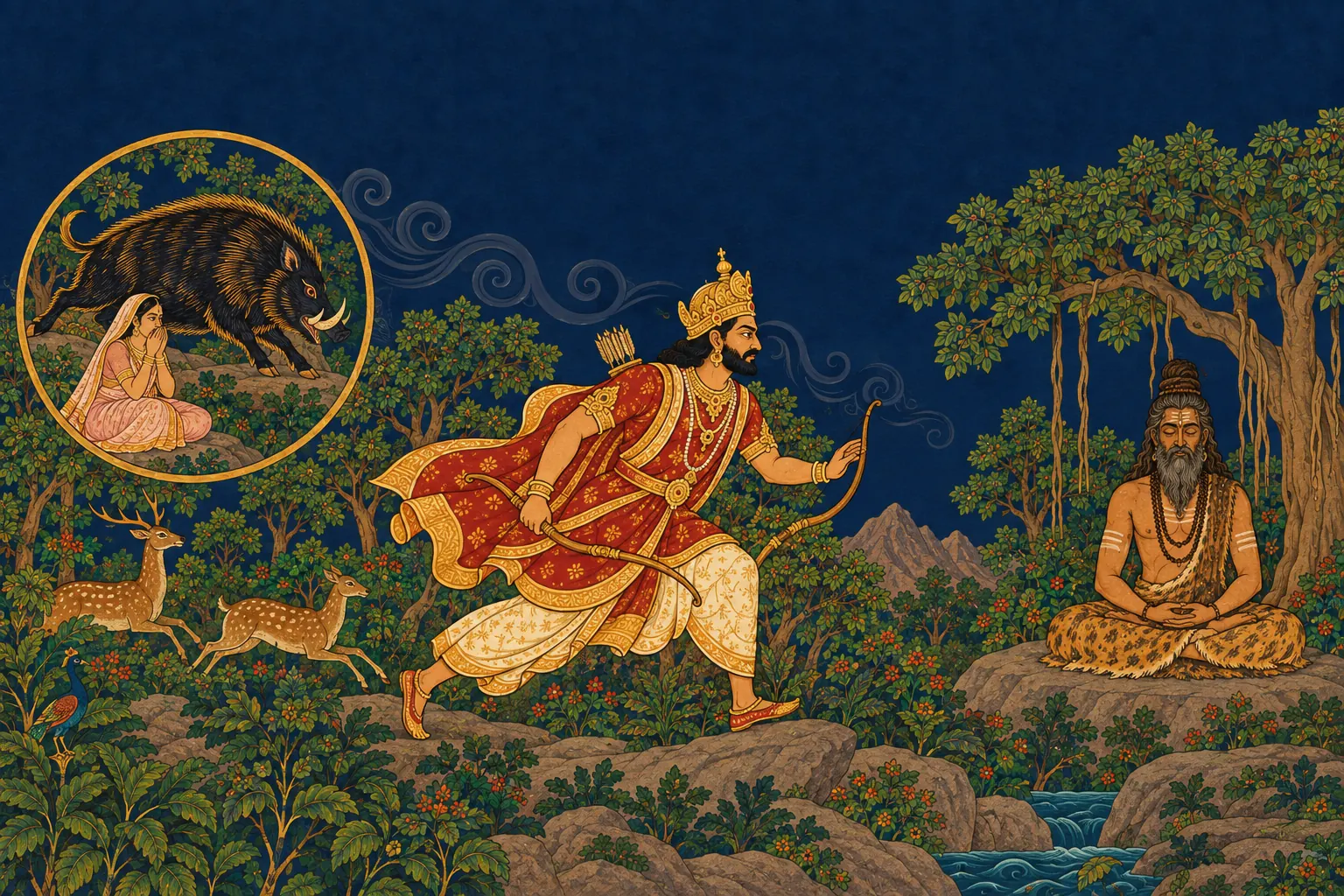
One day, chasing a deer, the king went deep into the forest. Just then he heard women crying out — as if someone were calling for help. That cry had to do with the penance Vishvamitra was performing nearby.

The king ran toward it. He called out: who in my kingdom dares to torment anyone? And in that very moment Vighnaraja — a fierce lord of obstacles — entered the king's body.

Under Vighnaraja's influence Harishchandra poured his anger out on Vishvamitra. The ascetic's penance was shattered, and he rose, trembling with rage.

At his feet

When the king came to his senses, he found before him a sage whose years of practice had been scattered. Harishchandra trembled. He caught hold of Vishvamitra's feet and begged, saying it had been a mistake; whatever you ask, I will give.

Vishvamitra asked for the kingdom, the treasury, the army, the whole earth — everything, except his wife, his son and his own dharma.

The king answered without hesitation: it is given.

The Devi Bhagavata's beginning

The Devi Bhagavata tells this same beginning differently. There, Harishchandra meets a weeping woman, who gives her own name as Siddharupini and says that Vishvamitra is performing fierce austerities to attain her. The king tells the sage that no such terrible penance should be performed in his kingdom, one that causes his people suffering.

Vishvamitra flares up. Remembering his old rivalry with Vasishtha, he resolves on revenge, and conjures a huge boar and sends it to lay waste to Harishchandra's forests. Later, at the bank of a sacred ford, he stages an illusory wedding for a young brahmin, and demands the whole kingdom from the king as the priestly fee.

Both texts arrive at the same place: a king who has already given away his kingdom, standing before an ascetic.

Note: This episode is in the Markandeya Purana (chapter 7) and the Devi Bhagavata (7.18–19), and the two tell it differently. In the Markandeya, the king runs toward women's cries during a hunt, and a fierce obstacle named "Vighnaraja" enters him, so that he pours his anger out on Vishvamitra. In the Devi Bhagavata, a weeping woman gives her own name as Siddharupini ("the form of success") and says Vishvamitra is performing penance to obtain her; the king objects to the penance, the sage retaliates by conjuring a huge boar, and later demands the kingdom on the pretext of an illusory wedding. This site has kept both versions and has not called either one "correct" over the other. Vighnaraja is named only this once in the text; nothing further has been added about him here. The English lines are a natural retelling of the Sanskrit, not a word-for-word translation.

Source: from the Aitareya Brahmana, the Markandeya Purana and the Devi Bhagavata, A Cry in the Forest

Now — how much stayed with you?

Fact

What does the Markandeya Purana say about Harishchandra's kingdom?

  • That famine struck it every year
  • That no one spoke for fear of the king
  • That there was no famine, no sickness, and no death before its time
  • That the king had stopped all sacrifices
Read the whole story — An ideal kingdom

The Markandeya Purana calls Harishchandra a rajarshi of the Treta age.

In his kingdom there was no famine, no sickness, and no death before its time.

It is on this very peaceful kingdom that the coming test falls.

What happened?

What did Harishchandra hear while hunting in the forest?

  • Women crying out
  • A lion's roar
  • Narada's veena
  • Varuna's voice
Read the whole story — Chasing a deer, and a cry

Chasing a deer, the king went deep into the forest.

Then he heard women crying out, and ran toward it.

That cry had to do with the penance Vishvamitra was performing nearby.

The texts disagree

How do the Markandeya Purana and the Devi Bhagavata tell the beginning of Harishchandra's quarrel?

  • Both tell it in exactly the same way
  • In the Markandeya there is a boar, in the Devi Bhagavata Vighnaraja
  • Neither has any quarrel at all
  • In the Markandeya, Vighnaraja enters the king; in the Devi Bhagavata, the king objects to a penance and the sage sends a boar
Read the whole story — One beginning, two forms

In the Markandeya Purana, a fierce obstacle-lord named Vighnaraja enters the king's body.

In the Devi Bhagavata, the king himself objects to the penance, and Vishvamitra conjures a boar in revenge.

In both, it ends the same way: the kingdom in the sage's hands.

Who am I?

I am a fierce lord of obstacles. When Harishchandra ran toward the cry, I entered his body, and his anger broke over an ascetic. Who am I?

  • Yama
  • Vighnaraja
  • Varuna
  • Siddharupini
Read the whole story — An obstacle that enters him

In the Markandeya Purana, a fierce being called Vighnaraja enters the king's body.

Under its influence the king pours his anger out on Vishvamitra.

The story shows this as one moment's mistake, not the king's ordinary nature.

Who said it?

"Give me the kingdom, the treasury, the army, the whole earth — everything, except your wife, your son and your own dharma." — who said this to whom?

  • Vishvamitra to Harishchandra
  • Harishchandra to Vishvamitra
  • Vasishtha to Harishchandra
  • Narada to Harishchandra
Read the whole story — What was asked for, and what was left

Vishvamitra asked for the kingdom, the treasury, the army, and the whole earth.

Only three things were left out: his wife, his son, and Harishchandra's own dharma.

The rest of the story turns around exactly these three.

Fact

When Vishvamitra asked for the kingdom, what did he leave Harishchandra with?

  • The treasury
  • The army
  • His crown and throne
  • His wife, his son, and his own dharma
Read the whole story — Three things left

Everything else was demanded, but three things remained: his wife Shaivya, his son Rohitashva, and the king's own dharma.

This is why, later in the story, the king says he has given up everything but these three.

But even those three are soon put on the line.

Why is that?

Why did Harishchandra give up his kingdom without hesitation?

  • Because he did not care about the kingdom
  • Because he had already caught the sage's feet and said, whatever you ask, I will give
  • Because Vishvamitra had frightened him
  • Because Narada told him to
Read the whole story — The promise comes first

Admitting his mistake, the king had already said: whatever you ask, I will give.

When the sage asked for the whole kingdom, the king gave it rather than go back on his word.

This is the very first test of the story.

The texts disagree

What is the difference between the Rohita of the Aitareya Brahmana and the Rohitashva of the Markandeya Purana?

  • No difference
  • Rohitashva is not Shaivya's son
  • The Aitareya's Rohita grows up and flees to the forest; the Purana's Rohitashva is a young child
  • Rohita later becomes king, Rohitashva does not
Read the whole story — Two sons, one name

The Aitareya's Rohita grows up and refuses his father, then runs away.

The Purana's Rohitashva is a child, who never leaves his mother's side.

The two stories are different, so the two sons should be taken as different too.

What happened?

According to the Devi Bhagavata, what did Vishvamitra send into Harishchandra's kingdom for revenge?

  • A famine
  • A plague
  • An army of demons
  • A huge boar, to lay waste to the forests and gardens
Read the whole story — The boar of revenge

In the Devi Bhagavata, once the king objected to the penance, Vishvamitra remembered his old rivalry with Vasishtha.

He conjured a huge boar and sent it into Harishchandra's kingdom.

This is not in the Markandeya's version of the story.

Riddle

I am heard in the middle of a hunt. Chasing me leads a just king straight into the greatest test of his life. What am I?

  • The cry of women in the forest
  • The tread of a deer
  • A tiger's roar
  • The sound of a conch
Read the whole story — A cry, a mistake

Chasing a deer took the king deep into the forest.

The king ran toward the cry there, and one moment's mistake put his entire kingdom at stake.

The whole story begins from this small incident.