
Chapter 5
What Could Not Be Sold
In a street in Kashi, a king sells his wife and son — and then sells himself, to a master he could never bring himself to accept
Kashi
The month was running out, and there was still no way to pay the fee. The three of them reached Kashi — Shaivya, Rohitashva, and the king who had once ruled Ayodhya.
Vishvamitra arrived and began demanding his account. The deadline was almost up. In the Devi Bhagavata the sage gives him only a quarter of a day. There was no way the money was going to appear.
Shaivya's request
In the Devi Bhagavata, Shaivya then said: sell me.
Not once, but again and again. Harishchandra refused. But in the end he agreed. "I will do," he said, "what even the most heartless of men would not dare to do."
The story itself is uneasy with this moment. It does not make it easy.
In the market
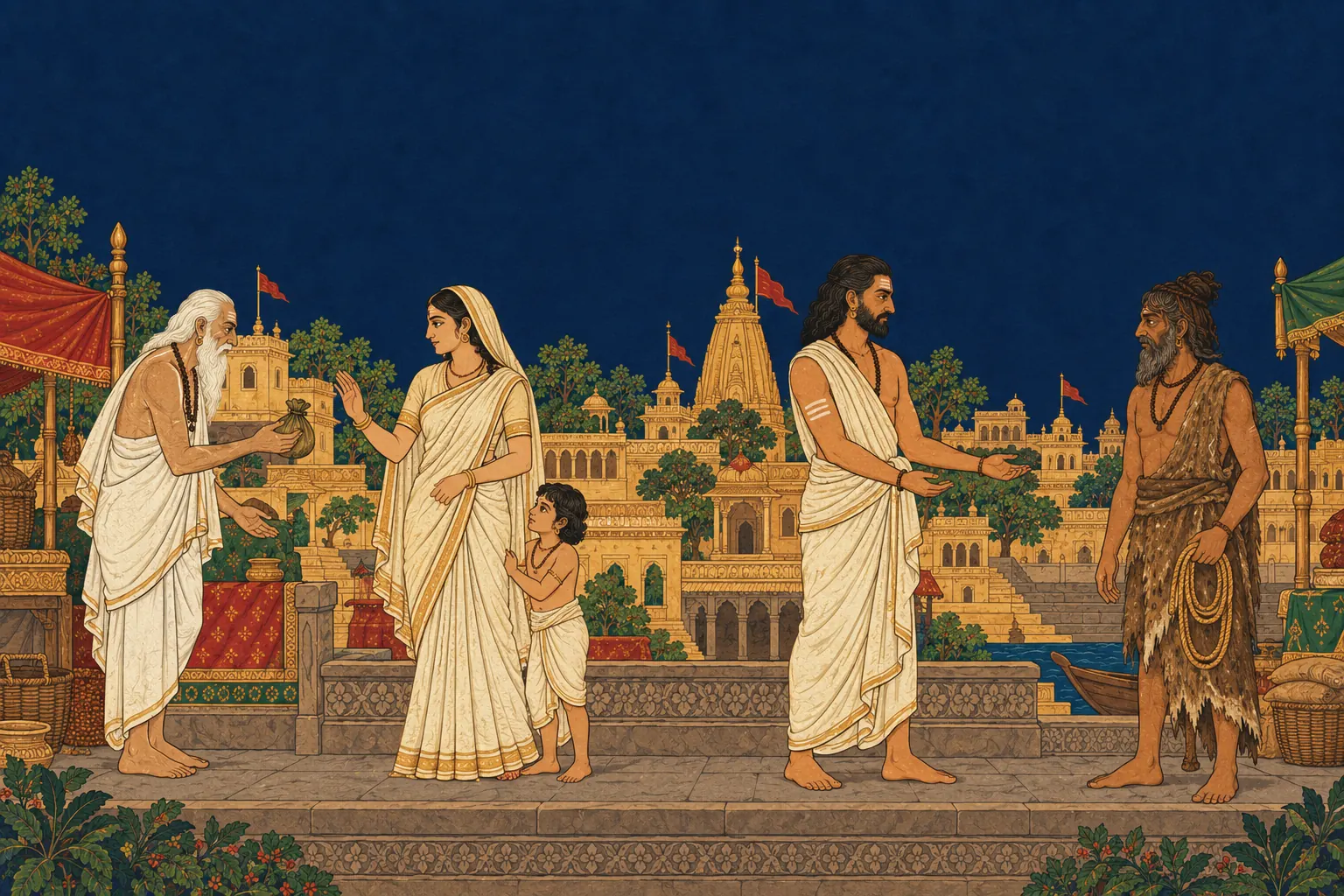
In the Devi Bhagavata the king stands his wife in the street and calls out: "Does anyone need a maidservant? This woman is dearer to me than my own life."
An old brahmin bought her. In the Devi Bhagavata this brahmin is Vishvamitra himself, in another form.
In the Devi Bhagavata, Rohitashva will not let go of his mother's cloth. He stumbles at every step, falls, then gets up and clings to it again. The brahmin beat him, but the boy kept walking with his mother, crying. So the brahmin bought him too.
But the money still fell short. Vishvamitra came for the fee and demanded the full amount.
The king's turn
Harishchandra called out: will anyone buy me? But it had to be before sunset.
An outcaste came forward, whom the Markandeya Purana names Pravira. Dharma himself had come in that form — but Harishchandra did not know it.
The king refused. He was a kshatriya, and becoming the servant of an outcaste felt, in his own eyes, like the lowest fall he could take. In the Devi Bhagavata he says that the dharma appropriate to the highest is one thing, that of the middling another, and that assigned to the lowest is degrading to the mind.
Then Vishvamitra stepped forward, and threatened him with a curse. The king panicked, and said: I will become your servant myself. Vishvamitra promptly sold him to that same outcaste, and collected the fee.
Harishchandra was now that outcaste's slave.
Note: The sale in Kashi is in the Markandeya Purana (chapter 8) and the Devi Bhagavata (7.22–23). In the Markandeya, an "old brahmin" buys the wife and son, and after selling himself Harishchandra becomes the servant of the outcaste Pravira, in whose form Dharma has come. In the Devi Bhagavata 7.22, the old brahmin who buys the wife and son is named as Kaushika — that is, Vishvamitra in a changed form — and Harishchandra first refuses the outcaste. But further on, in 7.27, Dharma says at the end that he himself was that outcaste, that brahmin, and that serpent too. Both statements stand in the text; this site records that internal tension rather than removing one to make it fit the other. This story rests on the sale of a wife and on becoming an outcaste's servant; the text itself is uneasy with both of these episodes, and they are kept just as uneasy here. The story treats the outcaste's caste status as "the lowest rung", but that is not a claim about anyone's natural or rightful standing — and by the end that same outcaste turns out to be Dharma himself. The sums involved differ between the two texts and are not given here. The English lines are a natural retelling of the Sanskrit, not a word-for-word translation.
Source: from the Aitareya Brahmana, the Markandeya Purana and the Devi Bhagavata, What Could Not Be Sold