Chapter 4

Everything, Then More Still

Giving away the kingdom does not finish the gift — a fee is still owed, and a month's deadline is set; and in the meantime, five gods pay the price of a curse

The gift

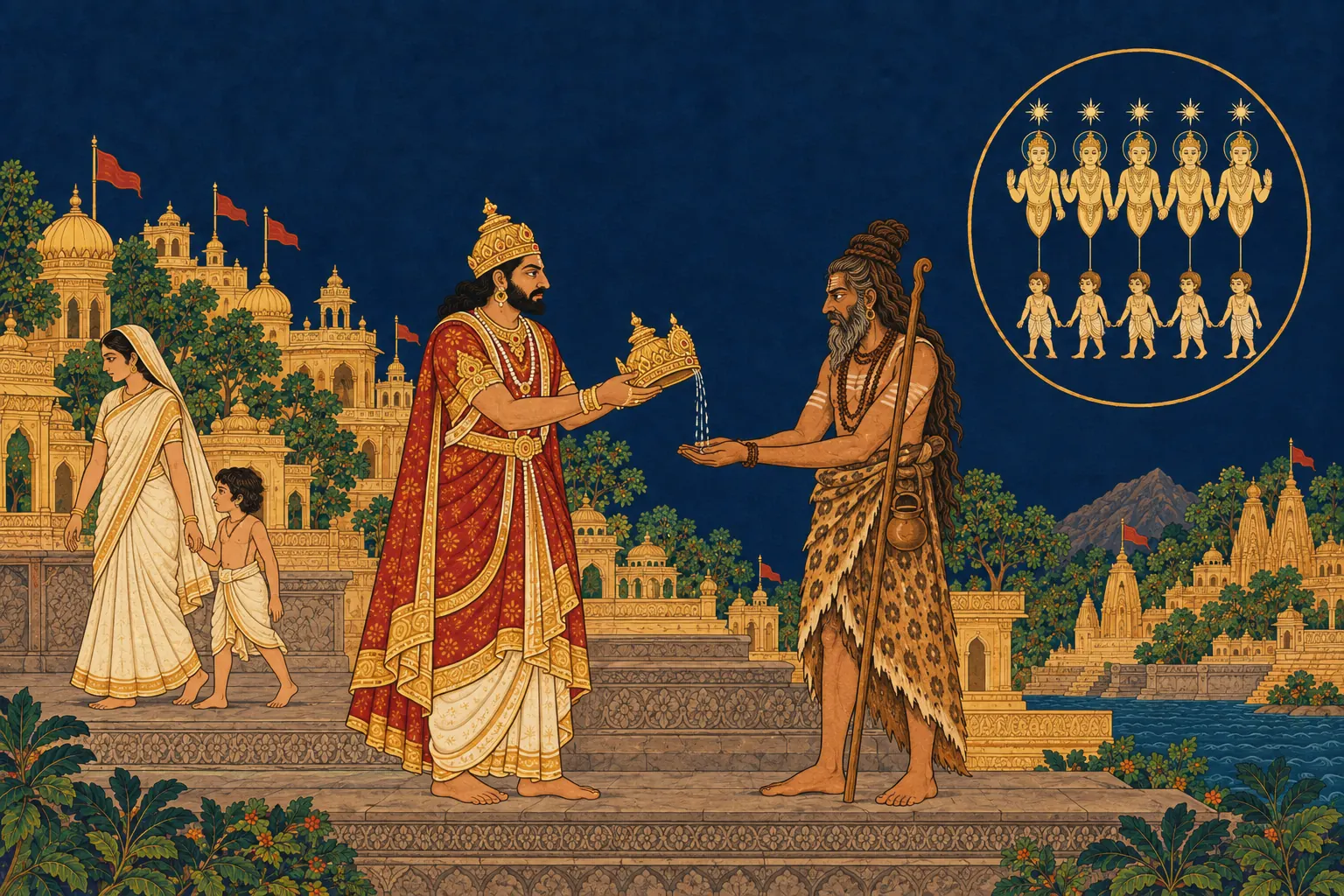
Harishchandra gave away his kingdom. The treasury, the army, the land, the elephants and horses, the royal umbrella — all of it.

But Vishvamitra held that a gift is incomplete without a fee. So the king still owed him a fee. In the Markandeya Purana this is the priestly fee for the rajasuya sacrifice. In the Devi Bhagavata it is two and a half loads of gold, and even the robes on the king's own body are counted as part of the gift.

The king's hands were now empty. Whatever there had been now belonged to the sage.

A month's deadline

Harishchandra said he would pay the fee, but asked for time. Vishvamitra gave him a month.

Harishchandra told his wife Shaivya and his son Rohitashva: I have given the kingdom to the sage. Apart from the three of us, I now have nothing.

The three of them set out from Ayodhya. According to the Devi Bhagavata, the whole city wept, and an uproar rose on every side.

The five gods' protest

Vishvamitra's harsh conduct was more than five Vishvedevas could bear to watch. They spoke up to the sage.

Vishvamitra was in a rage. He cursed the five gods to become human. Then he added one concession to the curse: they would be free of marriage and children.

Those same five gods became Draupadi's five sons — Prativindhya, Sutasoma, Shrutakarma, Shatanika and Shrutasena. They were the five sons born to Draupadi and the Pandavas, and were killed while still young; none of them ever married or left a child.

This is exactly the answer to Jaimini's fourth question. Harishchandra's story reaches all the way to these children of the Mahabharata.

Note: This episode of the gift of the kingdom and the fee is in the Markandeya Purana (chapter 7) and the Devi Bhagavata (7.19–21). In the Markandeya, Vishvamitra demands the fee for the rajasuya sacrifice and gives a month's deadline; in the Devi Bhagavata it is two and a half loads of gold, and there even the king's own royal robes are counted as part of the gift. Draupadi's five sons being formed from the curse on the five Vishvedevas is in the Markandeya Purana (chapter 7). The Markandeya's text calls these gods the Vishvedevas, and that is the name used here. The five sons' names follow the Mahabharata's tradition. The English lines are a natural retelling of the Sanskrit, not a word-for-word translation.

Source: from the Aitareya Brahmana, the Markandeya Purana and the Devi Bhagavata, Everything, Then More Still

Now — how much stayed with you?

What happened?

After Harishchandra had given away his kingdom, what more did Vishvamitra ask of him?

  • The king's sword
  • Shaivya, as a maidservant
  • The fee
  • The throne of Ayodhya back
Read the whole story — A fee after the gift

The king had already given up the kingdom, the treasury, the army and the land.

The sage said a gift is incomplete without a fee.

This is how the test moves beyond the gift itself.

The texts disagree

What is the difference between the Markandeya Purana and the Devi Bhagavata on the fee?

  • In the Markandeya it is the fee for the rajasuya sacrifice; in the Devi Bhagavata, two and a half loads of gold
  • No difference at all
  • The Markandeya has a hundred thousand cows, the Devi Bhagavata has nothing
  • The Devi Bhagavata has no fee at all
Read the whole story — Two names for the fee

The Markandeya Purana speaks of the fee for the rajasuya sacrifice.

In the Devi Bhagavata this same demand comes as two and a half loads of gold.

In both, the king is left with nothing to pay it with.

Fact

How much time did Vishvamitra give Harishchandra to pay the fee?

  • One day
  • One year
  • Twelve years
  • One month
Read the whole story — A month's deadline

Harishchandra asked the sage for time, and was given a month.

Within this month he set out for Kashi with his wife and son.

The money had to be found before the month ran out, and there was nothing to find it with.

What happened?

According to the Devi Bhagavata, what was the city like as they left Ayodhya?

  • Everyone stayed silent
  • The whole city wept, and an uproar rose on every side
  • People began cheering for Vishvamitra
  • The people stopped the king
Read the whole story — A weeping city

The king set out on foot with his wife and son.

In the Devi Bhagavata, the people of Ayodhya wept, and an uproar rose on every side.

These same people would later go to heaven with Harishchandra — in the final chapter.

Fact

Which gods spoke up on seeing Vishvamitra's harsh conduct?

  • The five Vishvedevas
  • The eight Vasus
  • The Lokapalas
  • The Saptarshis
Read the whole story — Five who could not stay silent

The five Vishvedevas spoke up to the sage over his harsh conduct.

Vishvamitra cursed them to be born as humans.

Not every telling of the story names these five; the most common list is given above.

What happened?

What concession did Vishvamitra add to the five gods' curse?

  • That they would be wise from birth
  • That they would be immortal
  • That they would become kings
  • That they would be free of marriage and children
Read the whole story — A concession within the curse

The sage said: you will become human.

But he added to the curse that they would be free of the bond of marriage and children.

This is exactly why, in the Mahabharata, those five sons never married and left no children.

Whose son?

Whose five sons did those five gods become?

  • Kunti's
  • Draupadi's
  • Gandhari's
  • Subhadra's
Read the whole story — A knot in the Mahabharata

According to the Markandeya Purana, those same five gods became Draupadi's five sons.

The five are Prativindhya, Sutasoma, Shrutakarma, Shatanika and Shrutasena.

This is where the Harishchandra story directly reconnects with the Mahabharata.

Why is that?

How does the story answer why Draupadi's five sons never married and left no children?

  • Because they were very ill
  • Because Krishna forbade it
  • Because Vishvamitra's curse kept them free of marriage and children
  • Because they lived in the forest
Read the whole story — The effect of the concession in the curse

The sage's curse turned five gods human, but free of marriage and children.

Draupadi's five sons were those same five gods.

This is exactly the answer to Jaimini's fourth question.

Put it in order

Put the events leading up to the departure from Ayodhya in order.

  • Cry during the hunt → demand for the fee → gift of the kingdom → leaving Ayodhya
  • Gift of the kingdom → cry during the hunt → demand for the fee → leaving Ayodhya
  • Demand for the fee → cry during the hunt → gift of the kingdom → leaving Ayodhya
  • Cry during the hunt → at Vishvamitra's feet → gift of the kingdom → demand for the fee → leaving Ayodhya
Read the whole story — One after another

First the cry, then Vishvamitra's anger and the king falling at his feet.

Then the gift of the kingdom, then the demand for the fee, and the month's deadline.

Only after this did Harishchandra leave Ayodhya with his wife and son.

Riddle

I am the thing asked for after a gift, and without me the gift is held incomplete. Harishchandra could not pay me. What am I?

  • The fee
  • The sacred thread
  • A tax
  • A promise
Read the whole story — Heavier even than the gift

Asking for a fee after a gift is a custom, and without it the sacrifice is held incomplete.

Harishchandra had given the kingdom, but the fee still stood unpaid.

This unpaid debt drives the whole of the story that follows.