Chapter 6

Keeper of the Cremation Ground

The king of Ayodhya now gathers shrouds from the dead at a cremation ground in Kashi — and in a dream he catches a glimpse of many lives

The ghat

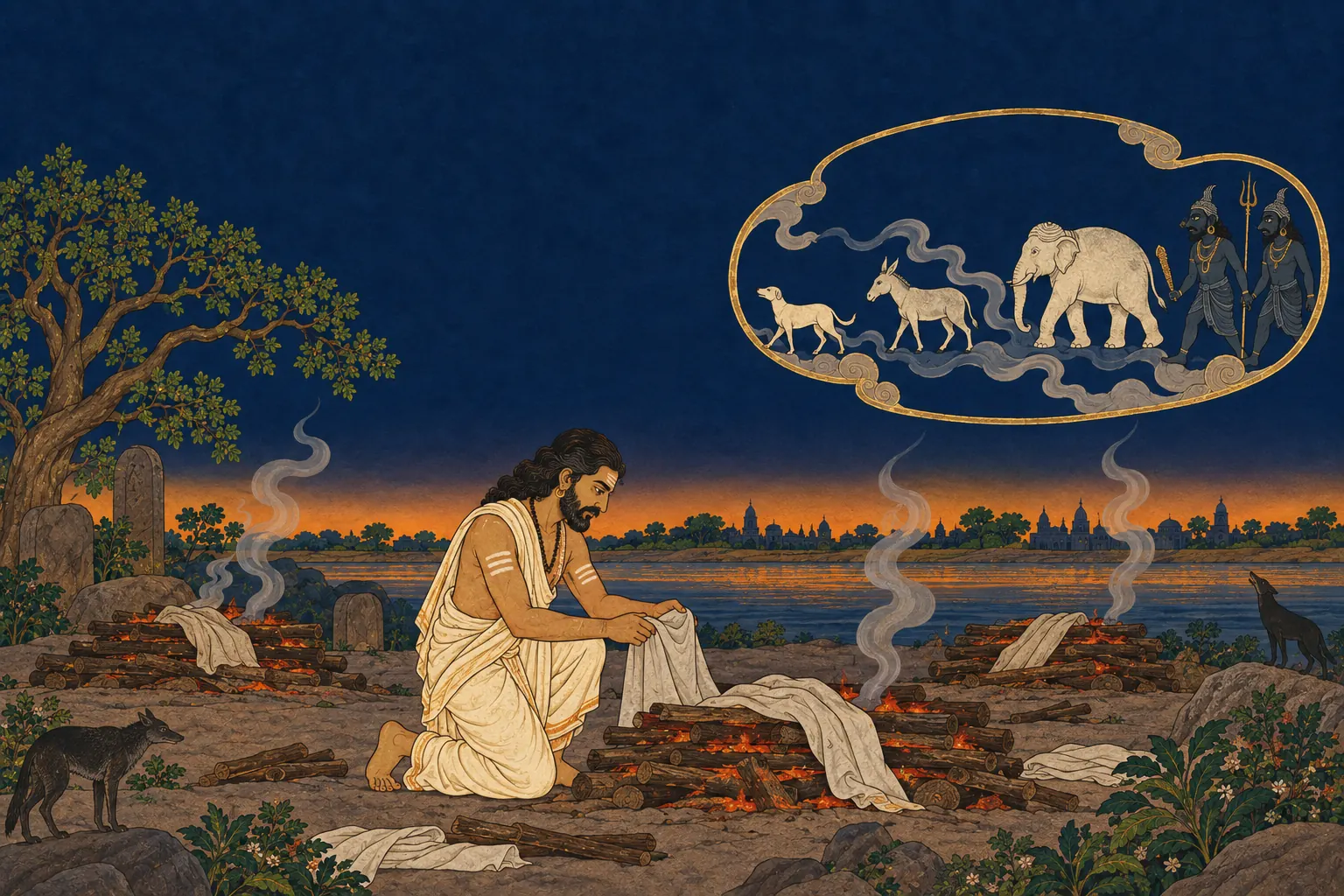
The outcaste Pravira took Harishchandra to the cremation ground in Kashi. According to the Devi Bhagavata this cremation ground was to the south of Kashi.

The Markandeya Purana describes it this way: a place of terrible cries, full of hundreds of jackals, littered with garlands stripped from corpses. The air was thick with stench and smoke.

The king of Ayodhya, who had once walked among sandalwood and flowers, now stood there.

The work

The outcaste explained the work. Harishchandra was to gather the clothes and shrouds taken off the dead, and a share of those earnings had to go to his master. In the Devi Bhagavata he calculates the charge for each corpse: this much for the king, this much for the outcaste, this much for me. An English translation of the Markandeya Purana also speaks of shares, but the exact division is unclear in the translation.

Harishchandra did the work. Every day he rose in smoke, every day he moved among the pyres, and every day he told himself that even here, truth was not to be given up.

The Markandeya Purana says: twelve months passed this way, as if they were a hundred years.

The dream

One night, exhausted, Harishchandra had a dream. He saw himself wandering through many lives — sometimes a pukkasa, sometimes a dog, a donkey, an elephant, a monkey. He caught a glimpse of hell too. And then one life in which he had been a king, and had lost his kingdom at dice.

At the end of the dream, Yama's messengers spoke: once you come out the other side, happiness will be yours.

The dream can be read as suggesting that this suffering is not endless, but part of a larger reckoning.

To himself

There in the Devi Bhagavata, Harishchandra says to himself: without dharma a man gets no auspicious fruit, so dharma must be earned carefully.

A ghat in Varanasi still carries his name today, and pyres burn there.

Note: This cremation-ground episode is in the Markandeya Purana (chapter 8) and the Devi Bhagavata (7.24). The outcaste's name is Pravira in the Markandeya (and in the Devi Bhagavata's twenty-third chapter); the Devi Bhagavata's twenty-fourth chapter calls him only "the outcaste". The division of the earnings is given differently in the two texts. In one English translation of the Markandeya the sentence about the king's share is unclear ("this share is to be given to the king, and a sixth part for the corpse..."), so this site has avoided settling on any exact fraction; a check against the Sanskrit is still pending. The list of lives in the dream is from the Markandeya Purana. Dharma himself is behind this outcaste's form, as becomes clear by the end of the story. The description of the cremation ground follows the text, and the story keeps it harsh; it has not been made beautiful. The English lines are a natural retelling of the Sanskrit, not a word-for-word translation.

Source: from the Aitareya Brahmana, the Markandeya Purana and the Devi Bhagavata, Keeper of the Cremation Ground

Now — how much stayed with you?

Fact

After being sold, in which city's cremation ground did Harishchandra have to work?

  • Ayodhya's
  • Ujjain's
  • Kashi's
  • Mathura's
Read the whole story — The ghat at Kashi

The outcaste took him to the cremation ground in Kashi.

According to the Devi Bhagavata this ground was to the south of the city.

Harishchandra Ghat in Varanasi today is traditionally linked to this story.

What happened?

What was Harishchandra's work at the cremation ground?

  • Gathering the clothes and shrouds taken off the dead
  • Lighting the pyres
  • Reciting mantras
  • Cutting wood
Read the whole story — A king who gathered shrouds

The outcaste gave him the work of gathering clothes and shrouds from the dead.

This was the cremation-ground work his master assigned to him.

The Markandeya Purana calls this work "gathering garments at the cremation ground".

Fact

According to the Markandeya Purana, how long did Harishchandra work at the cremation ground?

  • Seven days
  • One month
  • Twelve years
  • Twelve months, which felt like a hundred years
Read the whole story — Twelve months, like a hundred years

According to the text, Harishchandra worked there for twelve months.

But to him it felt like a hundred years had passed.

It is after this long stretch that the night of his son's death arrives.

Who am I?

I appear in Harishchandra's dream. I am a messenger who tells him: once you come out of this, happiness will be yours. Who am I?

  • A messenger of Varuna
  • A messenger of Yama
  • A messenger of Indra
  • A disciple of Vishvamitra
Read the whole story — A messenger who reassures

In the dream, Harishchandra sees glimpses of many lives and of hell.

Yama's messengers tell him that after all this, happiness will come to him.

The dream introduces the first hint that his suffering may eventually end.

What happened?

What did Harishchandra see in his dream?

  • His own many lives, a glimpse of hell, and heaven at the end
  • The rebuilding of Ayodhya
  • The deaths of Shaivya and Rohitashva
  • Varuna's anger
Read the whole story — A glimpse of many lives

In the dream he saw himself wandering through lives as a pukkasa, a dog, a donkey, an elephant and a monkey.

In one life he had lost his kingdom at dice.

At the end he saw heaven, and Yama's messengers gave him their assurance of happiness.

The texts disagree

What do the two texts show about the income at the cremation ground?

  • That Harishchandra received no wages at all
  • That the whole earning belonged to Harishchandra
  • That both texts give exactly the same division
  • That Harishchandra collected earnings or clothing tied to cremation, and a share of it had to go to his master; the two texts describe the shares differently
Read the whole story — How the shares were split

Harishchandra received earnings or clothing linked to the cremation rites, but a share of it had to go to his master.

In the Devi Bhagavata he calculates the charge for each corpse: this much for the king, this much for the outcaste, this much for himself.

An English translation of the Markandeya Purana also speaks of shares, but its exact division is unclear in the translation, so no fixed fraction is given here.

Why is that?

Why does a dream come into the story here?

  • Because Harishchandra could not sleep
  • It can be read this way: the dream shows suffering as a bounded sequence, at the end of which Yama's messengers offer the assurance of happiness
  • Because Indra wanted to frighten him
  • Because it was Varuna's curse
Read the whole story — What the dream does

The dream gives a glimpse of many lives, and ends with Yama's messengers' assurance.

This makes the suffering feel like part of a reckoning, not endless.

It is the story's first light, at a point where everything else looks dark.

Fact

How does the Markandeya Purana describe the cremation ground?

  • Quiet and fragrant
  • Empty and deserted
  • Full of terrible cries, thick with jackals, littered with garlands stripped from corpses
  • Clean as a temple
Read the whole story — A description of the cremation ground

The text calls it a place of terrible cries, full of jackals and stripped garlands.

The air is thick with stench and smoke.

The story shows, simply through this description, how far this was from the sandalwood-and-flowers kingdom the king once knew.

Put it in order

Put the events after Kashi in order.

  • Work at the cremation ground → sold to the outcaste → the dream → the son's death
  • Sold to the outcaste → the dream → work at the cremation ground → the son's death
  • The dream → sold to the outcaste → work at the cremation ground → the son's death
  • Sold to the outcaste → work at the cremation ground → the dream → the son's death
Read the whole story — One after another

First Harishchandra was sold to the outcaste.

Then the work at the cremation ground began, and twelve months passed.

In the middle of that work came the dream, and after it the night the news of his son's death arrived.

Riddle

I am the ghat where pyres burn, named for a king who once gathered shrouds from the dead here. Who am I?

  • Harishchandra Ghat, Varanasi
  • Manikarnika Ghat
  • Assi Ghat
  • Dashashwamedh Ghat
Read the whole story — A name on a ghat

Harishchandra Ghat in Varanasi is a cremation ghat.

It is traditionally linked to this story.

People still come there today for last rites.