
Chapter 7
That Night
A snake, a child, and one night at the cremation ground — when a woman arrived carrying her dead son at the very ghat where her husband was gathering shrouds
The son
Rohitashva was growing up in the house of the old brahmin who had bought him and his mother. One day he went outside, and a venomous snake bit him. The boy died. In the Devi Bhagavata this snake is said to have come at Vishvamitra's own order — and at the end of the story Dharma later says that he himself had taken the form of that serpent.
In the Devi Bhagavata, when Shaivya wept, the brahmin scolded her that crying in the evening is inauspicious. Only after much pleading did he allow the boy's last rites.
A woman at the cremation ground
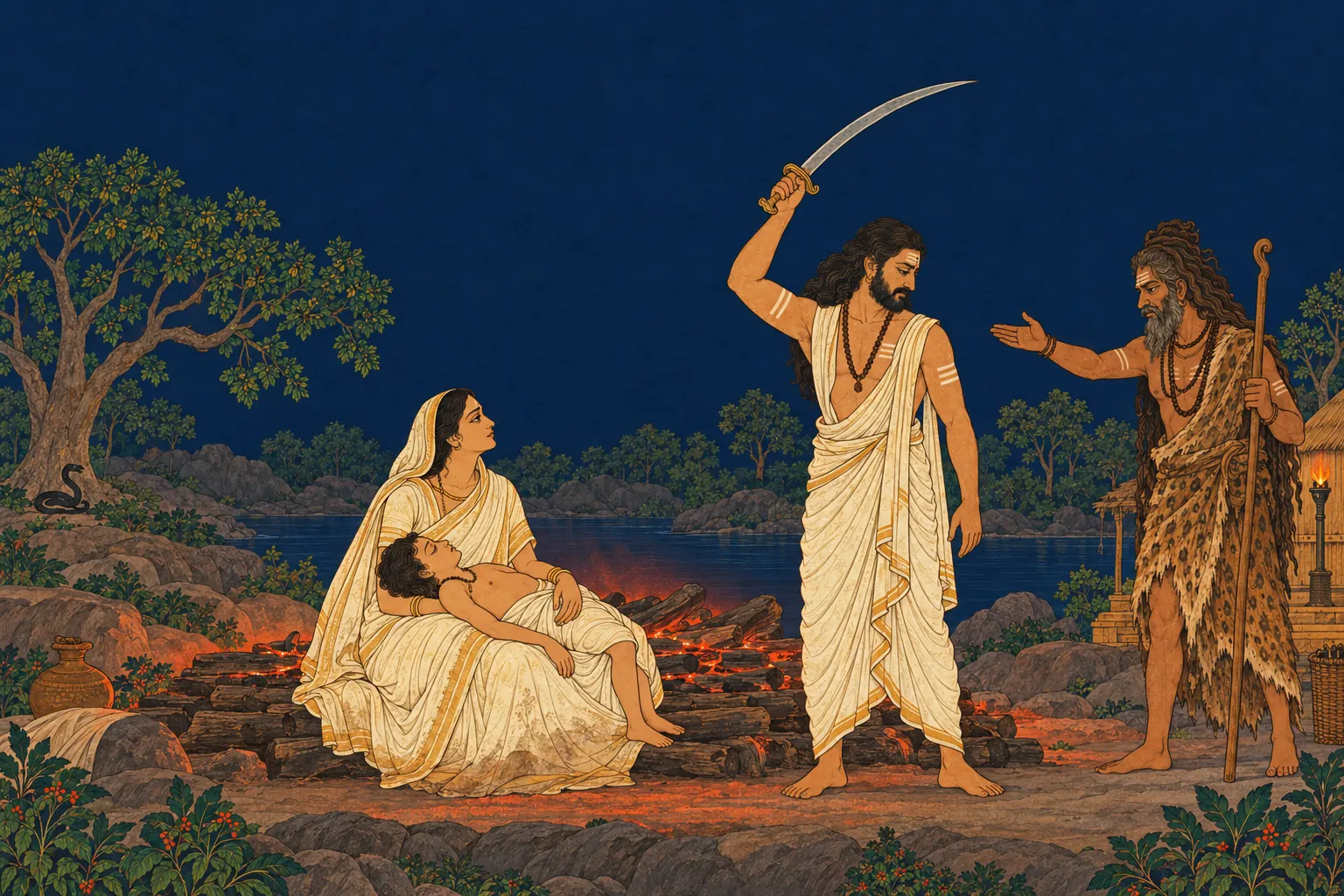
At midnight Shaivya arrived, carrying her son's body, at that same cremation ground in Kashi. She was thin, covered in dust, dressed in rags.
She kept crying. She said: my son went out to play, and a cruel venomous snake bit him.
In the Markandeya Purana, Harishchandra was right there. At first neither recognised the other — dried faces, rags, the ash of the pyre. Then the king looked at the boy's face; the marks he bore seemed to be his own son's, and Shaivya recognised her husband's voice.
In the Devi Bhagavata she sobs: you, here, in this state — and you will not even lift me up?
One more turn in the Devi Bhagavata
The Devi Bhagavata adds one more turn to this night, before the recognition, which is not in the Markandeya. The city's guards saw a lone, weeping woman at midnight. They took her for a child-eating demoness in a woman's form.
They brought her to the outcaste. The outcaste told Harishchandra: kill her. She is wicked by nature.
Harishchandra refused, again and again. He said that women should be protected, not killed; I have kept this vow my whole life. The outcaste grew angry, and ordered him to raise the sword. The king raised it.
At that very moment Shaivya asked for one thing only: let me perform my son's last rites.
Once she was allowed to, she returned carrying her son's body; only then does Harishchandra recognise Rohitashva by his royal marks, and Shaivya recognises Harishchandra by his voice and form.
The pyre
In the Markandeya Purana, they then make their decision beside the pyre. Shaivya said: I cannot bear this weight of grief. I too will step into this blazing fire with you.
Harishchandra said to his wife that she should go on serving the brahmin who had bought her, and that he would step into the fire with their son. Perhaps they would meet again in another world.
In the Devi Bhagavata, Harishchandra says the same thing: I will leap into the burning fire with my son's body.
The two of them stood by the fire — husband and wife, and between them a dead son.
What is not found in the text
The scene of a "fee" demanded at the cremation is very famous in the popular versions of this story. We did not find it in these two texts' Harishchandra episodes. It belongs to a later form of the story, and so it has not been kept in this telling.
Note: This night is in the Markandeya Purana (chapter 8) and the Devi Bhagavata (7.25–26), and the two tell it differently. In the Markandeya, Shaivya arrives with her son's body, the two recognise each other, and both decide to step into the pyre. In the Devi Bhagavata there is an added turn — the guards mistake Shaivya for a child-eating demoness, and the outcaste orders Harishchandra to kill her. The wife's name is Shaivya in the Markandeya; in some tellings and regional versions, Taramati or Chandramati. The scene demanding a "fee" for cremation, very well known in popular plays and films, was not found in this site's check of either text's Harishchandra episodes (Markandeya chapters 7–8 and Devi Bhagavata 7.25–26), and so has not been kept in the story here. In the Devi Bhagavata 7.25, the snake comes at Vishvamitra's order; in 7.27, Dharma says that same venomous snake was himself too. The English lines are a natural retelling of the Sanskrit, not a word-for-word translation.
Source: from the Aitareya Brahmana, the Markandeya Purana and the Devi Bhagavata, That Night