
Chapter 2
The Vow to Varuna
A king with a hundred queens made a vow to a god in exchange for a son — and then that same son had to run to the forest, out of fear of the vow
A king without a son
Harishchandra, king of the Ikshvaku line, had a hundred queens, and not one son. This is the story the Aitareya Brahmana tells: in a hundred palaces, nowhere was there the cry of a child.
Then Narada showed him a way. Ask Varuna for a son, he said, and vow that if a son is born, you will offer that very son to Varuna.
The king did just that. And a son was born to him — Rohita.
Varuna's demand
Varuna arrived. "A son has been born," he said. "Now perform the sacrifice, and offer him to me."
The king began to put it off. An animal is fit for sacrifice only after it is ten days old, he said; let his teeth come in first. The teeth came in, so he said: let them fall out now. They fell out, so he said: let new ones come in. New ones came in, so he said: let him become a kshatriya first, and learn to bear arms.
At last Varuna's patience ran out. He struck the king with dropsy — a swelling of the belly that was the punishment for breaking a vow.
Six years in the forest
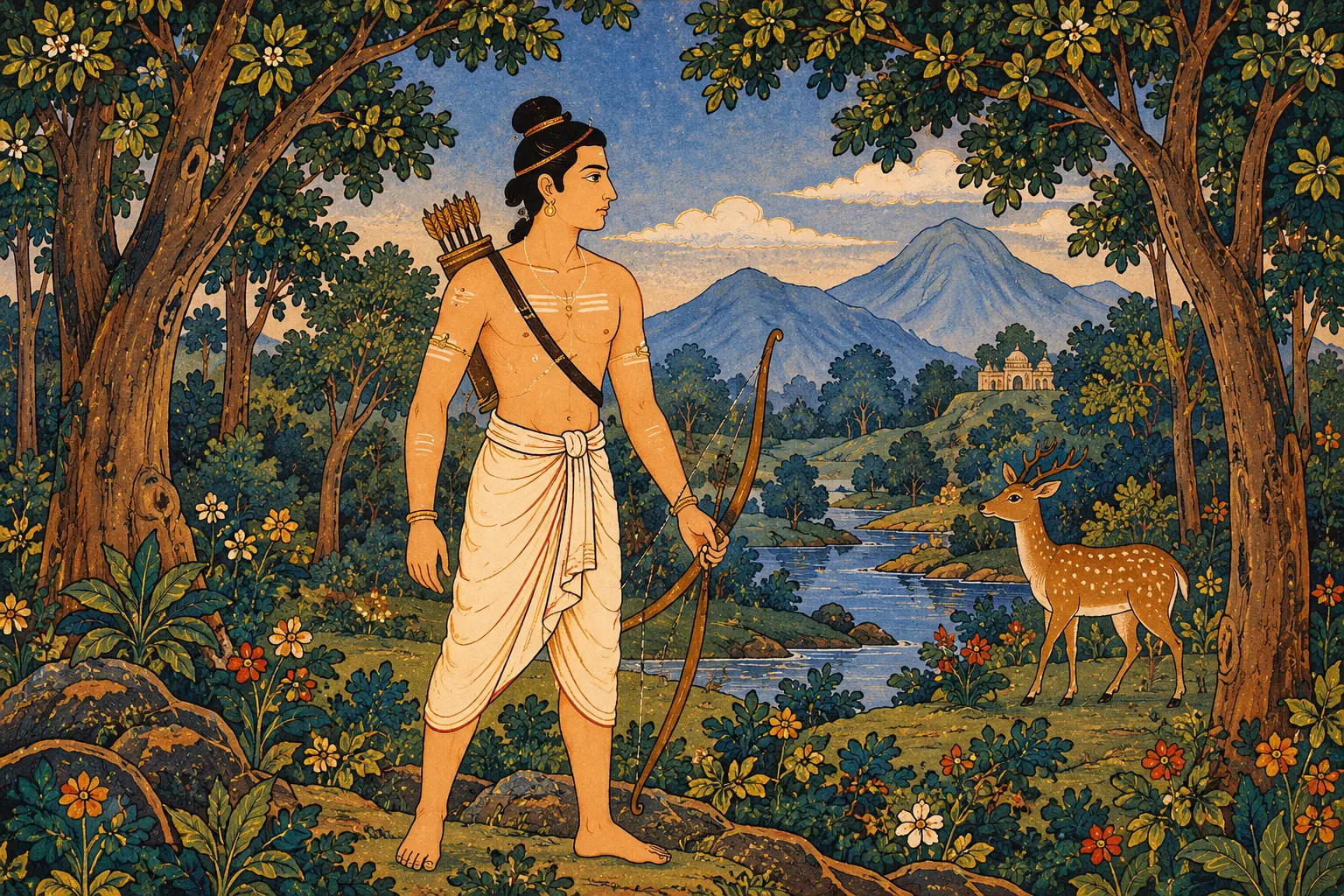
Rohita learned all of this. He was grown by now, and he refused to obey his father. He took up his bow and set out for the forest.
For six years he wandered from forest to forest. Every year, just as he thought of turning back, Indra would stand in his path, disguised as a brahmin.
"Keep moving," he would say. "The fortune of one who sits, sits. The fortune of one who stands, stands. The fortune of one who sleeps, sleeps. And the fortune of one who moves, moves too. So keep moving."
These are the lines "caraiveti, caraiveti" — still quoted today.
A hundred cows, three times over
In the sixth year Rohita met the sage Ajigarta, broken by poverty, who had three sons.
Rohita said to him: give me one of your sons, to take my place at the sacrifice. A hundred cows in return.
The father did not want to give his eldest son. The mother could not part with the youngest. So the middle son was chosen — Shunahshepa. Ajigarta took the hundred cows and handed his son over.
The sacrifice began. Vishvamitra was among the priests. But no one was willing to bind Shunahshepa to the sacrificial post. So Ajigarta said: give me another hundred cows, and I will bind him myself. He bound him.
Then no hand was raised to kill him. Ajigarta said: give me a third hundred, and I will kill him myself. Three separate payments of a hundred cows, all involving his own son.
The hymns to Ushas
Shunahshepa began to pray. He praised one god after another, and finally Ushas, the goddess of dawn.
With the verses his bonds loosened, and Harishchandra's illness eased too. With the final hymn to Ushas, Shunahshepa was completely freed, and Harishchandra was cured.
Vishvamitra took the boy as his own son and named him Devarata — given by the gods. Among Vishvamitra's own hundred sons, the elder ones, some refused to accept this new eldest brother, and they were cursed.
The Ramayana's Bala Kanda has another form of this same story. There the king is not Harishchandra but Ambarisha, and the father is not Ajigarta but Richika. These are separate traditions of the same subject, so it should not be mixed up with Harishchandra's story.
Note: This story is from the Aitareya Brahmana (7.13–18), traditionally said to be recited at the rajasuya sacrifice; the caraiveti verses of Rohita's wandering are around 7.15. Vishvamitra's name is given among the priests in the text. At the end of the text, Vishvamitra's cursed sons are named as the ancestors of certain peoples; this is a caste-origin story that names living communities, so this site has not repeated it. The Ramayana's Bala Kanda has another tradition on this same subject, in which the king is Ambarisha, the father is Richika, and the boy agrees to go of his own will — that has not been folded into Harishchandra's story here. This story includes a demand for human sacrifice, and that sacrifice is never carried out; the story ends there. The English lines are a natural retelling of the Sanskrit, not a word-for-word translation.
Source: from the Aitareya Brahmana, the Markandeya Purana and the Devi Bhagavata, The Vow to Varuna