
Chapter 4
Agni and Ganga
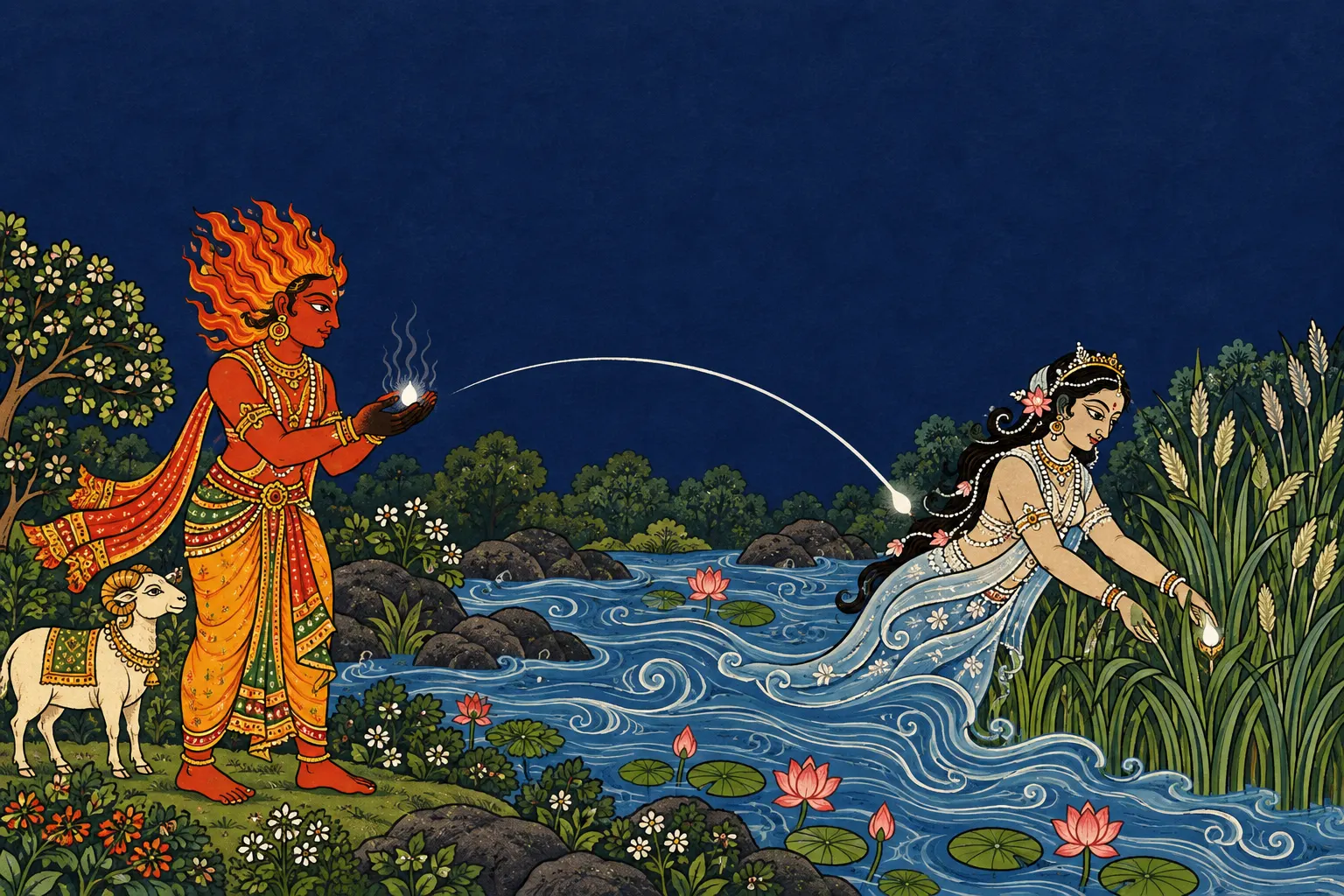
Shiva's seed was too fierce for any womb — Agni could not hold it, and neither could the Ganga
Too fierce
The gods could not wait.
They sent Agni to Shiva — in some texts as a dove or a parrot, in others as a mendicant.
Shiva's seed was too fierce for any womb. Agni received it, but it began to burn even Agni.
Into the river
Agni cast it into the Ganga.
(A different Puranic route inserts the six wives of the Seven Sages here: while warming themselves at Agni's fire, they receive Shiva's seed and are later rejected by their husbands. The Mahabharata's Vana Parva tells another story — Svaha assumes the forms of six sages' wives and receives Agni's seed, while the wives themselves are innocent.)
The Ganga could not bear the heat either. She set the seed in a thicket of reeds on her bank — a "sharavana".
From this came a name: Sharavanabhava — "born in the reed-forest". In Tamil Shaiva tradition "Sharavanabhava" is his root mantra.
Six mothers
Different texts name different parents.
He is the son of Shiva. He is the son of Agni and Svaha (the Mahabharata's Vana Parva says so). He is the son of the Ganga — Gangeya. He is the son of the Krittikas — Kartikeya. He is the son of Parvati.
Tradition folded the whole contradiction into one name: Shanmatura — "he who has six mothers".
Note: Skanda's birth is deliberately strange, and every text differs at every step. The Mahabharata's Vana Parva gives the Agni-Svaha cycle: Svaha impersonates six sages' wives, receives Agni's seed, and the innocent wives are later suspected. Other Sanskrit birth cycles instead carry Shiva's seed through Agni and Ganga to the reed-bed; some Puranic recensions insert the six sages' wives between Agni and Ganga. These are parallel routes, not one continuous story. The name "Sharavanabhava" is from the reed-forest and is the main mantra of the Tamil tradition. The child is called the son of Shiva, Agni, Ganga, the Krittikas and Parvati — all five — and "Shanmatura" (six-mothered) is tradition's own way of holding that contradiction. This epic records them all and calls none "correct".
Source: from several texts and traditions, Agni and Ganga