Chapter 6

The six-day-old general

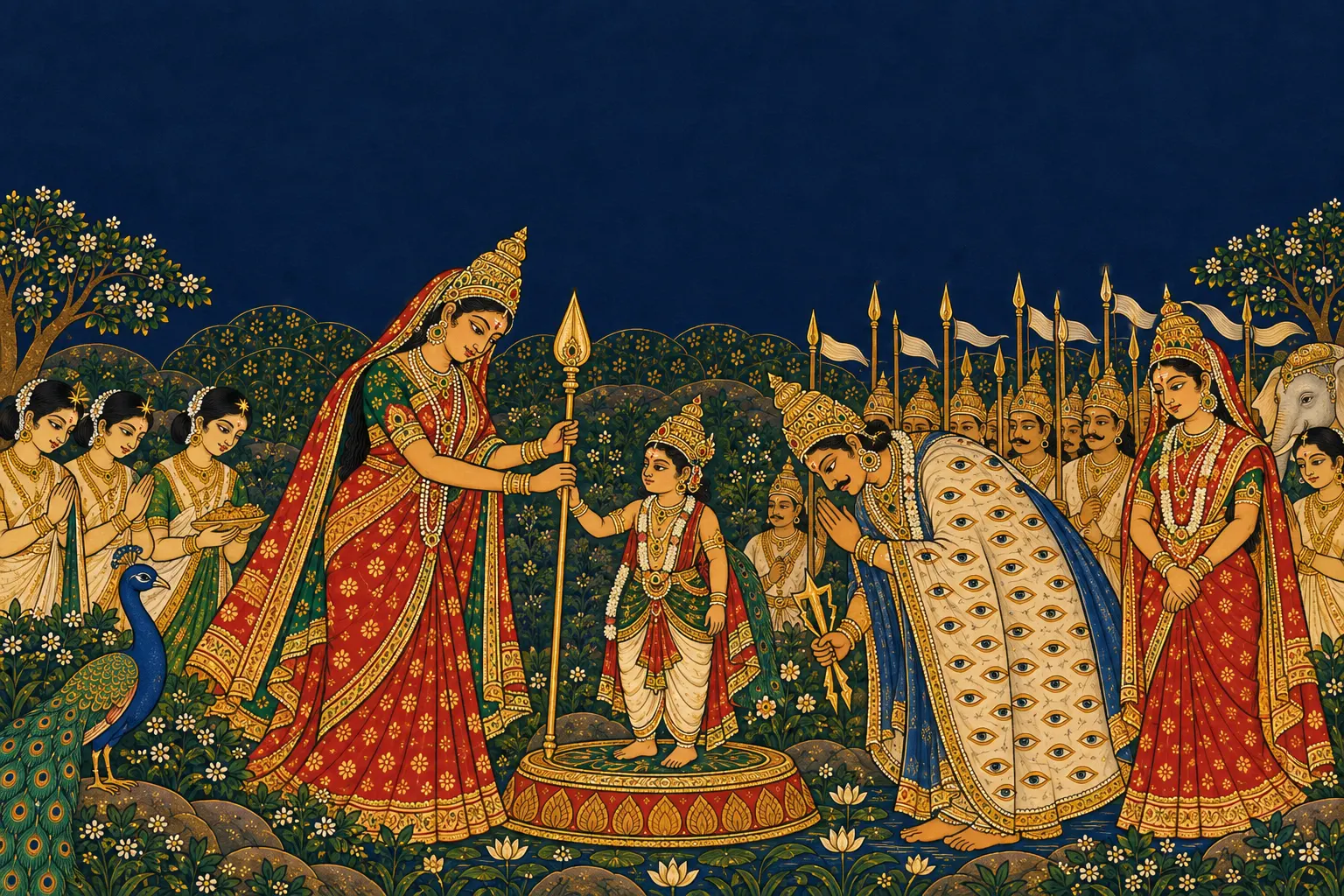
At six days old he was made commander of the army of the gods

Grown fast

The child grew at superhuman speed.

Within a few days the gods made him Devasenapati — commander of the army of the gods.

Indra handed over the command. (In some texts Indra first hurled his thunderbolt at the child, lost, then bowed.)

A girl named Devasena

"Devasena" is not only the army — it is also Skanda's consort.

In the Mahabharata she is a daughter of Prajapati and a relative of Indra; in the Tamil Kanda Puranam tradition she is Deivanai, Indra's daughter. In both, Indra arranges the marriage.

So "leading the army of the gods" and "marrying the daughter of the king of the gods" were the same political move. Tamil tradition places this wedding at Thiruparankundram — one of the six shrines.

The vel

In the northern texts Skanda carries a shakti — a lance, sometimes given by Agni, sometimes by Indra.

In Tamil tradition the vel is given by Parvati — Shakti — herself. It is the jnana-vel, the spear of wisdom. And it is Murugan's greatest symbol — the vel is worshipped in its own right.

Note: Skanda being made Devasenapati is the hinge of the northern story — command of the army of the gods at six days old. "Devasena" is also Skanda's consort: in the Mahabharata she is a daughter of Prajapati and related to Indra, who arranges the match; in Tamil Kanda-Puranam tradition Deivanai is Indra's daughter, and the wedding is placed at Thiruparankundram. The vel: in the northern texts it is a shakti given by Agni or Indra; in Tamil tradition it is the jnana-vel given by Parvati / Shakti, and is worshipped on its own. The Parvati-given vel remains especially prominent in living Tamil Murugan worship.

Source: from several texts and traditions, The six-day-old general

Now — how much stayed with you?

Fact

At what age was he made commander of the army of the gods?

  • Six days
  • Seven years
  • Seven months
  • Sixteen years
Read the whole story — Grown fast

The child grew at superhuman speed.

Within a few days the gods made him Devasenapati.

This is the hinge of the northern story.

What happened?

Who handed over the command of the army of the gods?

  • Brahma
  • Shiva
  • Indra
  • Agni
Read the whole story — Indra bowed

The army had been under Indra until then.

In some texts Indra first tested the child — hurled the thunderbolt and lost.

Then he handed the command to Skanda.

Fact

"Devasena" is not only the name of the army — what else is it?

  • A weapon
  • A person
  • A mountain
  • A city
Read the whole story — Army and girl

"Devasena" literally means "the army of the gods".

But it is also a person, married to Skanda.

In Tamil she is called Deivanai or Devayanai.

The texts disagree

How do the Mahabharata and Tamil tradition differ on Devasena's parents?

  • Both call her Parvati's daughter
  • The Mahabharata does not know her
  • No difference
  • The Mahabharata calls her a daughter of Prajapati and a relative of Indra; the Tamil Kanda Puranam makes her Indra's daughter directly
Read the whole story — Whose daughter

The "Indra's daughter" form is the Tamil stream.

In the Mahabharata she is a daughter of Prajapati, a relative of Indra.

In both, Indra arranges the marriage.

What happened?

Before handing over the command, in some texts what did Indra do to the child?

  • Took him in his arms
  • Cast him out of heaven
  • Set him a test
  • Hurled his thunderbolt at him, lost, then bowed
Read the whole story — First a clash, then a surrender

Indra had to give up command of his army — that was not easy.

In some texts he first challenged the child.

Having lost, he handed over the command.

Fact

In Tamil tradition, who gives the vel?

  • Agni
  • Parvati / Shakti
  • Indra
  • Brahma
Read the whole story — The spear of wisdom

In the northern texts Skanda carries a shakti, sometimes from Agni, sometimes from Indra.

In Tamil tradition Parvati gives the vel herself — the jnana-vel.

And it is Murugan's greatest symbol, worshipped in its own right.

The texts disagree

What do the northern and Tamil traditions say about the origin of the vel?

  • Both say Vishvakarma made it
  • Both say it is a piece of Shiva's trident
  • In the north it is a shakti given by Agni or Indra; in Tamil it is the jnana-vel given by Parvati / Shakti
  • No tradition gives the vel an origin
Read the whole story — One lance, two stories

In the northern story it is a weapon given by a god.

In the Tamil story it is the Goddess's power made solid.

The Parvati-given vel is especially prominent in living Tamil Murugan worship, where the spear itself may receive worship.

Why is that?

Why were "leading the army of the gods" and "marrying Indra's daughter" the same political move?

  • Because both bind Skanda into Indra's family and into the order of the gods
  • Because both happened on the same day
  • Because Devasena was herself the general
  • Because Indra had no other choice
Read the whole story — General and son-in-law

Skanda is a new god who comes from outside.

Giving him Indra's army and Indra's daughter both bring him "inside".

It is one manoeuvre, not two separate events.

Fact

Where does Tamil tradition place the Devasena wedding?

  • At Palani
  • At Tiruchendur
  • At Kataragama
  • At Thiruparankundram
Read the whole story — One of the six abodes

Thiruparankundram is one of Murugan's six main abodes.

Tamil tradition places the wedding to Deivanai there.

Each abode is tied to a part of the story.

Who am I?

At six days old I was made a general. My spear is called the spear of wisdom. Who am I?

  • Arjuna
  • Skanda / Murugan
  • Karna
  • Ghatotkacha
Read the whole story — The child-general

The hinge of the northern story is exactly this — a six-day-old general of the gods.

In Tamil tradition his vel is the jnana-vel given by Parvati.

That lance is his greatest mark.